

You have hit the point where doing everything yourself just is not working anymore. Your calendar is full of meetings you do not remember agreeing to. Three client emails from last week are still sitting there, unanswered. You keep telling yourself you will get organized once things calm down, except things never calm down.
So you start looking for help, and you run into a wall almost immediately. Half the people you ask say hire an executive assistant. The other half swear a virtual assistant is all you need. Most of what you find online treats the two as the same job with different price tags, which is exactly why this decision feels so confusing.
It does not have to be. These are two different roles, built for two different problems, with two very different price tags and two very different risks if you get the choice wrong. Here is the full picture, not the shortened version most comparison posts give you.
The short version: authority is the whole difference, and it drives everything else.
An executive assistant is a full authority hire who represents you and often manages other people. A virtual assistant is a task based hire who executes what you assign. That gap in authority is the entire reason the price gap between them is so large.
A full time, in house executive assistant costs roughly $105,000 a year once benefits and payroll costs are added to the median $74,260 executive assistant salary (U.S. Bureau of Labor Statistics, Occupational Outlook Handbook, and 2025 Employer Costs for Employee Compensation data). A managed virtual assistant typically runs $1,988 to $3,000 a month with no hiring costs attached (MyOutDesk, 2026 Virtual Assistant Cost Guide).
That number tells you the price. It does not tell you which one is actually right for your business today, and that takes a closer look at what each role really does, what happens if you choose wrong, and how fast each one can get up and running.
What an Executive Assistant Actually Does All Day
Ask ten business owners what their EA does and you will probably get ten different answers. That is kind of the point. An executive assistant’s job is shaped by the person they support, not by a fixed list of duties.
Still, most EA roles share a common core. They own the calendar completely: deciding which meetings you take, which get pushed to someone else, and which get declined before you ever see the request. They manage your inbox with real judgment, flagging what genuinely needs your attention and handling the rest without asking.
A lot of EAs also manage other admin staff, coordinate travel, prepare board materials, and sit in on meetings you cannot attend, taking notes and chasing follow ups. In smaller companies, they often pick up light HR or office management work too.
None of that works without trust, and trust takes months to build. That is the real cost of an EA, not just the paycheck.
What a Virtual Assistant Actually Does All Day
A virtual assistant’s day looks nothing like that. It is built around a defined list of tasks, not open ended judgment calls.
Typical VA work includes inbox triage using rules you have already set, scheduling within boundaries you define, data entry, research, customer service replies, social posting, invoicing, and light bookkeeping. A good VA documents how they do each task, so the work gets done the same way every time, whether it is them doing it or someone covering for them.
Most VAs work a set number of hours a week or a fixed monthly capacity, and plenty support several clients at once through an agency. They are not managing your business. They are clearing the repeatable work that eats your time without needing your judgment to do it.
That narrower scope is exactly why VAs cost less, start faster, and carry less risk if the fit is not quite right. If you want the fuller picture of what virtual assistants handle across a whole business, our Virtual Assistant for Business Owners: The Complete Guide covers that in depth.
The Full Comparison, Side by Side
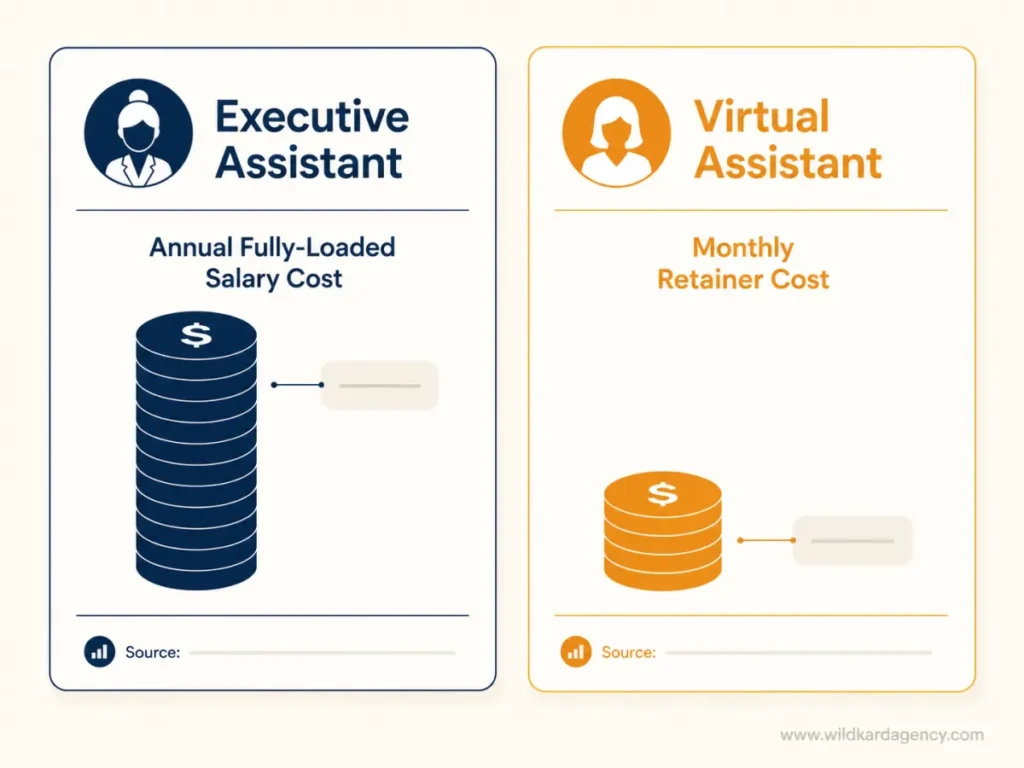
Titles and headline prices only tell you so much. Here is how the two roles actually stack up once you get past the top line number.
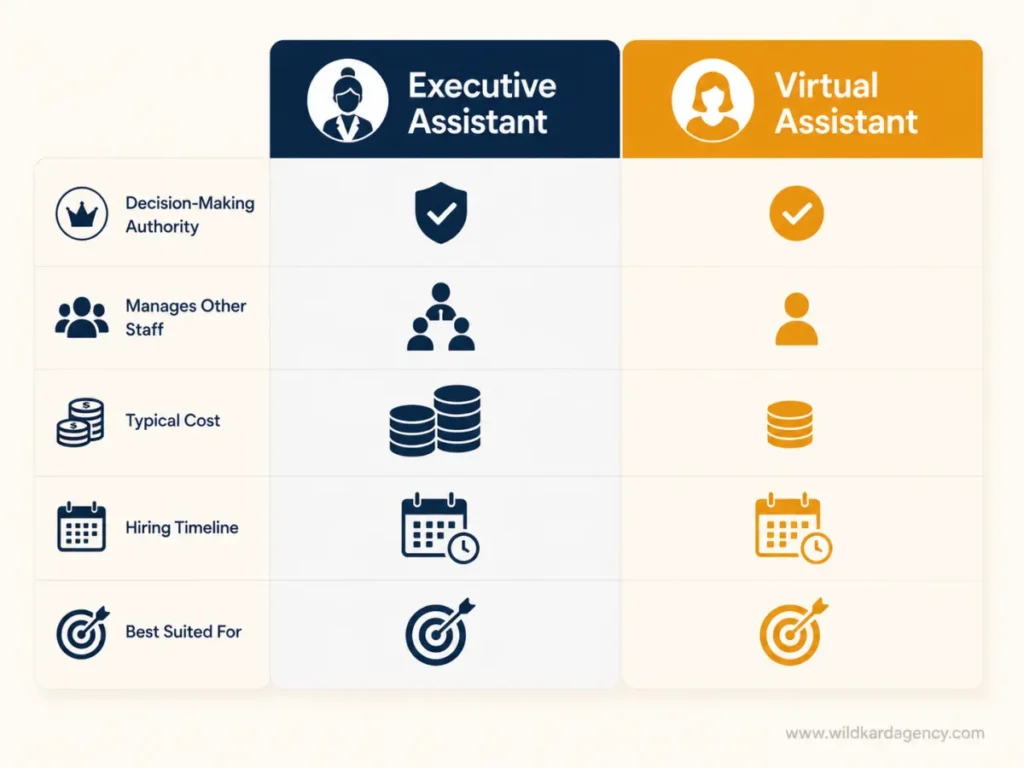
| Criteria | Executive Assistant | Virtual Assistant |
| Decision making authority | Can decide and act without asking first | Executes what you assign, does not decide independently |
| Manages other staff | Often, yes | Rarely |
| Typical employment type | W2 employee | 1099 contractor or agency employee |
| Typical cost | About $105,000 a year, fully loaded | $1,988 to $3,000 a month managed offshore, $4,000 to $8,000 or more for US based, roughly $9 to $50 an hour depending on provider |
| Hiring timeline | About 24 days on average, often 120 or more for a genuine senior search | Days, once matched with an agency |
| Ramp to full trust | Weeks to months | Days to a couple of weeks with clear SOPs |
| Confidentiality exposure | High, embedded in daily operations | Moderate, scoped to assigned tasks |
| Flexibility to scale down | Low, requires a termination process | High, contract based, easy to pause or end |
| Best suited for | The bottleneck is your own judgment and time | The bottleneck is task volume |
Two of those rows deserve more explanation than a table cell can hold, because they are the ones most comparison articles skip entirely.
The Employment Difference Nobody Explains Clearly
An in house executive assistant is almost always a W2 employee. That means your business carries the payroll taxes, unemployment insurance, and whatever benefits you offer, on top of the base salary. That is exactly why the BLS benefits data pushes a $74,260 salary up to roughly $105,000 in real annual cost.
A virtual assistant is usually a 1099 contractor, or an employee of the agency that places them. Either way, the payroll tax and benefits burden is not sitting on your business. That is a meaningful part of why the monthly VA number looks so much smaller than the EA number, and it is not a pricing trick. It is a genuinely different employment relationship.
This is general information, not tax advice. Confirm how it applies to your specific setup with your accountant before you make a hiring decision based on it.
What It Costs You If You Get This Decision Wrong
The U.S. Department of Labor’s 30 percent rule puts the cost of a bad hire at a minimum of 30 percent of that person’s first year expected earnings, described as a conservative, direct cost estimate. Applied to a median EA salary, that works out to roughly $22,000 in direct cost alone if the hire does not work out, before you even count the time it took to notice, manage out, and start the search over.
SHRM’s turnover cost data runs higher for senior or trust heavy roles, sometimes 100 percent to 200 percent of salary once lost productivity and management time are factored in. An executive assistant sits closer to that end of the range than a typical admin hire, because so much of the role’s value depends on judgment that is hard to evaluate until the person is already in the seat.
A virtual assistant mismatch costs you almost none of that. Most VA engagements run month to month through an agency, so a bad fit means ending a contract, not managing an exit. That risk gap belongs in this decision as much as the price gap does, and it ties back to the real cost of doing your own admin work in the first place, the thing that pushed you to look at either option.
How Fast You Can Actually Get Each One Started
Administrative hiring takes an average of 24 days to fill, and that is a general figure across admin roles, not the higher end reserved for genuinely senior executive support searches, which can stretch past 120 days when the search is done properly (hiring timeline data, Genius, 2025). If you need help right now, an EA search is not the fast option, even when it goes well.
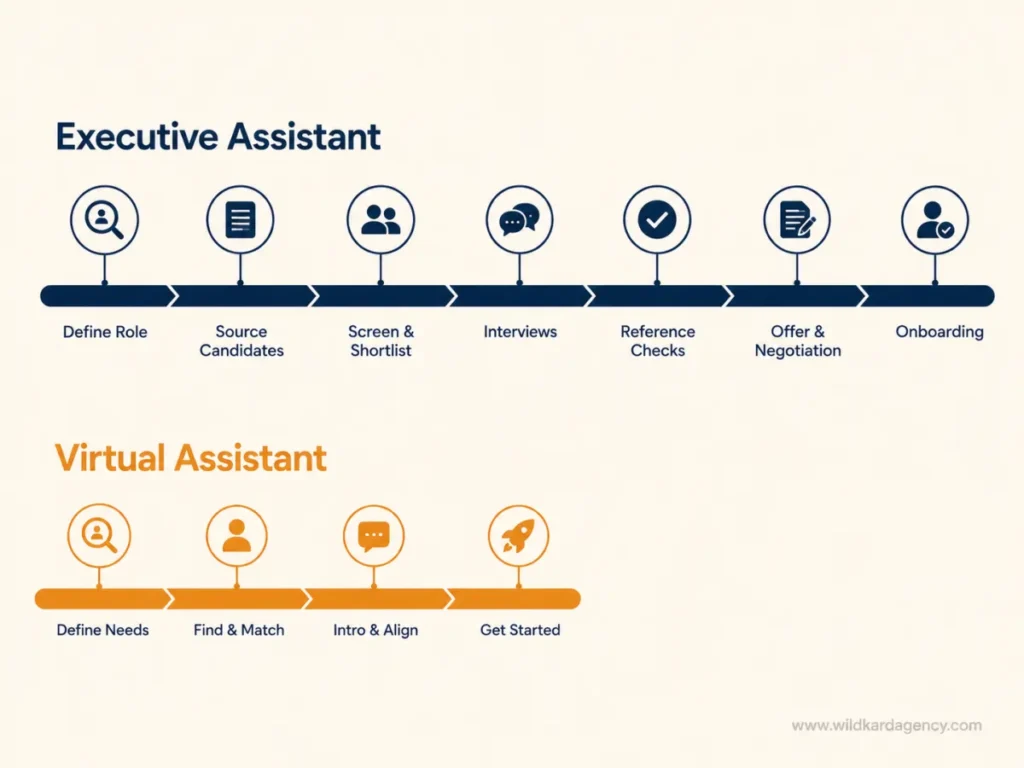
A managed virtual assistant, by comparison, can typically start within days of being matched with an agency, because the agency has already handled the vetting, onboarding, and training on their end. If your problem is urgent and you need relief this week, that speed difference alone can make the decision for you.
If the immediate problem is just too much on your plate, you do not need to solve the whole EA versus VA question today. Grab our free checklist, 10 Tasks to Hand Off to a VA This Week, and start clearing hours off your calendar while you work out the rest. Get the checklist.
Where the Line Between the Two Actually Blurs
Some agencies now offer what they call a virtual executive assistant: a remote hire who takes on real EA level responsibility (calendar authority, inbox ownership, light staff coordination) without sitting in your office or being on your direct payroll.
That is not a rebrand. It is a legitimate middle tier, and it exists because location stopped being what separated these two roles years ago. What still separates them is authority, not geography.
A virtual executive assistant can make decisions on your behalf and manage other people the same way an in house one can. A virtual assistant, wherever they are located, executes what is handed to them.
If you are evaluating a virtual executive assistant, ask exactly what decisions they are authorized to make without checking with you first. That answer tells you more than the job title ever will.
Which One Actually Fits Your Business Right Now
Company stage matters more than most people admit when they are making this call.

If you are a solo founder or running a team under ten people, this is when to hire a virtual assistant almost every time, not an EA. You are still working out what to delegate and how to document it, and a VA gives you room to learn that without a five figure commitment.
If you are running a team of ten to fifty people and you personally are the bottleneck on decisions, that is usually the signal for when to hire an executive assistant, or a virtual EA if you are not ready for someone on site. By that stage, the cost of your own indecision is often bigger than the salary. This is the same crossroads covered in Virtual Assistant vs In-House Admin, worth reading if payroll structure is the part you are still weighing.
If you have grown past fifty people, you probably need both: an EA for your own calendar and judgment calls, and VA support for the operational volume that keeps growing underneath it. Very few businesses at that size run on just one of these roles.
The Mistake Most Businesses Make With This Decision
The most common error is not picking the wrong role. It is picking the right role at the wrong time.
Some businesses hire an EA before they have documented anything, expecting the person to somehow absorb years of undocumented process on their own. That is an expensive way to learn what you actually needed to write down first. In our own client work, almost every EA hire a business later regretted skipped that exact step: nobody wrote down what they wanted delegated before the person started.
The opposite mistake happens too. A business hands a VA judgment heavy work the role was never scoped for, gets frustrated when it goes wrong, and decides VAs do not work, when the real issue was the scope of what got assigned in the first place. Our guide on how to delegate effectively to a virtual assistant walks through exactly how to scope that handoff so it does not happen.
Match the hire to the maturity of your own processes, not just to your budget or to wanting an EA on your team. That one adjustment fixes more bad hiring decisions than anything else in this article.
Frequently Asked Questions
Is a virtual assistant less capable than an executive assistant?
No. Capability is not the difference, scope of authority is. A skilled VA can absolutely handle complex, specialized work. What a VA typically does not do is make independent decisions on your behalf or manage other staff, regardless of how good they are at their job.
What is the difference between an executive assistant and a personal assistant?
A personal assistant usually handles a mix of professional and personal tasks, such as appointments, errands, and household coordination, for one individual. An executive assistant is scoped to the business side: calendar, inbox, meetings, staff coordination. The titles get used loosely, so always confirm scope in the job description rather than trusting the label.
Do virtual assistants pay their own taxes?
Generally yes. Most VAs work as independent contractors or as employees of the agency that places them, so payroll tax and benefits obligations sit with them or their agency, not with your business. Confirm the specific arrangement with your provider, since it varies.
Can a virtual assistant become an executive assistant over time?
Yes, and it happens often. As trust builds and documentation improves, businesses expand a VA’s authority, such as approving their own scheduling calls or managing a second VA, until the role functions like an EA in practice, even if the pricing model stays hourly.
How much does an executive assistant cost compared to a virtual assistant?
A full time, in house EA runs roughly $105,000 a year fully loaded (BLS data). A managed virtual assistant typically costs $1,988 to $3,000 a month with no hiring overhead. The EA costs three to four times more, for a role built around authority, not just task volume.
Which one should a small business hire first?
A virtual assistant, in almost every case. It is lower risk, faster to start, and forces you to document what you actually need before committing to a full time salary. If you are not sure the need is real yet, 10 Signs You Need a Virtual Assistant Right Now is the fastest way to check. Businesses that jump straight to an EA hire often cannot clearly explain what the role is even for yet.

If admin work is eating hours you should be spending on the business itself, you do not need to solve it with a $105,000 hire. Book a free 15 minute call and we will map out exactly which one fits where your business is right now, plus the first three tasks you could hand off this week if a VA turns out to be the move.