
Local SEO for Ohio small businesses in 2026: the Google local pack ranking factors that actually move the needle, and the exact fixes that get you back on the map.
Your website ranks. Your blog gets read. And when someone in your own city searches for what you sell, three other businesses show up above you, sometimes businesses that aren’t even headquartered in Ohio. Local SEO for Ohio small businesses is not a bonus tactic sitting next to your website content. It decides whether you show up when someone fifteen minutes away is ready to buy, or get skipped without ever knowing you existed.
Ohio has 1.1 million small businesses fighting for space in a search result that only shows three names at a time. Most of them are optimizing nothing. That is either terrible news or the best opportunity you have this quarter, depending on which side of the local pack you end up on.
| Local SEO for Ohio small businesses means optimizing your Google Business Profile category, address and proximity signals, review volume, and dedicated service pages so you appear in the three-result local pack for near-me searches in your city. Google Business Profile signals carry the most weight, followed by reviews and on-page content, according to Whitespark’s 2026 Local Search Ranking Factors survey of 47 local SEO experts. Roughly half of all Google searches now carry local intent, so ignoring this costs visibility on nearly every search that matters. |
Your Website Ranks. Your Google Business Profile Doesn’t. Here’s What That Costs You
Nearly 46% of all Google searches carry local intent, which works out to roughly 3.9 billion local searches every single day. Most of those never make it past the map and the three business names sitting above the regular organic results.
Businesses that appear in that local 3-pack see 126% more traffic and 93% more actions, calls, direction requests, website clicks, than businesses ranked 4 through 10, according to SOCi’s own research. And the searcher isn’t browsing. 76% of people who search for something nearby on their phone visit a business within 24 hours.
Picture a Dayton HVAC company with a genuinely good website. Solid blog, decent Core Web Vitals, a few backlinks. None of that matters to the homeowners searching “AC repair near me” at 2pm on a 95-degree day, because Google is deciding who appears in that map pack using an almost entirely different signal set. That’s the gap this article closes.
Google Told You What Matters. Almost Nobody Reads It.
Buried inside Google’s own Business Profile Help Center is a direct answer to the question every Ohio owner is really asking: “local results are based primarily on relevance, distance, and prominence”, in Google’s own words.
Relevance is how well your profile matches the search. Distance is how close you are to the person searching, which you cannot change. Prominence is how well-known and trusted your business appears, built from reviews, links, and mentions. Everything in this article is a way of strengthening one of those three.
Whitespark’s expert survey exists because that three-word answer from Google doesn’t tell you which specific setting to fix first. It scores 187 individual signals inside those three buckets so you know where to spend the next hour of your time, not just the next year.
1.1 Million Ohio Small Businesses Are Fighting for Three Spots in the Local Pack
Ohio is home to 1.1 million small businesses, 99.6% of every business in the state. Between March 2023 and March 2024 alone, 26,579 Ohio establishments opened and 27,585 closed. Ohioans filed roughly 169,000 new business applications in 2025, the most in six years.
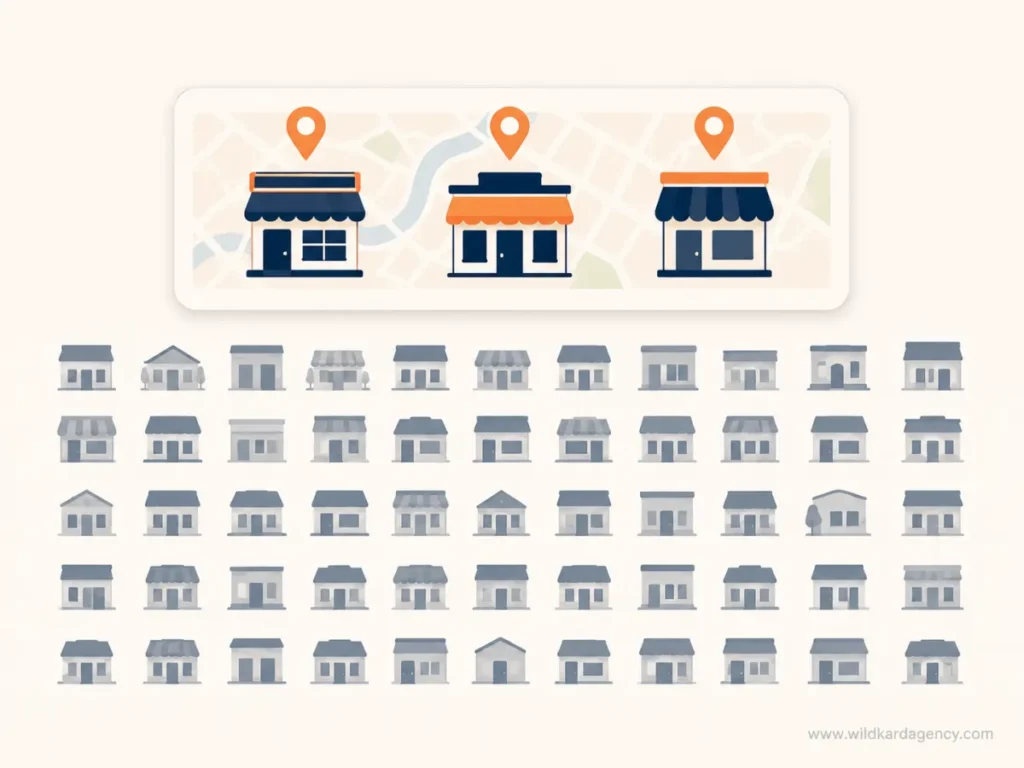
That density is exactly why the local pack feels impossible to break into. You are not competing with the two businesses down the street. You are competing with every service business within your city’s search radius, plus something most local SEO guides never mention: businesses that aren’t actually local at all.
National lead-generation companies and multi-location franchises routinely set up Google Business Profiles as service-area businesses covering entire Ohio metros from an office in another state. It’s a real tactic, and Google’s own ranking data treats it as a manipulation risk rather than a feature. Setting a service area larger than a 2-hour driving distance is flagged as a negative ranking factor in Whitespark’s 2026 survey, which is exactly why copying that move is the wrong response to seeing it work for someone else.
What Local SEO for Ohio Small Businesses Actually Requires in 2026: The 5 Ranking Factors That Matter Most
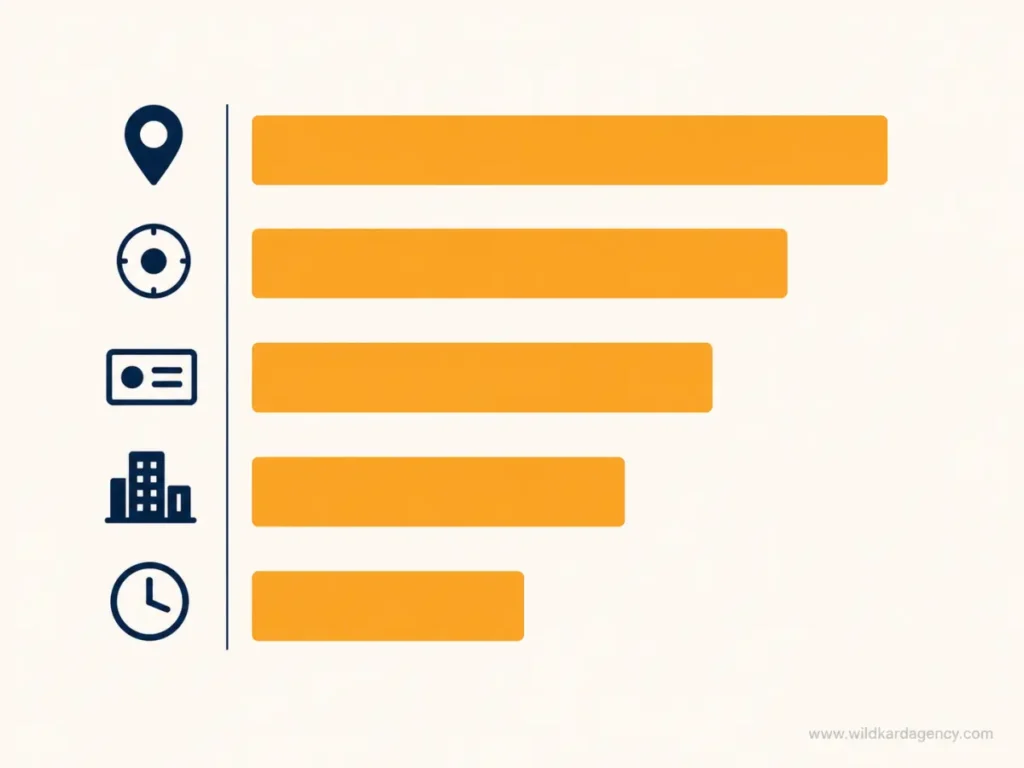
Whitespark surveys 47 of the world’s leading local SEO experts every year, scoring 187 individual factors for their impact on local pack rankings. Here are the five that scored highest in the 2026 edition.
- Primary GBP Category (#1, score 227). This single dropdown field outweighs almost everything else you can control. A general “contractor” category loses to a competitor correctly listed as “HVAC contractor.”
- Proximity of your address to the searcher (#2, score 225). You cannot change where a customer is standing, but you can make sure your listed address, service area, and map pin are set correctly for the neighborhoods you actually serve.
- Keywords in your GBP business title (#3, score 223). This means your registered business name, not a stuffed version of it. “Smith Plumbing Columbus Ohio” as a fabricated name change will get your profile suspended. Use your real name; this factor rewards businesses whose real name already contains a relevant term.
- Physical address in the city of search (#4, score 213). A Cleveland-based business will consistently struggle to rank for “Akron” searches without a genuine Akron presence, which is worth knowing before you assume a single Ohio listing covers the whole state.
- Business is open at the time of the search (#5, score 189). Google now weighs your posted hours heavily enough that being closed can drop you out of the pack entirely during that window, then restore you the moment you reopen.
None of these five require a redesign or a big budget. They require someone to actually sit inside your Google Business Profile settings and get them right, which is precisely the step most Ohio small businesses skip.
Claim and Verify Your Profile Before Anything Else
Everything above assumes you already control your Google Business Profile. A meaningful share of Ohio small businesses don’t, because Google auto-generates a basic listing for many businesses whether anyone claims it or not. None of the ranking factors above matter until you own the profile.
Verification methods vary by business type: a postcard mailed to your address (typically 5 to 14 days), an instant phone or text code for many eligible businesses, email verification, or a video verification where you film your storefront and signage. Google occasionally offers bulk verification for businesses managing multiple locations.
Search your own business name and address before starting. A duplicate, unclaimed, or previously-abandoned listing competing against your real one splits your reviews and confuses the exact proximity and prominence signals covered above. Request the duplicate be removed through Google’s process before investing further effort.
Google Business Profile Optimization Starts With One Setting Most Ohio Owners Ignore
It’s worth naming what doesn’t work, because it’s where most owners spend their time instead. A controlled study by Sterling Sky tracking 441 keywords found zero direct ranking movement from Google Business Profile posts. Posting updates helps click-through and engagement. It does not move your position in the pack.
Google Business Profile optimization that actually works starts with the boring settings: your primary category, your business hours matching reality, and your service list. Those three fields carry more ranking weight than a year of Google Posts.
One factor jumped sharply in the 2026 survey after research from Joy Hawkins at Sterling Sky showed Google’s own predefined services list directly affects rankings. It moved from barely registering in 2023 to the #22 most impactful local pack factor this year. If you haven’t filled out the “Services” section of your profile beyond the default category, this is the single fastest fix on this list.
Your Google Business Profile Categories Decide Whether You Show Up At All
Most Ohio business owners pick a primary category once, during setup, and never touch it again. That single choice is the highest-weighted local pack ranking factor there is, which means a wrong or overly broad category quietly caps your visibility no matter what else you do.
Two fixes cost nothing: first, choose the most specific primary category that genuinely describes your core business, not the broadest one that technically fits. Second, add every relevant additional category Google offers, additional GBP categories rank as the #8 factor on their own.
A general contractor who also does roofing should have a roofing-specific additional category, not just “General Contractor.” A law firm handling both family and estate law should reflect both. This takes fifteen minutes inside the profile and nothing else on this list beats it for return on effort.
How to Rank on Google Maps When You Don’t Have a Storefront
Service-area businesses, plumbers, cleaners, mobile mechanics, consultants who visit clients, don’t get a simple answer here, and most guides gloss over it. The correct setup depends entirely on whether customers ever visit your physical location.
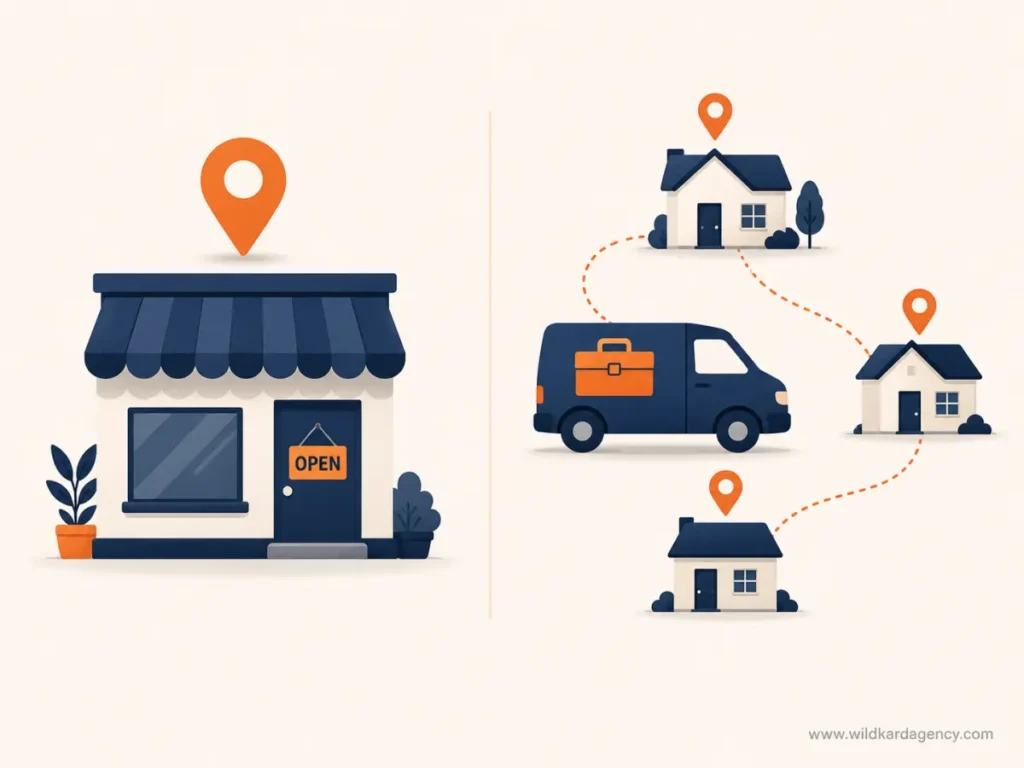
If customers never come to you, hide your address and set your service area honestly. If you do have a real storefront, showing your address is one of the top factors, address is showing (not SAB) ranks #7. Get this backwards and you risk a suspension review, showing your address on a genuine service-area profile is flagged as a suspension risk factor in the 2026 survey.
This is exactly the setup mistake behind the crowded, oddly-broad local results Ohio owners often notice. A business with a real service area of two adjacent counties has a defensible profile. A business claiming coverage of the entire state from a single office is playing a version of the game Google is actively working to penalize, which is one more reason not to copy it.
Dedicated Service Pages: The Local Pack Ranking Factors Most Ohio Websites Skip
The local pack factors above control whether you show up on the map. A separate set of local pack ranking factors governs a different result: your regular organic listing underneath it. The single most important one there is a dedicated page for each service you offer, the #1 factor for local organic rankings in the 2026 survey.
Most small business websites in Ohio have one generic “Services” page listing everything. That page cannot rank for a specific search like “water heater installation Columbus” the way a dedicated page built for exactly that service and that city can. This is genuinely a web development task, not just a content one, and it’s the reason WildKard treats web build and content strategy as one project rather than two separate hires.
Build one page per core service, name the city or region in the page’s title and heading, and answer the specific questions a buyer of that exact service actually has. A locksmith needs a separate page for residential lockouts and commercial rekeying, not one page that mentions both in passing.
Citations Are Back: Why NAP Consistency Matters Again
For most of the last decade, local SEO experts treated citation building, getting your business name, address, and phone number listed consistently across directories, as a solved problem not worth much attention. Whitespark’s 2026 survey reverses that.
Three of the top five AI Search visibility factors are citation-related, and citation consistency across primary search engines, Google Maps, Bing Maps, and Apple Maps, ranks as the #28 local pack factor on its own.
The mechanism is simple. When ChatGPT, Gemini, or Google’s AI Mode answer a local question, they pull from the same scattered pool of business data sitting across directories, review sites, and your own website. If your business name, address, or phone number differs even slightly between your site, your Google Business Profile, and a directory listing like Yelp or the Better Business Bureau, those systems struggle to confirm you’re a real, trustworthy option, and an AI answer can skip you entirely in favor of a competitor whose records match everywhere.
Fixing this is unglamorous but finite. Pick one exact version of your business name, address, and phone number. Update your Google Business Profile, your website footer, and your top five directory listings, Yelp, BBB, Apple Maps, Bing Places, and one relevant industry directory, so all five match exactly.
AI Search Is Already Changing How Ohio Customers Find You
Nearly half of consumers, 45%, now use ChatGPT or a similar AI tool for local business recommendations, up from just 6% a year earlier. That’s not a future trend to plan around. It’s already reshaping how a homeowner in your Ohio city finds a plumber, a lawyer, or a dentist right now.
When ChatGPT Search answers a local query, it draws roughly 58% of its sources from business websites, 27% from business mentions, and 15% from online directories. The dedicated service pages and citation consistency covered above aren’t only Google Maps tactics. They also decide whether an AI assistant recommends your business by name when someone asks it directly instead of typing into Google.
None of this replaces the fundamentals. Every expert in Whitespark’s survey still points back to the same core signals, a correct Google Business Profile, consistent citations, real reviews, and dedicated content. AI search is raising the stakes on getting those fundamentals right, not replacing them with something new.
Reviews Compound Faster Than Almost Anything Else on This List

Sites ranking in the top three local positions carry an average of 561 Google reviews, and every additional 10 reviews correlates with roughly a 3% lift in profile conversions, according to SOCi’s own local search research.
Recency matters as much as volume. 74% of consumers say they only care about reviews written in the last three months, and in 2026, nearly a third of consumers, 31%, only use businesses rated 4.5 stars or higher, up sharply from the year before. A pile of five-star reviews from 2022 does less for you than a slower, steady stream of recent ones.
Whitespark’s data backs this up directly: sustained influx of reviews over time outranks review bursts as a ranking signal. A business that asks every satisfied customer for a review, consistently, beats a business that runs one review-request campaign a year, even if the total counts end up similar.
Multi-Location Ohio Businesses Need a Different Playbook
A business with one location in Columbus follows everything above directly. A business with locations in Columbus, Cincinnati, and Cleveland needs a variation on it, and treating all three like one business is a common way multi-location Ohio companies quietly lose ground.
- Each physical location gets its own Google Business Profile, its own verification, and its own review history. Do not route every location’s calls or reviews through one central profile.
- Each location needs its own dedicated page on the website, with unique content, not the same paragraph with the city name swapped in. Whitespark’s data on service-area size applies here too: keep each profile’s service area realistic to that specific location, not the whole state.
- Watch for overlapping service areas between your own locations. Two of your own profiles competing for the same searches confuses Google about which one to show, and Whitespark’s 2026 survey flags overlapping service areas on multi-location profiles as a negative signal in its own right.
This is exactly the setup difference between a business that genuinely operates in three Ohio cities and the out-of-state lead-generation operations described earlier that fake the same appearance from one office. Real multi-location presence means real, separately-verified, separately-optimized profiles for each place.
Put Location Data in Your Website’s Code, Not Just Its Copy
Everything covered so far lives inside Google Business Profile or in visible page content. One more piece lives in code a visitor never sees: structured data, specifically LocalBusiness schema markup in JSON-LD format on your website.
Schema doesn’t rank you on its own. It gives Google and AI search tools a machine-readable confirmation of your business name, address, phone number, hours, and service area, the same NAP details covered in the citations section above, formatted so a machine can verify them instantly rather than infer them from prose. For a multi-location business, this means a distinct LocalBusiness schema block on each location’s dedicated page, matching that location’s profile exactly.
This is a genuinely technical task, not a content one, which is why WildKard treats web development and content strategy as one project instead of two separate hires for a business that only needs to solve this once.
How to Actually Measure Whether Any of This Is Working
None of the fixes above matter if nobody checks whether they moved anything. Three free sources cover most of what an Ohio small business needs to track.
- Google Business Profile Insights, built into your profile dashboard, shows how many people found you via a direct search for your name versus a discovery search for your category, plus the calls, direction requests, and website clicks that resulted.
- Google Search Console, filtered to queries containing your city or neighborhood name, shows whether your dedicated service pages are actually earning impressions and clicks for the local terms they were built for.
- A dedicated tracking phone number on your Google Business Profile, separate from your main line, shows plainly how many calls the profile itself is generating, not just website traffic.
Check these monthly, not daily. Local pack position moves slowly and noisily enough that daily checking mostly produces anxiety rather than insight. A monthly look at the same three sources will show a real trend line within a single quarter.
| If this is starting to feel like one more list you don’t have time for:Reach out to the WildKard team. We’ll walk through your Google Business Profile category, service pages, and review setup together and tell you honestly which of these factors is costing you the most visibility right now. |
Common Mistakes Ohio Small Businesses Make With Local SEO
- Never claiming or verifying the Google Business Profile Google auto-generated, or leaving a duplicate listing live alongside the real one.
- Setting service areas larger than a realistic 2-hour driving radius to appear in more cities, which Whitespark’s data flags as a negative ranking signal, not a growth hack.
- Leaving the primary GBP category as a broad, generic label instead of the most specific accurate option available.
- Treating Google Posts as the main optimization task while the business hours, categories, and services fields sit untouched.
- Building one generic “Services” page instead of a dedicated page per service and per city served.
- Running review requests once a year instead of building them into every completed job or closed sale.
- Showing a business address on a profile that’s genuinely a service-area business, or hiding the address on a real storefront, either mismatch works against you.
- Routing multiple physical locations through one shared profile instead of verifying and optimizing each location separately.
The Ohio Local SEO Checklist Every Small Business Owner Can Run This Week
- Confirm your Google Business Profile is claimed and verified, and check for competing duplicate listings.
- Confirm your Google Business Profile primary category is the most specific accurate option, not the broadest one.
- Add every genuinely relevant additional category Google offers for your business.
- Fill out the GBP Services section completely, using the terms customers actually search.
- Match your posted hours exactly to your real hours, no padding for “bonus ranking time.”
- Decide honestly whether you’re a storefront or a service-area business, and set your address visibility accordingly.
- Set service areas no larger than a real 2-hour driving distance, and check for overlap if you run multiple locations.
- Build one dedicated page per core service, naming the specific service and city in the title and heading, with LocalBusiness schema on each location page.
- Match your business name, address, and phone number exactly across your website, GBP, and top directory listings.
- Set up a standing process to request a review after every completed job, not a once-a-year push.
- Respond to reviews, especially recent ones, since review recency outweighs total volume.
- Check Google Business Profile Insights and Search Console monthly to confirm what’s actually moving.
Where WildKard Fits Into This

WildKard runs on the same rules laid out here. As an Ohio-based, remote-first agency, we keep our own Google Business Profile category, service pages, and review cadence current using this exact checklist, not a separate playbook we only hand to clients.
Local SEO for Ohio small businesses isn’t a one-time project. It’s a small set of settings and habits, most of them free, that compound the longer you keep them current. The businesses winning the local pack in your city right now are rarely the biggest ones. They’re the ones that got the boring fields right and kept them right.
If your business is one of Ohio’s 1.1 million small businesses trying to get found locally, reach out to the WildKard team and we’ll show you exactly which of these factors is costing you the most visibility right now.
Frequently Asked Questions
What is local SEO for Ohio small businesses?
It’s the practice of optimizing your Google Business Profile, address and service-area settings, reviews, and website service pages so you appear in Google’s local 3-pack for near-me searches in your Ohio city. It’s separate from general SEO, which focuses on organic rankings alone.
How long does local SEO take to show results?
Google Business Profile fixes, category, hours, services, can shift local pack visibility within weeks. Reviews and dedicated service pages compound over several months. Treat this as an ongoing habit, not a one-time project with a fixed finish date.
Do I need a physical Ohio office to rank locally?
No, but you do need an honest, correctly configured profile. Storefront businesses should show their address. Genuine service-area businesses should hide it and set a realistic service radius instead. Mismatching the two works against you either way.
Does posting on Google Business Profile help rankings?
A controlled Sterling Sky study tracking 441 keywords found no direct ranking movement from GBP posts. Posts can help click-through and engagement, but your category, hours, and services fields carry far more ranking weight.
How many Google reviews do I need to rank in the local pack?
Businesses in the top three local positions average 561 reviews, but recency and consistency matter more than hitting a specific number. A steady stream of recent reviews outperforms a large batch of old ones.
Do I need to verify my Google Business Profile if it already shows up?
Yes. Google auto-generates basic listings for many businesses whether anyone claims them or not. An unclaimed or unverified profile means you don’t control the category, hours, or services, the highest-weighted ranking factors on this whole list, and duplicate listings can split your reviews.
How is local SEO different for a business with multiple Ohio locations?
Each physical location needs its own verified Google Business Profile and its own dedicated website page, not one shared profile or a single page with the city swapped in. Overlapping service areas between your own locations is flagged as a negative ranking signal, so each location’s service area should stay realistic to that specific site.
What’s the difference between local SEO and regular SEO?
Regular SEO focuses on ranking your website in Google’s organic results. Local SEO focuses on ranking in the map-based local pack, which uses a largely different signal set centered on your Google Business Profile, proximity, and reviews rather than website content alone.
Does AI search like ChatGPT affect local SEO for Ohio businesses?
Yes. 45% of consumers now use ChatGPT or a similar tool for local recommendations, up from 6% the year before. These tools pull heavily from business websites, citations, and mentions, so the same fundamentals, a correct Google Business Profile, consistent NAP data, and dedicated service pages, determine whether AI recommends you too.