

A step-by-step framework for building a content marketing strategy that generates leads, not just traffic: from buyer-journey mapping to revenue-tied measurement.
Your blog has more posts on it than it did a year ago. The social calendar is full. The enquiry form still sits empty most weeks.
That gap is exactly why business owners go looking for a content marketing strategy that generates leads instead of another list of topic ideas. The problem was never a shortage of content. It was a shortage of structure.
A content marketing strategy that generates leads maps content to a real buyer’s journey, organizes it into pillars and clusters instead of random topics, assigns every piece a conversion path, and measures revenue instead of traffic alone. Organizations with a documented strategy generate three times more leads per dollar spent than those without one, according to 2026 research compiled by Digital Applied. Skip any one of those four parts and the content usually still exists. The leads just do not.
Why Most Content Marketing Never Generates a Lead
Most businesses do not actually have a content problem. They have a documentation problem. Seventy-three percent of B2B marketers report a documented content strategy in 2026, per Digital Applied’s research. The businesses without one are not publishing less. They are publishing without a plan for what happens after someone reads a post.
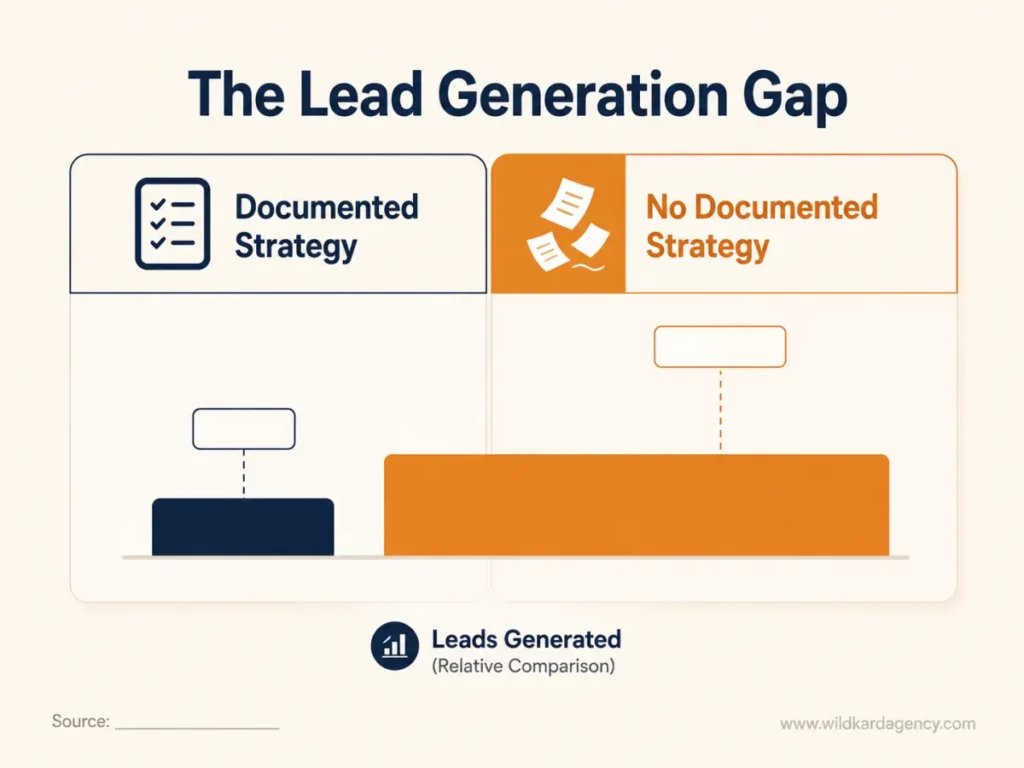
The gap shows up in measurement first. Eighty-seven percent of content teams track website traffic, but only thirty-one percent track revenue attribution, according to the same 2026 dataset. Fifty-six percent of B2B marketers separately admit it is hard to connect content efforts to ROI at all, per Demand Metric research cited by SeoProfy. Nobody here is lying about their traffic numbers. They just cannot say what those numbers are worth.
The fix is not more content. It is a strategy that ties every piece back to a stage in the buyer’s journey and a specific next action, which is what the rest of this framework builds toward.
What a Content Marketing Strategy That Generates Leads Actually Looks Like
A content marketing strategy that generates leads is not a spreadsheet of blog titles. It is a documented system built from four working parts: audience and buyer-journey mapping, a pillar-and-cluster content architecture, a conversion path attached to every piece, and revenue-tied measurement.
Skip the mapping and content gets written for nobody in particular. Skip the architecture and each post competes with the last one instead of building on it. Skip the conversion path and even good content dead-ends at “thanks for reading.” Skip the measurement and the whole program becomes a matter of opinion at budget time.
Companies with active blogs generate sixty-seven percent more leads per month than non-blogging competitors, according to 2026 research summarized by OmniBound. That number holds for businesses running all four parts together. A blog without the rest of the system is still just a blog.
Building the Content Marketing Strategy Framework: Start With the Buyer’s Journey
Before a single topic gets chosen, name who the content is for and what they need to believe before they pick up the phone. Most B2B buyers consume three to five pieces of content before contacting sales, per Digital Applied’s 2026 data. That means the strategy has to plan for a sequence, not one high-performing post.

Map three stages. Awareness content answers a problem the reader already knows they have. Consideration content compares options and frameworks once they know solutions exist. Decision content addresses the specific objections that come up right before someone reaches out.
Skipping straight to decision-stage content is the more common mistake among small businesses, not the reverse. A comparison post means little to a reader who has not yet accepted they have the problem it is comparing solutions for. The buyer’s journey, not the content calendar, is the actual starting point of the strategy.
In practice, this looks different for every business but follows the same shape. An awareness-stage post names a pain point the reader already feels: “why your website gets traffic but no enquiries,” for example, rather than a post about the business itself. A consideration-stage post compares real options once the reader accepts the problem is worth solving, the way a piece comparing in-house hiring against outside support helps someone who already knows they need help decide what kind. A decision-stage post handles the objection that shows up right before someone reaches out: cost, timeline, or what the first thirty days actually look like.
Each stage should exist somewhere in the content plan before volume gets added to any single stage. A pillar with twelve awareness posts and nothing at decision stage will keep generating traffic and nothing else.
If mapping a buyer’s journey against your own service lines sounds like the missing piece, reach out to the WildKard team and we’ll walk through what that mapping looks like for your business specifically.
Content Pillars and Clusters Beat Random Topic Lists
Once the journey is mapped, organize content around pillars, not a running list of unrelated ideas. A pillar is one long-form, comprehensive post per core service or topic area. Cluster posts underneath it target narrower, specific questions and link back to the pillar, which links back out to them.
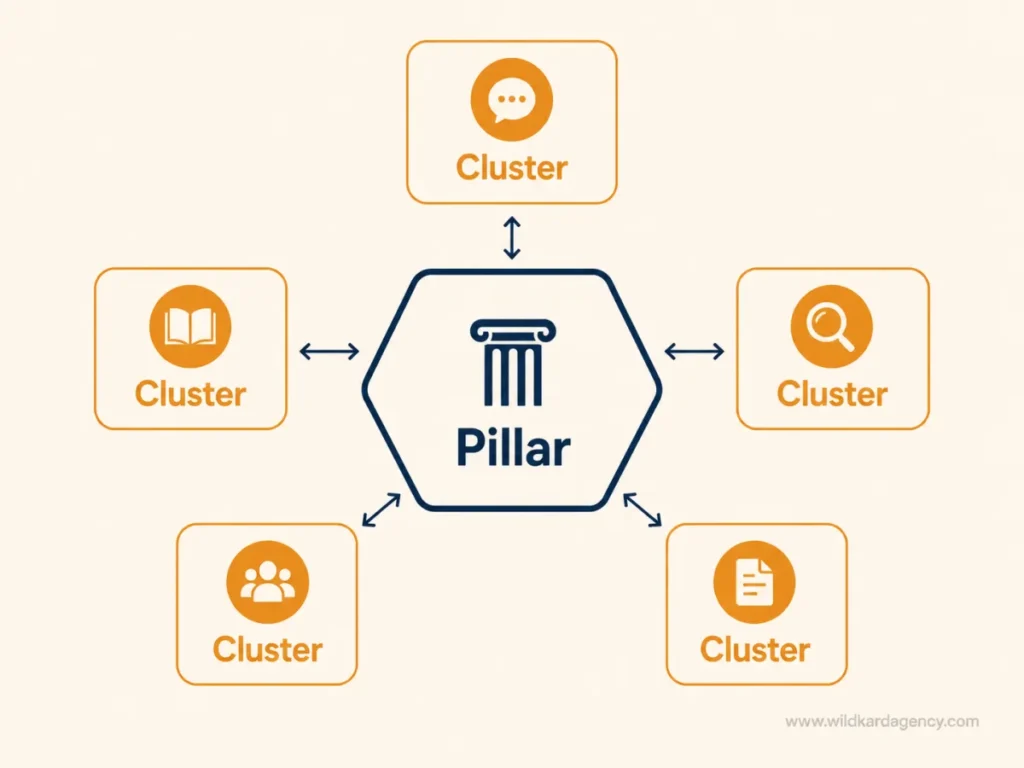
This is not a theoretical model. It is the exact architecture behind WildKard’s own SEO and GEO guide, supported by cluster posts including a guide to generative engine optimization. Content pillars and clusters build what search engines and AI answer engines both reward: topical authority, not just individual page rank.
Original, named data is also getting harder to skip. Eighty-nine percent of marketers say original research is their strongest content differentiator, according to Digital Applied’s 2026 findings, and posts over 3,000 words earn three and a half times more backlinks than shorter posts in the same dataset. Depth compounds. A pillar built shallow rarely earns the links its clusters need to rank.
Content Format Allocation: What to Actually Produce
Once pillars and clusters are mapped, the next question is format, and most small businesses default to blog posts for everything. Blog posts are the right default; ninety-two percent of marketers use them, per Digital Applied’s 2026 usage data. They are not the right choice for every stage.
Video content carries the highest engagement rate of any format tracked in 2026, and eighty-eight percent of marketers say it delivers positive ROI, according to the same research. It tends to fit best at the awareness stage, where the goal is attention, not a detailed comparison. Infographics and interactive content generate roughly twice the conversion rate of static content, which makes them useful wherever a stat needs to be shareable on its own, not just buried mid-article.
Case studies and whitepapers sit at the opposite end. They take longer to produce, fit best at the consideration and decision stages, and score “very high” for lead-generation effectiveness precisely because the reader engaging with one has already self-selected as further along. A realistic allocation for a small business running one pillar a quarter looks like mostly blog posts, one or two video pieces, and a single gated asset (a checklist, a short guide, or a case study) per pillar, not an even split across every format available.
The mistake is not choosing the wrong format. It is choosing one format for every stage and wondering why the middle and bottom of the funnel stay empty.
Match Every Piece to a Funnel Stage and a Conversion Path
Every piece of content needs two things before it goes live: a funnel stage and a next action. An awareness-stage blog post should offer a related read or a lead magnet, not a hard sales pitch. A consideration-stage comparison page can carry a stronger CTA, because the reader is closer to deciding.
Format matters here too. Case studies and whitepapers score “very high” for lead-generation effectiveness in 2026 format-performance data from Digital Applied, well above general blog posts, even though blog posts carry the highest usage among marketers. That is not an argument against blogging. It is an argument for pairing blog content with at least one gated or higher-commitment asset per pillar. For a closer look at turning individual posts into enquiries once this structure is in place, see how blog posts turn into enquiries.
A piece of content with no conversion path is not free. It cost the time to write it and returned nothing. Every article, without exception, needs an assigned next step before it gets scheduled.
Set a Publishing Cadence You Can Actually Sustain
Consistency outperforms volume. Businesses that publish consistently are thirteen times more likely to see positive content ROI, according to Digital Applied’s 2026 research, and most programs need a minimum of six months of steady publishing before traffic growth becomes measurable at all.
That timeline is exactly why so many small businesses quit right before a strategy starts working. A cadence of two well-researched, fully-optimized posts a month, sustained for six months, will outperform eight rushed posts a month for six weeks followed by silence.
Pick a cadence based on capacity, not ambition. A realistic, boring, kept schedule beats an aggressive one that collapses in month two.
Seasonality and resourcing both belong in this decision too. A business with a slow quarter can bank pillar research during it and publish through the busier months that follow, rather than trying to hold the same output year-round. What matters is that the cadence, once set, gets written down and treated as a commitment the same way a client deadline would be, not a target that quietly slips whenever the week gets busy.
Make Distribution Part of the Strategy, Not an Afterthought
Publishing is not distribution. A post that only lives on the blog reaches whoever happens to find it organically, which takes months to build. The same post shared to the right LinkedIn audience, sent to an email list, and structured for AI answer engines reaches people the same week it goes live.
That last channel is no longer optional. Ninety-four percent of B2B buyers now use large language models to research vendors before ever visiting a website, according to 6sense’s 2025 Buyer Experience Report cited by OmniBound. Content that is not structured for extraction, meaning clear direct answers, defined entities, and FAQ sections, is effectively invisible during that research phase.
Treat distribution as a line item in the plan, not a hope. Every piece of pillar or cluster content should have a named channel and a named owner before it is scheduled, the same way it already has a funnel stage and a conversion path.
Measuring Content Marketing for Lead Generation: Revenue, Not Just Traffic
Measuring content marketing for lead generation means tracking what happens after the click, not just the click itself. Traffic is the easiest number to report and the least useful one on its own. Eighty-seven percent of teams track it. Only thirty-one percent track revenue attribution, and only forty-two percent of marketers say they can prove content ROI to leadership at all, per Digital Applied’s 2026 measurement data.
That gap has a real cost. Teams that can demonstrate ROI to leadership see three-point-one times higher budget growth the following year, according to the same research. Under-measuring content marketing does not just hide its value. It actively starves the budget that would make it work better.
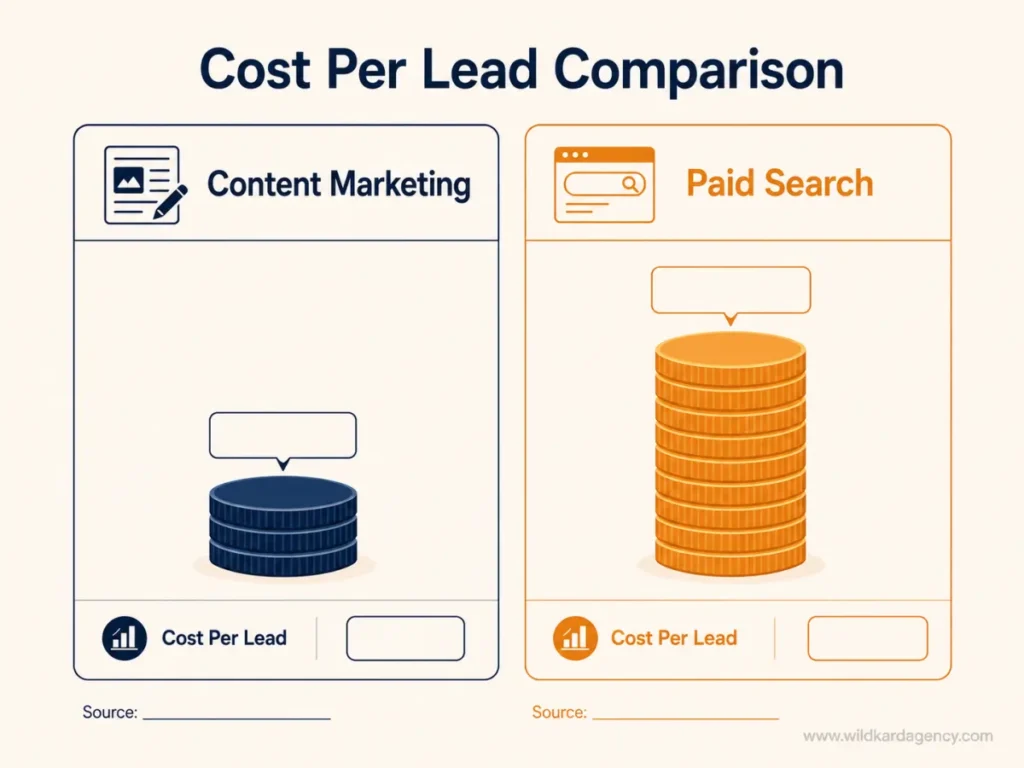
At minimum, track leads generated per piece, cost per lead by content type, and which pieces actually show up in a buyer’s path before a sale closes. Content marketing produces an average cost per lead of ninety-two dollars in B2B, against two hundred forty-two dollars for paid search, per Digital Applied’s data. That comparison only holds if the lead is actually being counted in the first place.
In-House vs Agency Content Marketing: How to Decide
In-house vs agency content marketing is not really an either-or question. It is a resourcing question, and the honest answer depends on team size and how much of this framework a business can run consistently on its own. The median in-house content team at a fifty-to-five-hundred-employee company is four people, and thirty-seven percent of teams report being understaffed relative to their goals, per Digital Applied’s 2026 team-structure data.
That understaffing is why fifty-eight percent of teams already supplement in-house staff with freelancers or an agency, and forty-seven percent of companies outsource at least some content creation outright, according to the same research. None of this is a sign of failure. Strategy, writing, SEO research, and measurement infrastructure are four distinct skill sets, and few small businesses run all four in-house at once.
This is squarely where WildKard operates, worth naming plainly since it is the service this framework describes. WildKard runs this exact pillar-and-cluster model on its own site, at Starter, Growth, and Scale retainers built for businesses that need the framework executed, not just explained. That is a disclosure, not a pitch buried inside neutral advice: the rest of this article works whether or not a business ever talks to WildKard, and an in-house team running it well is an equally legitimate path.
Common Mistakes That Quietly Kill Lead-Generating Content
A handful of mistakes account for most content programs that publish consistently and still generate nothing. None of them are about writing quality.
- Publishing without a documented strategy, then judging results against a plan that was never actually written down
- Writing almost exclusively for the awareness stage and never producing anything a reader can act on
- Tracking traffic and stopping there, with no link between a specific post and a specific lead
- Treating distribution as automatic once a post is published, instead of planning it in advance
- Abandoning a cadence at month two, right before the six-month mark where results usually start showing
- Building content pillars around what the business wants to say instead of what the buyer’s journey actually requires at each stage
Any one of these alone will slow a program down. Two or three together are usually why a business concludes content marketing “doesn’t work” when the real issue was never tested.
The Content Marketing Strategy Checklist
- Buyer’s journey mapped across awareness, consideration, and decision stages
- One pillar post per core service or topic area, with four to six supporting cluster posts each
- Every piece assigned a funnel stage and a specific conversion path before it is scheduled
- A publishing cadence set at a sustainable volume and held for a minimum of six months
- A named distribution channel and owner for every piece, including AI-search structuring
- Measurement that tracks leads and cost per lead by content type, not traffic alone
- A resourcing decision made deliberately: in-house, freelance, agency, or a mix
Frequently Asked Questions
How long does a content marketing strategy take to generate leads?
Most programs need a minimum of six months of consistent publishing before traffic growth becomes measurable, and eight to fourteen months before content ROI typically overtakes paid alternatives, per 2026 research from Digital Applied. Businesses expecting results in the first sixty days are measuring the wrong timeline, not living through a failed strategy.
How much should a small business budget for content marketing?
B2B content marketing budgets average twenty-six percent of total marketing spend in 2026, though small businesses can start meaningfully below that with a focused pillar-and-cluster program. What matters more than the number is consistency. A modest budget held for six-plus months outperforms a larger one that stops after two.
What is the difference between a content strategy and a content calendar?
A content calendar is a schedule of what publishes when. A content marketing strategy is the reasoning behind it: who each piece is for, what stage of the buyer’s journey it serves, and what happens after someone reads it. A calendar without that reasoning is a to-do list with dates on it.
Which content format generates the most leads?
Case studies and whitepapers score highest for lead-generation effectiveness in 2026 data, but blog posts remain the highest-usage format because they build the top-of-funnel audience those gated assets convert. The two work together. Neither replaces the other.
Do we need an in-house content team, or can an agency build this?
Either can work. The deciding factor is whether the business already has strategy, writing, SEO, and measurement skill sets in-house, plus the time to run them consistently. Fifty-eight percent of content teams already supplement in-house staff with freelancers or an agency, which makes a hybrid approach the norm, not the exception.
Does AI search change how a content marketing strategy should be built?
Yes. Ninety-four percent of B2B buyers now use AI tools to research vendors before visiting a website, per 6sense’s 2025 Buyer Experience Report. Content built only for Google rankings misses that research phase entirely, which is why direct-answer framing and clear entity structure belong in the strategy from the start, not as an afterthought.
What’s the single biggest sign a content marketing strategy is missing?
A pillar-and-cluster structure with no decision-stage content and no tracked leads is the clearest sign. Traffic can be climbing while enquiries stay flat, because nothing in the content plan is built to convert a reader who already has the problem. Adding one gated, decision-stage asset per pillar is usually the fastest fix.
Building the System Instead of the Next Post
None of this requires more content than most businesses already have room for. It requires a documented content marketing strategy that generates leads instead of one that generates page views: a mapped buyer’s journey, a pillar-and-cluster structure, a conversion path on every piece, and measurement that follows the lead all the way to revenue.

Building that structure from a blank page is the hard part, not writing the individual posts. If that’s where things stand right now, get in touch with the WildKard team and we’ll help map the framework to your business before a single new post gets written.