

| A virtual assistant vs in house admin decision comes down to predictability, not just cost. An in-house admin typically costs $59,000 to $74,000 in the first year once salary, benefits, and hiring costs are counted, and takes weeks to months to onboard. A virtual assistant runs $800 to $2,000 a month with no hiring cost and a start time measured in days. In-house still wins when the role needs constant physical presence or a steady, high-volume daily workload. A virtual assistant wins for variable, remote-friendly work that doesn’t justify a full-time salary. |
You’ve decided you need help. The next decision is harder: hire someone to sit in the office, or bring on a virtual assistant who works remotely. Most comparisons of this decision stop at salary versus hourly rate, which is the least useful way to compare them.
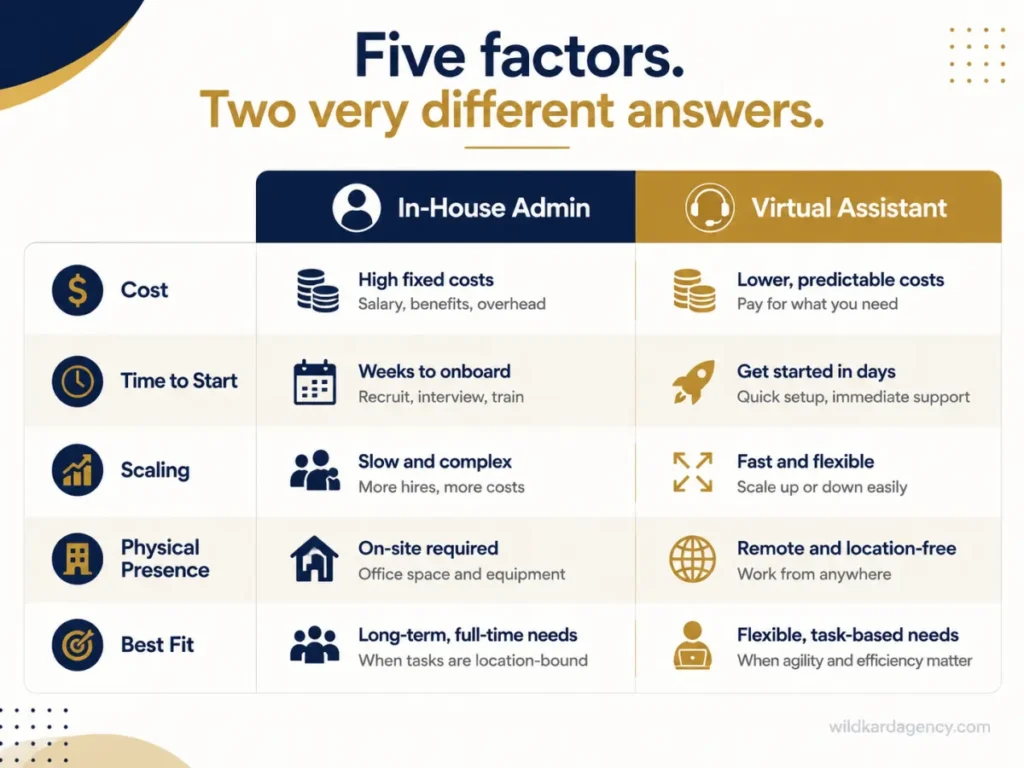
The real virtual assistant vs in house admin comparison has to account for benefits, hiring costs, ramp-up time, and how predictable your workload actually is. As our VA guide covers, the honest answer depends on your specific situation, not a blanket rule either direction.
Here’s the comparison at a glance, then the full cost breakdown most articles skip.
| Factor | In-House Admin | Virtual Assistant |
| First-year cost | ~$59K to $74K, salary plus benefits and hiring costs | $9.6K to $24K, transparent monthly retainer |
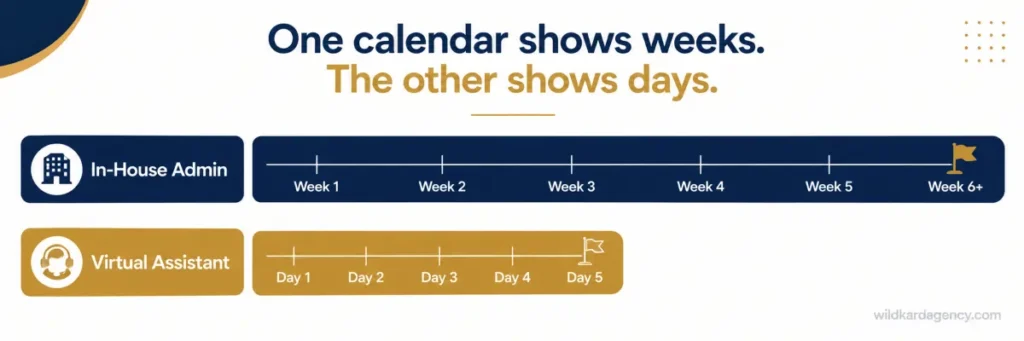
| Time to start | Weeks to months, per SHRM time-to-fill data | Typically days |
| Scaling up or down | Slow, tied to a hiring or layoff process | Fast, adjust hours or scope month to month |
| Physical presence | Yes, in the office if needed | No, fully remote |
| Best fit | Steady, high-volume, in-person daily workload | Variable workload, remote-friendly tasks |
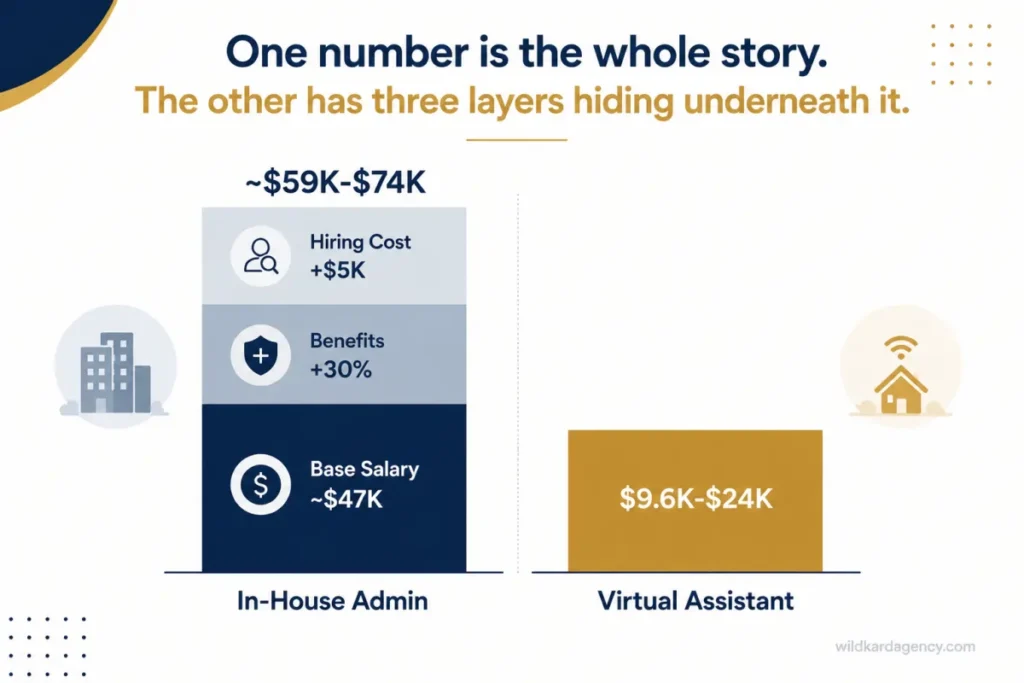
The Real Cost Comparison (Not Just Salary vs. Retainer)
Most comparisons quote a salary number and a VA rate and call it done. That misses most of what an in-house hire actually costs before they answer their first email.
| In-House Admin: What It Actually Costs | Source |
| Base salary: $42,000 to $52,750/year | Robert Half 2026 Salary Guide |
| + Benefits and payroll overhead: ~30.1% on top of wages | U.S. Bureau of Labor Statistics, Q1 2026 |
| + One-time cost to hire: $4,700 to $5,475 | SHRM Talent Acquisition Benchmarking |
| Estimated first-year total: ~$59,300 to $74,050 | WildKard calculation from the three figures above |
That estimate uses Robert Half’s 2026 salary range, the U.S. Bureau of Labor Statistics’ Q1 2026 finding that benefits add roughly 30 percent on top of wages, and SHRM’s benchmark for the cost to hire a non-executive employee. None of those numbers include office space, equipment, or software seats.
A WildKard virtual assistant retainer runs $800 to $2,000 a month, or $9,600 to $24,000 a year, fully transparent from day one. There’s no hiring cost, no benefits calculation, and no ramp-up period measured in months.
When In-House Actually Wins
The cost comparison isn’t the whole story, and pretending otherwise wouldn’t be honest. Some situations genuinely call for an in-house hire despite the higher cost.
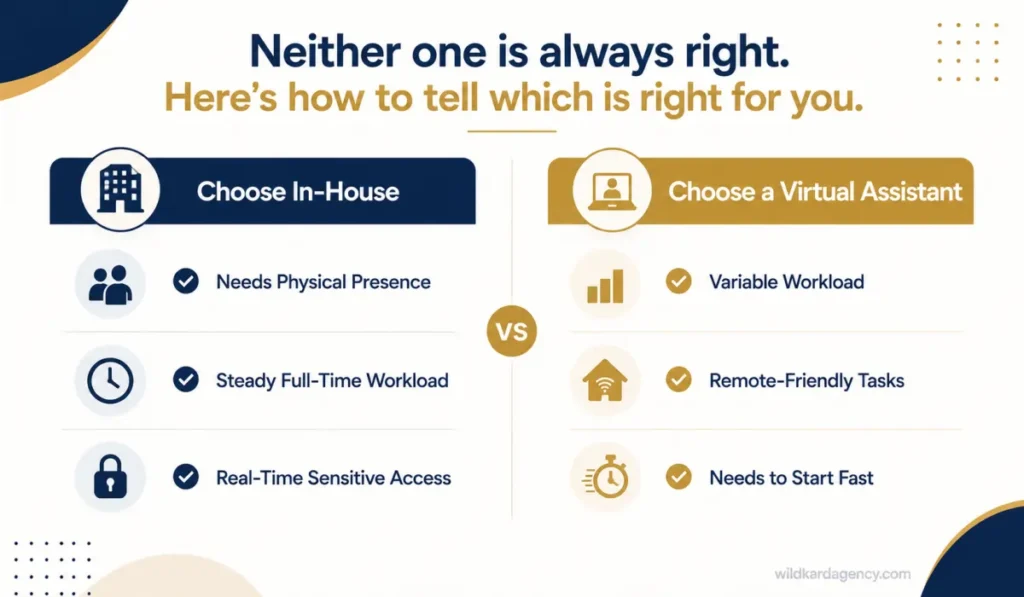
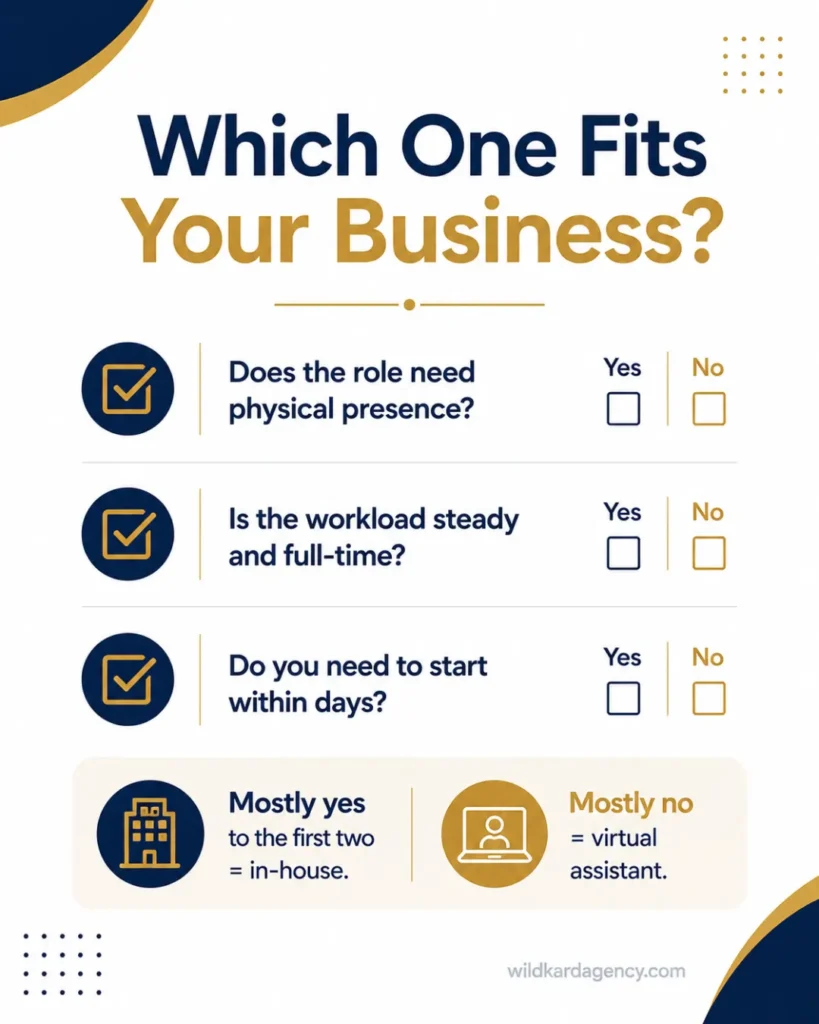
- The role requires being physically present, greeting visitors, managing a front desk, or handling in-person deliveries
- Workload is steady and high-volume enough to fill 40 hours a week, every week, without lulls
- The role needs deep, real-time access to sensitive systems that are difficult to grant remotely
If all three of those are true, an in-house hire is probably the right call, and the higher cost is the price of availability and presence that remote support can’t replicate.
When a Virtual Assistant Actually Wins
For most small businesses, the workload doesn’t look like that. It looks like what we described in 10 signs you need help: inconsistent volume, task variety, and hours that don’t add up to a full-time role but still eat the owner’s week.
We’ve also covered the flip side in real cost of doing it yourself: the option being compared isn’t always in-house vs. VA. Often it’s VA vs. the owner’s own unpaid hours, which is a very different calculation.
A virtual assistant wins when the work is real but doesn’t justify a full salary, when speed to start matters more than in-person presence, and when the ability to scale hours up or down month to month matters more than having someone permanently on payroll.
| Not sure which side of this comparison your business actually falls on? Book a call and we’ll walk through your specific workload together. |
Frequently Asked Questions
Is a virtual assistant always cheaper than an in-house admin?
On direct cost, almost always, since a VA retainer skips benefits, payroll overhead, and hiring costs entirely. But cost isn’t the only factor. Steady, high-volume, in-person work can still justify an in-house hire despite the higher price.
How fast can a virtual assistant actually start, compared to hiring?
A virtual assistant typically starts within days. An in-house hire takes weeks to months once you count posting the role, interviewing, and the notice period at their previous job.
Can a virtual assistant handle the same tasks as an in-house admin?
Most non-physical administrative tasks translate directly: scheduling, inbox management, data entry, correspondence, and research. Tasks requiring a physical presence in your office don’t transfer.
What’s the biggest hidden cost of hiring in-house?
Benefits and payroll overhead, which add roughly 30 percent on top of the base salary according to BLS data, on top of a separate one-time cost to hire that most budgets don’t account for upfront.
Can a business use both a virtual assistant and in-house staff?
Yes, and many growing businesses do. A VA absorbs the variable, remote-friendly workload while in-house staff handle what genuinely requires a physical presence or dedicated full-time attention.
| The right answer isn’t the same for every business, but the math is knowable before you commit to either one. Book a call with WildKard and we’ll help you run the numbers for your specific situation. |