

You have probably done the calculation at least once. Your hourly rate, multiplied by how many hours a week you spend on admin. The cost of doing your own admin work adds up to a number that is uncomfortable enough to notice and easy enough to ignore. You close the spreadsheet. You go back to the inbox.
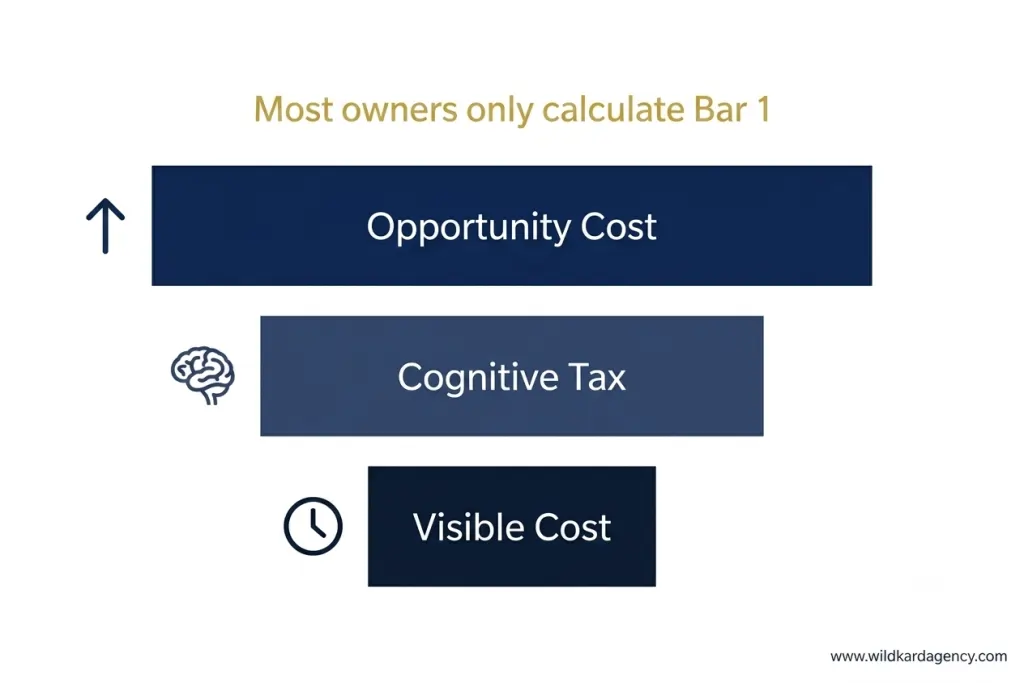
Here is what most business owners have never been told. That calculation only captures one of three layers of the real admin cost. The other two are hidden – not because they are small, but because nobody has given them a name yet. This article changes that.
By the time you reach the end, you will have a complete picture of what doing your own admin is actually costing your business – and a two-table framework you can use to run the full numbers for your own situation.
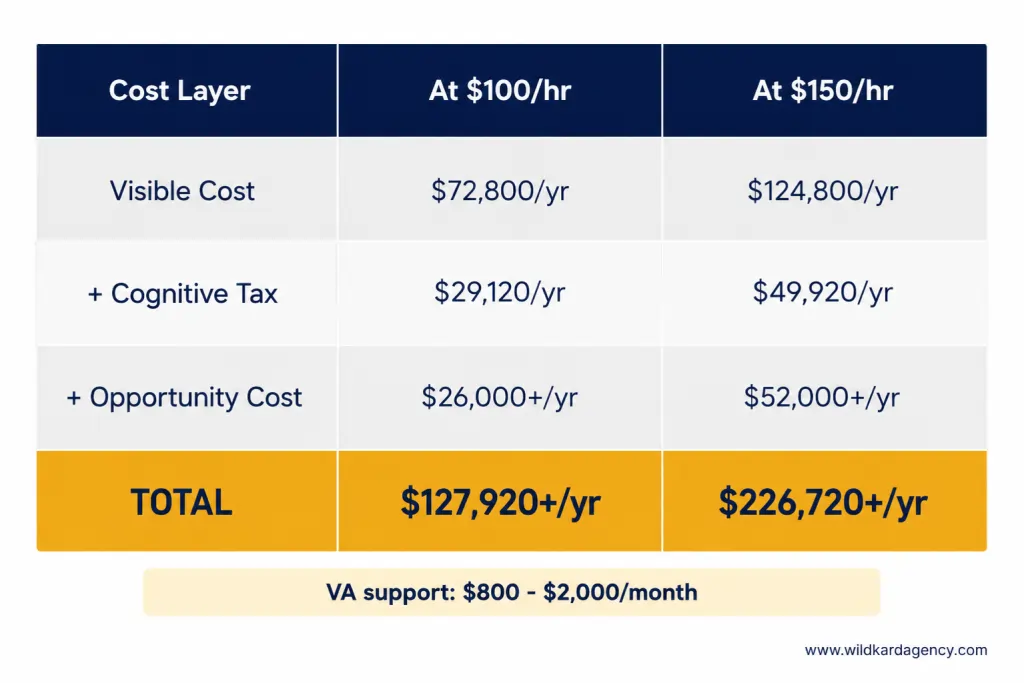
| You probably know one cost of doing your own admin work: time multiplied by your hourly rate. But the real cost of doing your own admin work has three layers – not one. The second is the cognitive tax from constant task switching, which research shows reduces productive output by up to 40% across the full day. The third is admin debt: the compounding cost of tasks handled poorly or not at all, which builds silently until it becomes a structural drag on your business. When you add all three layers, the true annual cost for a founder billing at $150 an hour is closer to $175,000 to $225,000 – not the $124,800 the standard calculation produces. The VA retainer that covers the same work costs $800 to $2,000 a month. |
The Calculation You Already Know About Admin Work Costs
Start here, because the baseline number matters before you can understand the full cost of doing your own admin work.
A survey of 251 US-based entrepreneurs by virtual assistant company Time etc found that the average entrepreneur works a 45.5-hour week – and more than a third of it (36%) goes to administrative tasks. That is roughly 16 hours every week. Not 16 hours of deep strategic thinking. Sixteen hours of email, scheduling, data entry, formatting, and the hundred other tasks that cycle through your week without stopping.
| Your Hourly Rate | Weekly Admin Hours | Weekly Cost | Annual Cost |
| $75/hr | 10 hours | $750 | $39,000 |
| $100/hr | 14 hours | $1,400 | $72,800 |
| $125/hr | 16 hours | $2,000 | $104,000 |
| $150/hr | 16 hours | $2,400 | $124,800 |
| $200/hr | 18 hours | $3,600 | $187,200 |
Table 1: Visible admin cost using the standard time-times-rate calculation. These figures use the hourly rate the Time etc survey average of 16 weekly admin hours. Adjust for your own rate and hours.
That number is real and it matters. But if it were the whole story, most business owners would have already solved it. The reason so many have not is that this calculation only captures the visible cost of doing your own admin work. The hidden layers are bigger.
The Hidden Cost of Admin Work That Nobody Calculates: The Cognitive Tax
Every time you switch from a strategic task to an administrative one, your brain pays a toll. It does not appear in your bank account. But it shows up in the quality of every decision you make for the rest of the day.
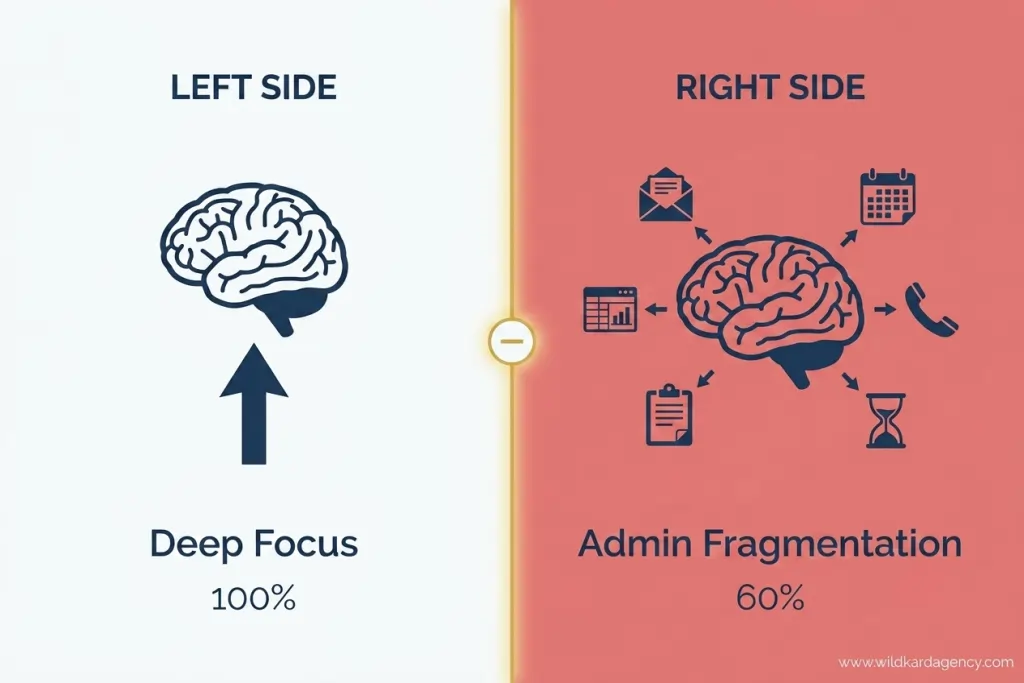
Research from the American Psychological Association shows that frequent task switching reduces productive output by up to 40%. A business owner moving between admin and strategic work throughout the day is not just losing the admin hours. They are operating at significantly reduced capacity during every other hour too.
The refocus cost compounds it. Dr. Gloria Mark at UC Irvine – whose 2023 book Attention Span was named the number one best business book of the year by The Globe and Mail – found that it takes an average of 25 minutes to fully regain deep focus after an interruption. Four admin interruptions in a day costs you close to two hours of your best thinking. Not two hours of work. Two hours of high-quality cognitive capacity.
Then there is the switching volume. A 2022 Harvard Business Review study found that the average digital worker toggles between different apps and websites nearly 1,200 times per day. Admin work – with its mix of email, spreadsheets, calendar tools, and messaging platforms – is the primary engine of that fragmentation.
And underneath all of this is decision fatigue. Psychologist Roy Baumeister’s research established that the quality of your decision-making degrades with each choice you make throughout the day. Admin work is full of micro-decisions: which email to open first, what to file, what to respond to now versus later. By mid-afternoon, after a morning of admin, you are making your most expensive business decisions with a depleted cognitive tank.
This is the hidden cost of admin work that almost no calculation accounts for. The McKinsey Global Institute found that the average knowledge worker spends 28% of the workweek on email alone – and nearly 20% searching for information. That is close to half the working week gone before any strategic work has started. For a business owner doing their own admin, the cognitive overhead is even higher.
| Research Source | Finding |
| American Psychological Association | Frequent task switching reduces productive output by up to 40% |
| Dr. Gloria Mark, UC Irvine (2023) | Takes 25 minutes to fully regain deep focus after an interruption |
| Harvard Business Review (2022) | Average digital worker toggles between apps 1,200 times per day |
| McKinsey Global Institute | Knowledge workers spend 28% of workweek on email alone |
| Slack / Salesforce (2024, n=2,000) | Small business owners lose 1.5 productive hours every single day |
Table 2: Research on the cognitive cost of task switching and fragmented attention. All findings are from peer-reviewed or independently verified sources.
Admin Debt: Why the Admin Overload Cost Compounds Over Time
Here is a concept that most conversations about admin cost completely overlook.
In software development, there is a concept called technical debt: the long-term cost of cutting corners today instead of building things properly. Every shortcut accumulates interest. What starts as a small problem becomes a structural drag that slows everything down.
Admin overload cost works exactly the same way. Call it admin debt.
Every missed follow-up means a lead cools. Every document that does not get filed properly means 20 minutes wasted finding it later. Every onboarding task handled inconsistently means a new hire’s first week is worse than it needed to be. Every process that lives in someone’s head instead of a document gets reinvented from scratch the next time it is needed.
The Slack / Salesforce 2024 survey of 2,000 US small business owners found that the average owner loses 1.5 productive hours every day to preventable time waste – amounting to three full weeks of lost productivity every year. The key word is preventable. That lost time is not random. It is the interest being charged on accumulated admin debt.
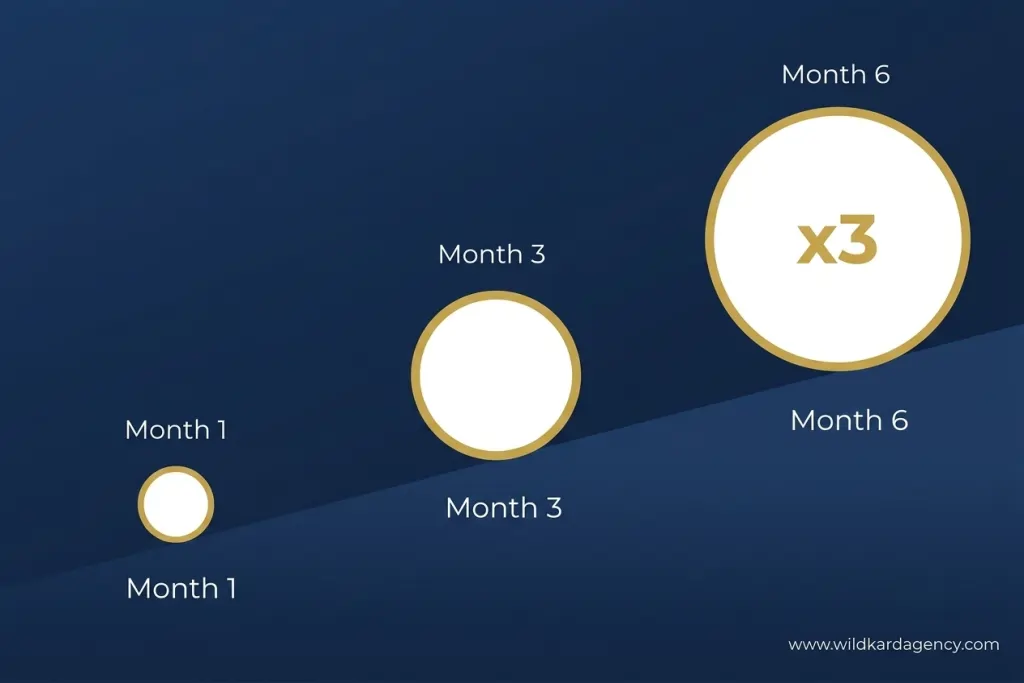
The business owner who has been managing their own admin for two or three years is not just behind by a few hours a week. They are carrying the compounded interest of every follow-up that fell through, every system that never got properly set up, every process that was never documented. And that debt keeps accruing until something changes.
The Invisible Growth Ceiling
Here is the second concept that almost nobody addresses when talking about admin cost.
When a significant portion of your working week goes to admin, you are not operating at full capacity. You are operating at 60 or 70 percent of it. And a business run by a founder at 70 percent has an invisible growth ceiling baked into its structure.
A founder who is maxed out at 70 percent of capacity cannot pursue the new client. Cannot develop the new offer. Cannot build the partnership that has been on the to-do list for four months. The Agility PR time management survey found that 73% of business owners said they would prefer to be working on their business rather than in it. The gap between what they want to be doing and what they are actually doing is not a motivation problem. It is an operational one.
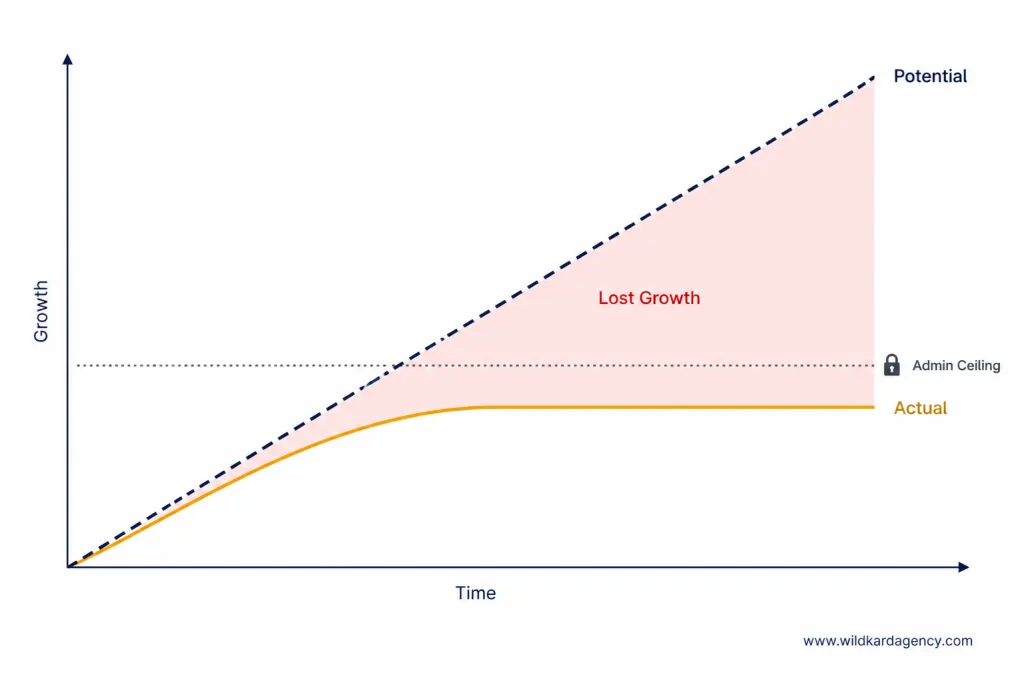
The business does not stop growing because the market stopped responding. It stops growing because the person running it ran out of capacity. And admin is what filled that capacity.
This is why the admin cost conversation matters beyond the maths. It is not just about what admin costs per hour. It is about what admin costs per year of business growth.
The Opportunity Cost of Not Delegating: The Full Three-Layer Calculation
Here is what the real cost of doing your own admin looks like when you account for all three layers together. Run it for your own hourly rate.
| Cost Layer | What It Is | At $100/hr | At $150/hr |
| Visible time cost | Weekly admin hours x hourly rate | $1,400/wk | $72,800/yr | $2,400/wk | $124,800/yr |
| Cognitive tax (40% output loss) | Reduced strategic quality across the full day | $560/wk | $29,120/yr | $960/wk | $49,920/yr |
| Opportunity cost of not delegating | Revenue work and growth displaced by admin hours | $500-$1,500/wk | $1,000-$2,500/wk |
| Admin debt interest | Compounding cost of poor processes and missed tasks | $200-$500/wk | $300-$800/wk |
| TOTAL (conservative) | All four layers combined | $2,660-$3,960/wk | $4,660-$6,660/wk |
| ANNUAL TOTAL | At conservative estimate | $138,320-$205,920 | $242,320-$346,320 |
Table 3: The full three-layer admin cost framework. The opportunity cost of not delegating is calculated conservatively based on the revenue-generating work displaced by admin hours. Admin debt interest reflects the compounding cost of accumulated process failures and missed tasks. Both figures are conservative starting estimates.
| Run the Numbers for Your BusinessStep 1: Count your weekly admin hours honestly. Include email, scheduling, data entry, follow-ups, and anything else that does not directly generate revenue.Step 2: Multiply by your effective hourly rate. That is your visible cost.Step 3: Multiply the visible cost by 1.4 (adding the 40% cognitive tax). That is the two-layer cost.Step 4: Add a conservative opportunity cost estimate – what revenue work you did not do because admin occupied those hours. Even $500 a week is $26,000 a year. |
The VA retainer that handles the same administrative work: typically $800 to $2,000 per month. The opportunity cost of not delegating is almost always greater than the cost of delegating. The 2026 VA Industry Report from Wishup confirmed that 41% of US small businesses now use at least one virtual assistant – primarily to break exactly this bottleneck.
| If you have run these numbers and the case is already clear – book a free 15-minute call with WildKard – no pitch, just a clear picture of what a handoff looks like for your business. |
Care Agencies: When the Admin Overload Cost Falls on the Wrong People
For directors and operations managers at social services agencies, the admin cost calculation looks different – but hits just as hard.
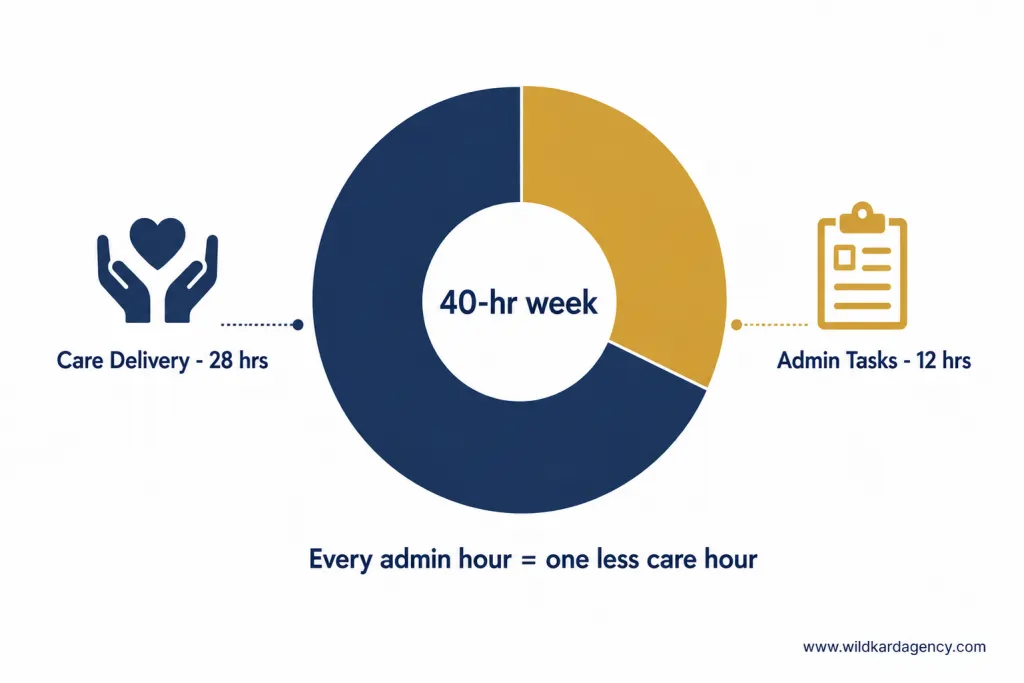
In a care agency, the admin burden does not sit with one founder. It distributes across the entire team – and it lands hardest on the people who were hired specifically to do something else entirely. DSPs document incidents, coordinate schedules, and field onboarding queries on top of their care work. That is not just an efficiency problem. It is a care quality problem and a retention problem at the same time.
We have published the full research on this – including the specific data connecting administrative overload to DSP burnout and turnover – in Why DSP Burnout Often Starts With Admin, Not Care Delivery. If you run a care agency and you recognise the pattern described in this article, that piece gives you the complete picture.
For care agencies, admin debt does not show up in a founder’s spreadsheet. It shows up in staff turnover figures, in the weeks it takes to onboard a new DSP, and in the gap between the care standard the agency aims for and the care standard that is achievable when staff are stretched across two jobs at once.
What Changes When You Stop Paying This Cost
The shift that happens when admin comes off a business owner’s plate is not just about hours. It is about what those hours give back.
At WildKard, the pattern we see consistently in the first 30 days with a new client is this: within two weeks, the calendar looks different. By week four, the decisions look different. Not because the business changed – but because the person running it has more cognitive bandwidth, fewer interruptions, and a clearer view of what actually needs their attention.
The visible cost is recoverable quickly. The cognitive tax lifts almost immediately once the task switching drops. Admin debt takes longer – because some of the compounded interest has to be worked through before the slate is genuinely clean. The growth ceiling lifts progressively as strategic capacity opens up and attention can go where it belongs.
That is the full picture of what the cost of doing your own admin work is actually costing you. Most business owners have only ever seen the headline. The ones who act on the full number are the ones that grow past the ceiling their competitors are still pushing against. You can see what a virtual assistant for business owners actually looks like in practice here, or check the 10 signs that most business owners are past the right moment to act.
– FREQUENTLY ASKED QUESTIONS –
Why do most business owners underestimate the real cost of doing their own admin work?
Because the standard calculation – time multiplied by hourly rate – only captures the visible cost. It misses the cognitive tax from context switching (which research shows reduces productive output by up to 40%), the admin debt that accumulates when tasks pile up and compound over months, and the opportunity cost of the strategic work that does not get done. When you add all three layers, the real cost is typically two to three times the headline number.
What is the opportunity cost of not delegating – and how is it different from the time cost?
Time cost is the monetary value of hours spent on admin. Opportunity cost of not delegating is the value of what those hours could have produced instead. A founder spending 16 hours on admin at $150 an hour loses $2,400 in direct time value. But if those 16 hours would have gone to client development, proposals, or strategic planning, the opportunity cost is typically significantly higher – because strategic work often has a multiplied revenue impact. Most calculations only ever count the time cost.
What is admin debt and how does it differ from regular admin overload?
Admin overload describes the volume of admin work you are carrying at any given moment. Admin debt is what that overload costs you over time through compounding. Every missed follow-up creates a secondary recovery task. Every undocumented process gets rebuilt from scratch the next time it is needed. Every disorganised system wastes incremental time on every use. The Slack / Salesforce 2024 survey found that small business owners lose three weeks of productivity every year to preventable time waste – that accumulated loss is admin debt in practice.
Is the 40% productivity reduction figure reliable for business owners specifically?
The 40% figure comes from American Psychological Association research on the productivity cost of chronic task switching. For business owners, the cost is likely at or above the 40% figure – because the cognitive gap between administrative tasks (repetitive, process-driven) and strategic tasks (complex, judgment-based) is larger than for most knowledge workers. The refocus time is correspondingly longer. Using 30% as a conservative working estimate is reasonable for most business owners switching between admin and strategic work multiple times per day.
At what point does the maths on hiring a virtual assistant actually make sense?
For most business owners, the maths makes sense as soon as admin hours exceed five per week – because at that level, even a conservative cognitive tax calculation brings the opportunity cost above the cost of a basic VA retainer. The 2026 VA Industry Report from Wishup found that 41% of US small businesses now use at least one virtual assistant, confirming this is no longer a premium strategy but a mainstream operational decision. The question is not whether the maths works. It is how much longer the cost of not acting is worth paying.