

A practical framework for what to hand off first, how to document it once, and how trust actually gets built, so delegating doesn’t mean losing your grip on the business.
You’ve hired a virtual assistant, or you’re about to. And somewhere underneath the relief is a quieter worry: what if they get it wrong, and it’s your name on it.
That worry is the reason so many business owners hand off two or three small tasks, watch one come back slightly off, and quietly pull everything back in-house. This guide covers how to delegate to a virtual assistant in a way that actually holds, not through more trust or less anxiety, but through a specific, learnable system: what to hand off first, how to document it once, how access and security actually work, what never gets delegated, and what to do the moment something goes wrong.
Why “Losing Control” Is the Wrong Fear
Delegation resistance rarely comes from arrogance. According to Bigin’s 2026 analysis of small business owners, it comes from history: the owner tried handing something off before, watched it get done poorly, and the experience hardened into a rule that it’s faster and safer to do it themselves.
The cost of that rule is measurable. Leaders who delegate effectively spend 23% more time on strategic activities that drive revenue growth, according to Harvard Business Review research cited by AssistsYourBiz. On the other side of the ledger, leaders struggling with the burnout that comes from refusing to delegate are 34% less likely to rate themselves as effective and over three times more likely to leave their role, according to research cited by Beyond The Chaos.
The reframe matters because it changes what you actually fix. “I don’t trust anyone else to do this” leads to more anxiety and less delegation. “I haven’t given this task the structure it needs to be handed off safely” leads somewhere useful.
The Real Reason Delegation Fails (Almost Every Time)
The most common reason delegation fails in a small business is that the task is handed off without sufficient context, per Bigin’s research. Not without sufficient trust. Without sufficient context.
A related but distinct diagnosis comes from Forbes Coaches Council: most business owners don’t actually have a delegation problem, they have a decision-rights problem. Tasks get handed off, but the authority to make the small judgment calls inside those tasks never does, so every decision still routes back to the owner regardless of who’s technically doing the work.
Both point to the same fix. Delegation succeeds when the task comes with enough context and enough explicit decision-making authority that the VA doesn’t have to guess, and enough enforced structure that guessing wrong is caught early rather than after it’s already gone out the door.
What to Delegate First: The Task Filter
Not every task is equally safe to hand off first. A simple filter, adapted from the Delegation Matrix framework, sorts tasks by importance against how well the VA already knows the work.
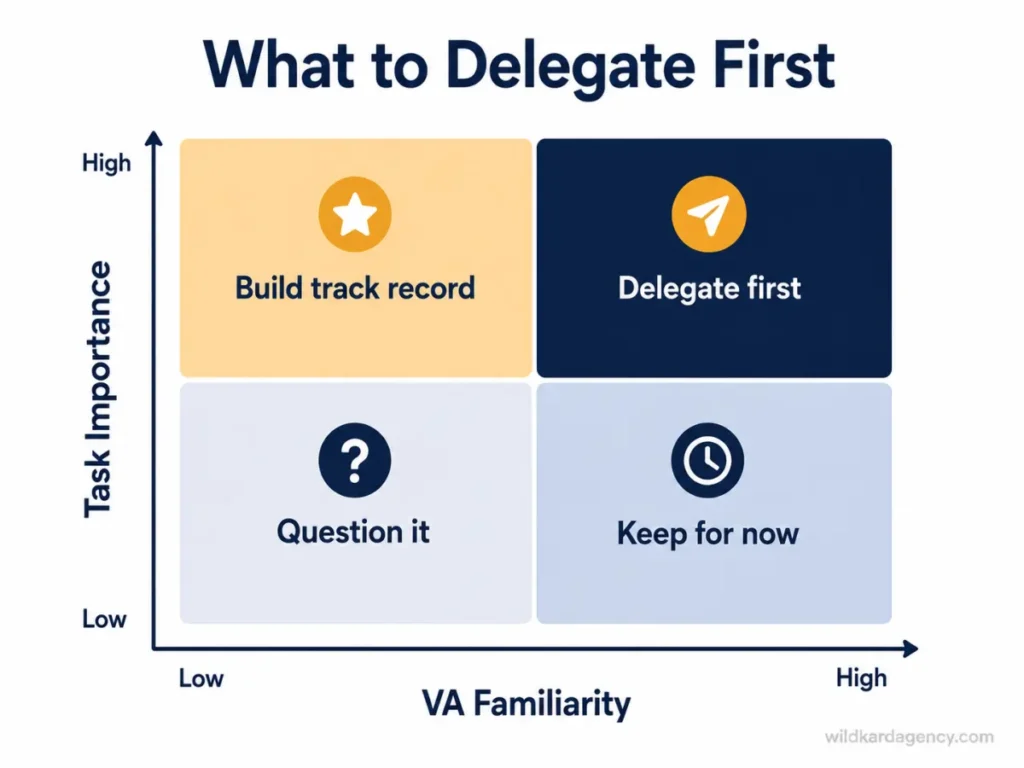
| Task Importance | VA Skill/Familiarity Low | VA Skill/Familiarity High |
| High importance | Keep it yourself for now, or train deliberately with close supervision | Delegate fully, with periodic outcome checks |
| Low importance | Question whether the task needs to happen at all | Delegate fully; low risk makes this the easiest starting point |
The practical starting point is always the bottom-right cell: low-importance, high-familiarity work. Inbox triage, scheduling, data entry, and routine follow-ups are the classic first handoffs for exactly this reason. High-importance, low-familiarity work, client-facing judgment calls, financial decisions, anything with legal exposure, stays with the owner until a VA has built a track record on smaller things first.
Document Once, Delegate Forever: Why SOPs Are the Real Unlock
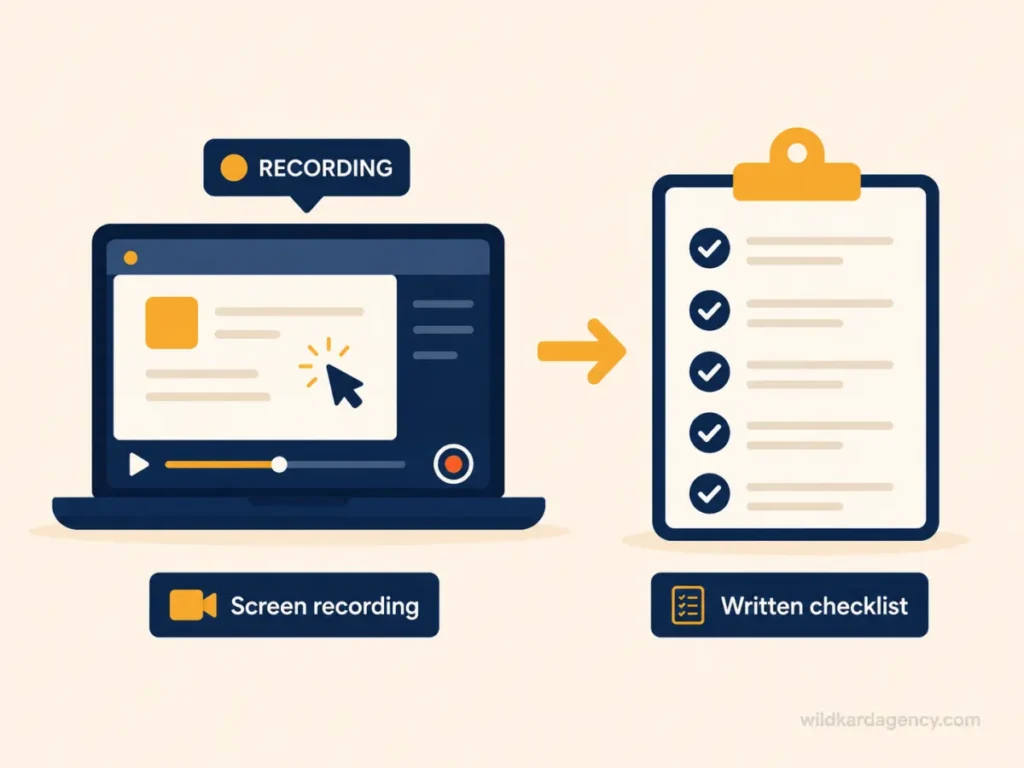
Most written procedures fail the moment someone has to follow them under time pressure, and video closes that gap. Video beats text-only SOPs because the VA can see the screen, the click order, and the finished result, according to a 2026 analysis of SOP formats. The best setup layers a short screen recording with a checklist and a few screenshots for the riskiest steps.
This isn’t a minor efficiency tip. Pro Sulum’s delegation methodology, built around a document-first approach, reports clients reclaiming 20 to 30 hours per week within 30 to 60 days once tasks are recorded once and handed off as a system rather than explained live every time.
The practical version: the next time you catch yourself doing a task you could hand off, record your screen for five to ten minutes while you do it, narrating why you’re making each choice, not just what you’re clicking. That recording becomes the SOP. You show it once. After that, you’re reviewing outcomes, not re-explaining the process.
If your team is still figuring out which tasks to hand off first, our guide to the real cost of doing your own admin work is a useful starting audit.
The Five Levels of Delegation: Building Trust Without Losing Oversight
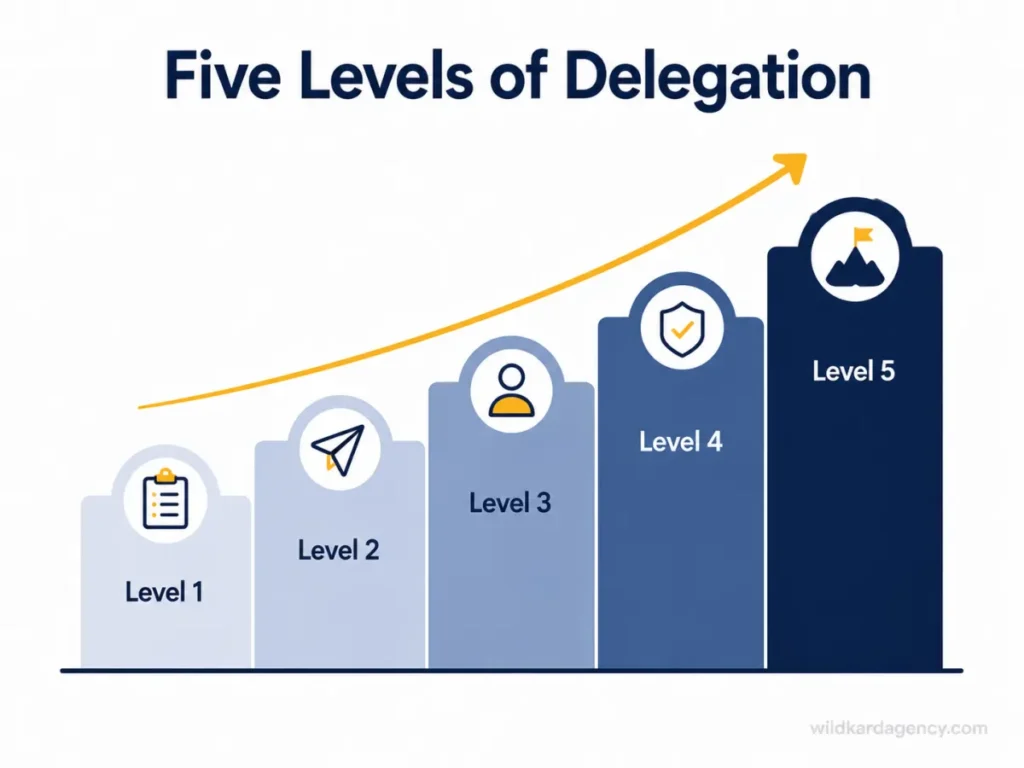
Delegation isn’t binary. Jim Schleckser’s widely-used framework breaks it into five levels, moving a task from close supervision to full ownership as trust is actually earned, not assumed.
| Level | What Happens | When to Use It |
| Level 1 | You demonstrate, they observe | Brand-new task, brand-new VA relationship |
| Level 2 | They propose, you approve | VA understands the task but hasn’t proven judgment on it yet |
| Level 3 | They act within a clear framework, report after | Task has been done correctly several times already |
| Level 4 | They act, you’re informed only if something’s unusual | Consistent track record on this specific task type |
| Level 5 | Full ownership, no reporting required | Reserved for the few tasks a VA has fully mastered over months |
Two things make this work. First, the level is attached to a specific task, not to the VA as a person; someone can be at Level 4 on scheduling and Level 1 on a brand-new responsibility they started last week. Second, movement between levels should be visible and named, not assumed. Telling a VA directly “you’ve earned Level 3 on this, report back after instead of before” turns oversight into a system instead of a running background worry.
Writing a Delegation Brief a VA Can Actually Follow
A task handed off in a Slack message with no structure is the single most common way delegation fails on day one. A workable brief answers three questions explicitly:
- Who: who owns this task, who approves it, and who gets looped in if something’s unusual.
- What: the specific outcome that defines success, not just the activity. “Draft three client follow-up emails matching the tone in the attached examples” is a brief. “Handle client follow-ups” is a hope.
- By when: an explicit deadline, even for recurring tasks. Undated delegation is one of the fastest ways a task quietly slips.
Attach the SOP recording from the previous section, state the current delegation level explicitly, and the brief is complete. Anything missing from those four pieces, who, what, by when, and the reference material, is exactly where ambiguity creeps back in.
Access and Security: What to Actually Hand Over
Delegation eventually means handing over logins, and doing it over email or a shared spreadsheet is one of the most common entry points for a breach at a small business. The fix is a password manager, 1Password, LastPass, or Bitwarden are the standard choices, which lets a VA use an account without ever seeing the actual password, and lets access be revoked instantly the moment a task ends or the relationship does.

Two more practices matter as much as the tool itself. First, the principle of least privilege: decide exactly what the VA needs for this specific task and grant only that, per Jam-Pot’s guide, calendar access for scheduling, not the whole inbox. Second, multi-factor authentication on every shared account, so a leaked password alone isn’t enough to get in.
For law firms and care agencies specifically, this isn’t optional polish. Client confidentiality and compliance obligations mean access boundaries need to be explicit and documented from day one, not worked out after something goes wrong. A short NDA and a written access log, who has access to what, and when it was granted or revoked, costs almost nothing to set up and removes an entire category of risk.
What to Never Delegate
Most delegation guides gesture vaguely at “high-stakes work” without naming it. Here’s the explicit boundary:
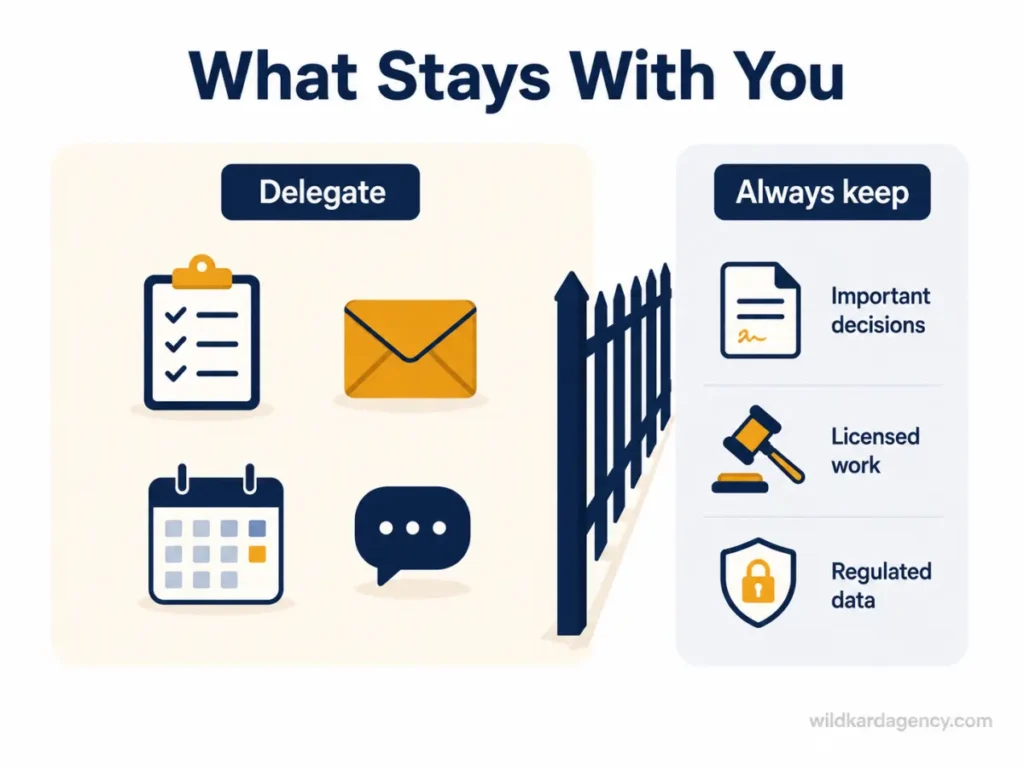
- Anything requiring a license or credential the VA doesn’t hold. Legal filings, clinical judgments, and licensed financial advice stay with a qualified person, always.
- Final client-facing decisions with real consequences. A VA can draft the response to a difficult client; the decision to send it, especially anywhere near a complaint or a legal question, should not be delegated away entirely.
- Anything touching regulated data without a documented access boundary. Client PII, health information, and financial records need the access controls from the previous section in place before the task is delegated, not after.
- Irreversible actions with no review step. Deleting records, sending a mass communication, or finalizing a payment should always have a checkpoint, no matter how routine the task has become.
Everything else is a candidate for delegation eventually. This list isn’t about permanent limits on a VA’s capability, it’s about which tasks need a human check-in built into the process itself, forever, regardless of how much trust has been earned.
Working Across Time Zones: Async by Default
Most VA relationships span time zones, which means most delegation has to work without real-time back-and-forth. The single highest-leverage practice here is a standing “if you get blocked, do X” rule, stated in advance for every task, according to Workew’s analysis of cross-timezone delegation. The default failure mode of async work is a silent stall while a VA waits hours for an answer to a question you could have anticipated.
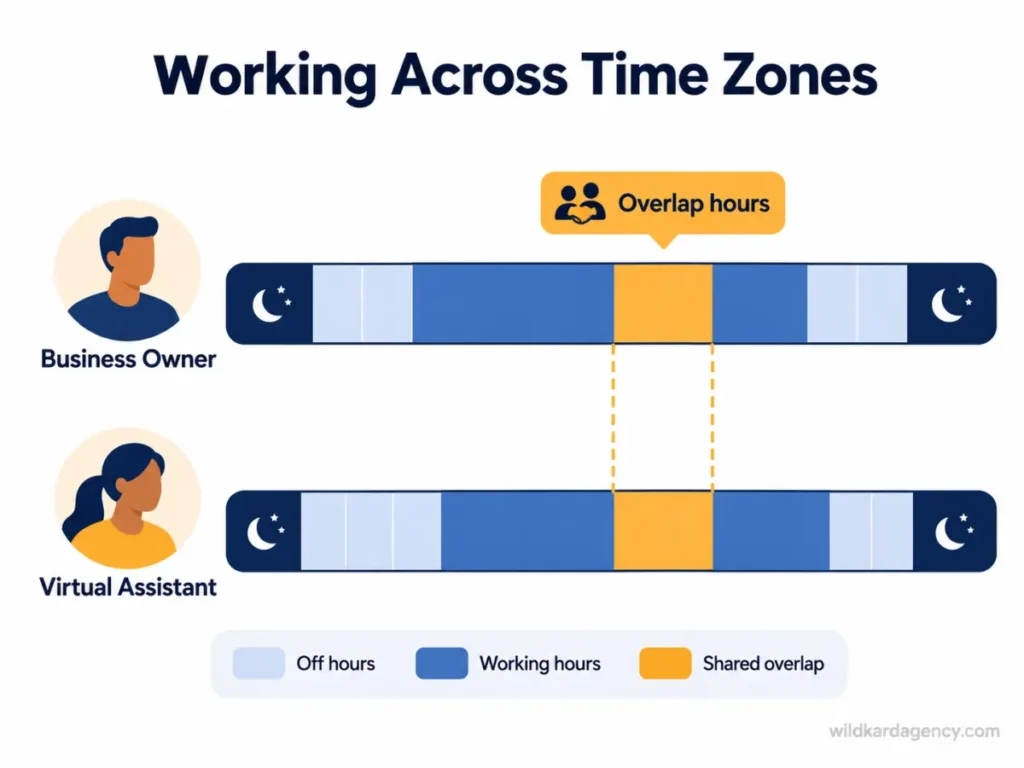
A short end-of-day report closes the loop from the other direction: what got done, what’s in progress, what’s blocked, and what’s planned next, landing in your inbox before your day starts, per VirtualAssistantVA’s async workflow guide. If there’s any daily overlap in working hours at all, protect that window specifically for the decisions that can’t wait, and let everything else run async.
Write every brief assuming the reader can’t ask a follow-up question for several hours. That single habit does more for cross-timezone delegation than any tool purchase.
The First 30 Days: A Trust-Building Timeline
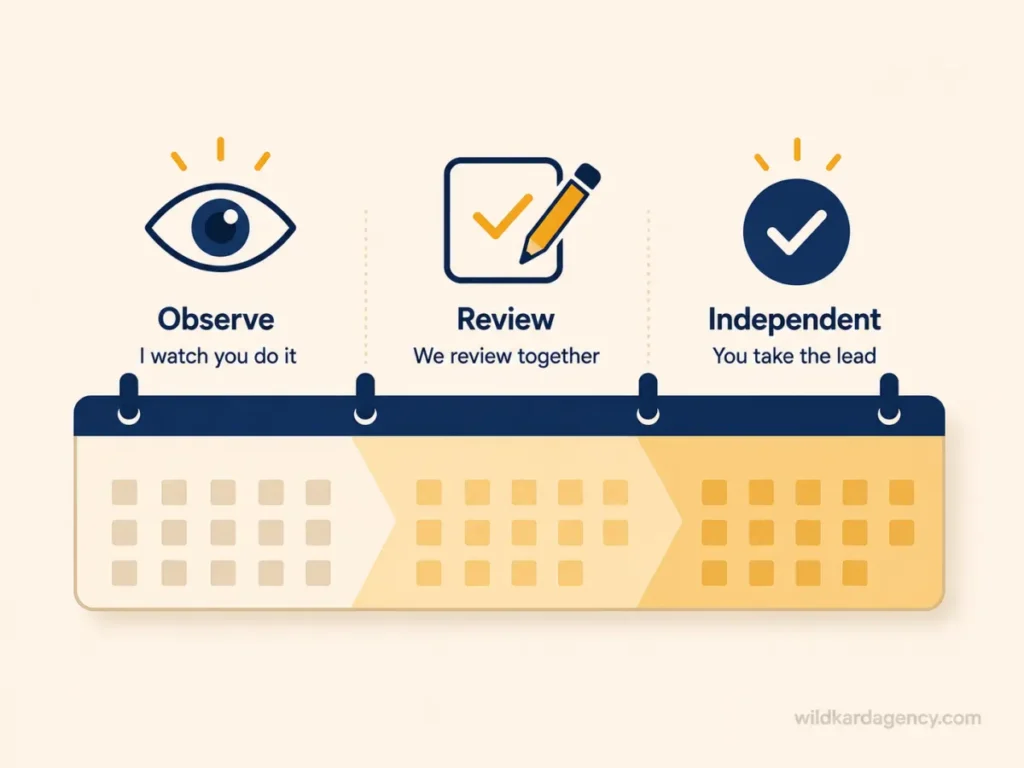
Week 1: Demonstrate
Record the SOP, walk through it together live once, and let the VA shadow the task at Level 1. The goal isn’t speed yet. It’s making sure the context actually transferred.
Weeks 2-3: Propose and Approve
The VA drafts or executes, you review before it goes out. This is where most of the real calibration happens: small corrections here prevent large ones later.
Week 4: Independent, With Checkpoints
The VA operates at Level 3 on this specific task: acting within the agreed framework and reporting after, not before. If nothing’s gone wrong by this point, that’s the signal to move it to Level 4.
Common Delegation Mistakes That Sabotage a VA Relationship
- Delegating the task but not the decision. If every small judgment call still has to come back to you, you haven’t actually delegated the work, only the typing.
- Over-specifying exactly how, instead of defining what. Dictating every step removes the ownership that makes a VA improve at the task over time.
- Delegating and then disappearing until the deadline. No check-in structure signals the task wasn’t important, and problems surface too late to fix cheaply.
- Explaining the same task from scratch every time. This is the exact cost an SOP eliminates permanently after one documentation session.
When It Goes Wrong: A Recovery Protocol
Something will eventually come back wrong. What happens in the next fifteen minutes matters more than the mistake itself.
- Contain it first, diagnose it second. Fix or pause whatever’s client-facing before investigating why it happened. A wrong email in a client’s inbox is more urgent than the root cause.
- Treat it as a documentation gap, not a competence problem. Ask what the brief or SOP was missing that let this happen, per the same context-first diagnosis covered earlier in this guide.
- Update the SOP immediately, while the gap is fresh. A mistake that updates the documentation prevents the same mistake happening twice. A mistake that just gets apologized for doesn’t.
- Don’t silently pull the whole task back in-house. One error doesn’t erase the delegation level a VA has already earned on everything else. Narrow the correction to the specific gap, not the whole relationship.
The Complete Checklist: How to Delegate to a Virtual Assistant
- Start with low-importance, high-familiarity tasks, not the hardest thing on your plate.
- Record a five-to-ten-minute SOP video before handing off any recurring task.
- Write every brief with who, what, and by when explicitly stated.
- Assign a delegation level per task, not per person, and name it out loud.
- Review outcomes on a set cadence rather than checking in on the process itself.
- Move tasks up a delegation level only after a real track record, not a single success.
- Treat every recurring correction as a sign the brief or SOP was missing something, not that the VA failed.
- Set up a password manager and grant access on a least-privilege basis before delegating anything touching client data.
- Write down what never gets delegated, licensed work, final client decisions, irreversible actions, before you need the list.
- Agree on a standing “if blocked, do X” rule for every task before working across time zones.
- Have a recovery protocol ready before the first mistake happens, not after.
Delegating effectively to a virtual assistant isn’t about learning to trust faster. It’s about building a specific, repeatable system: the right first tasks, a documented process instead of a repeated explanation, and a visible framework for how oversight loosens as it’s earned. Business owners who build that system stop being the bottleneck without ever actually losing control of the outcome.

Frequently Asked Questions
Q: How do I know which tasks to delegate to my VA first?
A: Start with tasks that are low-importance and where the VA already has some familiarity: inbox triage, scheduling, data entry, and routine follow-ups. Save high-importance, unfamiliar work, client-facing judgment calls or anything with legal exposure, until the VA has built a track record on smaller tasks.
Q: What’s the fastest way to document a task before delegating it?
A: Record your screen for five to ten minutes while doing the task, narrating why you make each choice, not just what you click. That recording becomes the SOP, and you only have to explain the task once instead of every time it comes up.
Q: How do I delegate without micromanaging every step?
A: Use a leveled system. Start new tasks at Level 1 (you demonstrate, they observe), move to Level 2 (they propose, you approve) once they understand it, then to Level 3 and beyond as they build a track record. Review outcomes on a set cadence instead of checking the process itself.
Q: My VA keeps getting small details wrong. Does that mean delegation isn’t working?
A: Usually it means the brief or SOP was missing context, not that the VA isn’t capable. Treat repeated corrections as a signal to tighten the documentation, not a reason to pull the task back in-house.
Q: How long does it take before I can fully trust a VA with a task?
A: There’s no fixed timeline; it depends on task complexity and how much context was documented upfront. A structured approach, demonstrate in week one, review before output in weeks two and three, independent with checkpoints by week four, gives most tasks a clear trust-building path within a month.
Q: Should I delegate the decision, or just the task?
A: Both, deliberately. Handing off a task without the authority to make its small judgment calls means every decision still routes back to you, which is why many owners feel like delegation “isn’t working” even after handing off real work.
Q: What’s the safest way to share passwords and account access with a VA?
A: Use a password manager like 1Password, LastPass, or Bitwarden so the VA can use an account without ever seeing the actual password, and access can be revoked instantly. Grant only what’s needed for the specific task, calendar access for scheduling, not the whole inbox, and require multi-factor authentication on shared accounts.
Q: What should I never delegate to a virtual assistant?
A: Anything requiring a license the VA doesn’t hold, final client-facing decisions with real consequences, work touching regulated data without a documented access boundary, and irreversible actions with no review step. Everything else can be delegated eventually; these need a permanent human checkpoint regardless of trust earned.
Q: How do I delegate effectively when my VA is in a different time zone?
A: Build workflows async by default. State a standing “if you get blocked, do X” rule for every task so a VA never silently stalls waiting on you, use end-of-day reports to close the loop, and protect any daily overlap in hours specifically for decisions that can’t wait.
If you’re ready to build this system with a real virtual assistant rather than figuring it out solo, get in touch and we’ll walk through what to hand off first.