
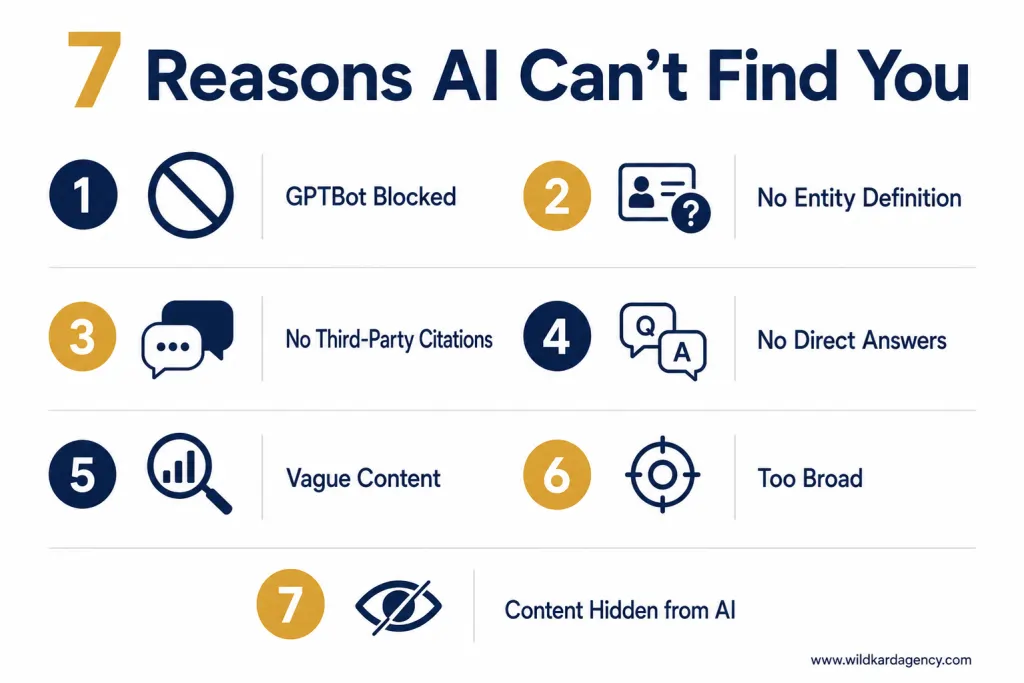
| If your business isn’t showing up in ChatGPT results, there are seven diagnosable reasons – and almost every business fails on at least three of them simultaneously. The most common: AI can’t access your website (GPTBot is blocked in your robots.txt), it can’t identify what your business is (no schema markup or entity definition), and there’s no independent third-party content talking about you (85% of AI citations come from sources other than your own website). Each of these problems has a specific fix. This article walks through all seven, with a quick self-check for each one so you can identify your gaps in under 10 minutes. |
Do this right now. Open ChatGPT and type: ‘What are the best virtual assistant services for small businesses?’ Or if you run a care agency: ‘Which care agencies provide administrative support in [your state]?’
If your business isn’t in the answer, you are not alone. SOCi’s 2026 Local Visibility Index, which audited over 350,000 business locations across 2,751 brands, found that 98.8% of local businesses are completely invisible in AI-generated recommendations. ChatGPT recommends just 1.2% of all business locations when users ask for suggestions.
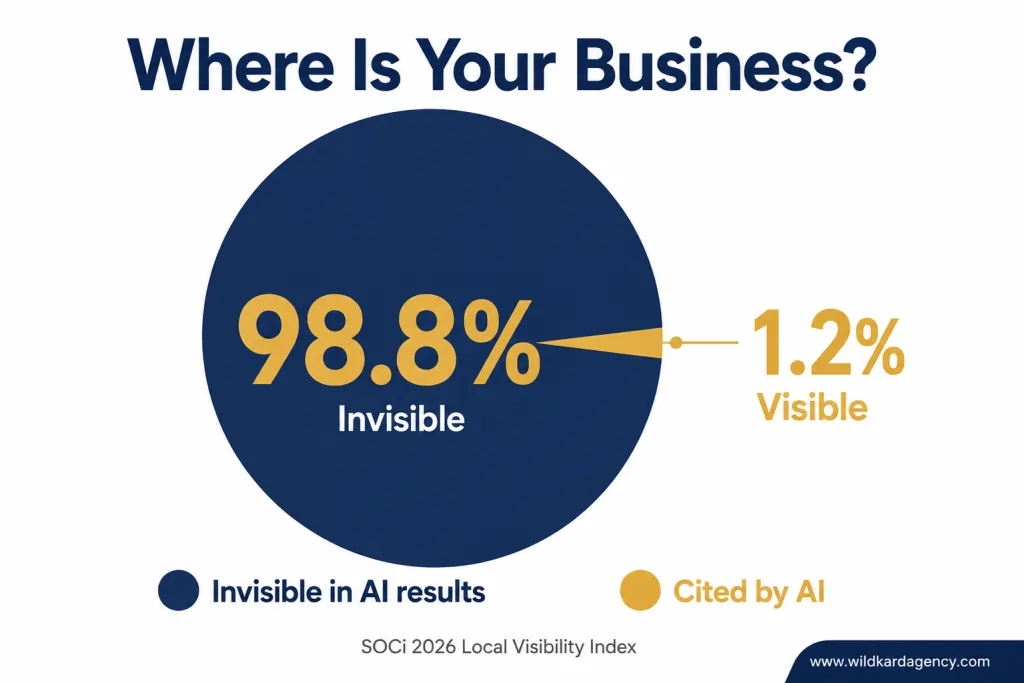
And here is the part that should concern you: Omni Eclipse’s 2026 AI Search Visibility Report, which analysed 356 page-one Google rankings, found that only 23% of businesses ranking on Google’s first page also appear in ChatGPT. Strong SEO is not the same as AI visibility. They are related but distinct – and right now, most businesses are optimized for one and invisible in the other.
This article is a diagnostic. Not a theory piece - you read what GEO is in the previous article. This one is about why your business isn't showing up in ChatGPT results, and what to do about each reason. There are seven. Work through them in order. Understanding the full picture of ChatGPT business visibility starts with knowing which of these gaps you have.
| What the data shows | Why it matters |
| 98.8% of local businesses are invisible in AI recommendations (SOCi, 2026) | If you are not actively building AI visibility, you are almost certainly in the 98.8%. |
| Only 23% of Google page-1 rankings also appear in ChatGPT (Omni Eclipse, 2026) | Your SEO ranking does not protect you from AI invisibility. |
| 58% of consumers use AI as their first stop when researching products or services (Bain & Company, 2025) | More than half your potential clients are starting their search in an AI tool. |
| 44% of consumers now prefer AI search for buying decisions over traditional search (McKinsey, 2025) | The preference shift is already mainstream, not early adopter. |
Sources: SOCi 2026 Local Visibility Index (350,000+ business locations); Omni Eclipse 2026 AI Search Visibility Report (356 businesses); Bain & Company 2025 consumer research; McKinsey New Front Door to the Internet.
Reason 1: ChatGPT Can’t Actually Find Your Website
ChatGPT uses a crawler called GPTBot to index web content. If your robots.txt file blocks GPTBot – which many websites do, often because a developer set it up that way years ago and nobody has checked since – ChatGPT literally cannot read your website. It cannot recommend a business it has never been able to access.
This is the most straightforward reason a business isn’t showing up in ChatGPT results, and the most easily missed because nothing on your end signals that it’s happening. Your website looks fine. Google still indexes you. But GPTBot has been blocked at the door the whole time.
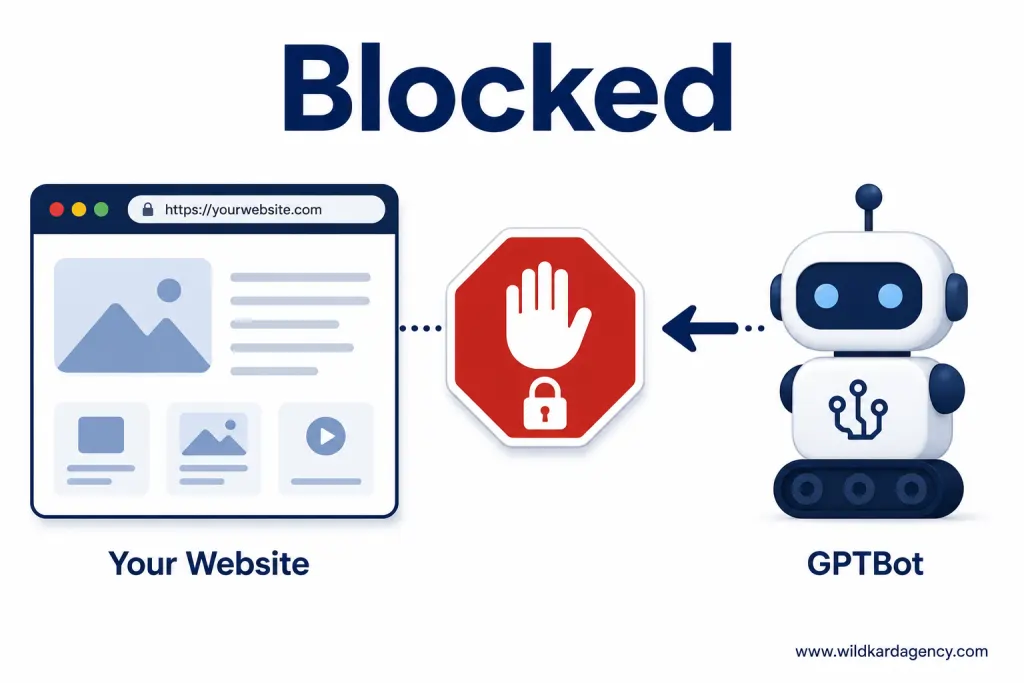
| QUICK CHECK – Is GPTBot blocked?Do this now: Go to yourwebsite.com/robots.txt in your browser. Look for any line that says ‘User-agent: GPTBot’ followed by ‘Disallow: /’. If you see it, GPTBot is blocked.The fix: Remove the GPTBot disallow rule from your robots.txt file, or add ‘User-agent: GPTBot’ with ‘Allow: /’ to explicitly permit access. Ask your web developer if you are unsure where this file is. |
Reason 2: AI Doesn’t Know What Your Business Actually Is
AI systems build recommendations by identifying entities – their structured understanding of what a business is, what it does, who it serves, and where it operates. Without a clear entity definition in your website’s code, ChatGPT reads your website the same way it reads a random blog post: as unstructured text with no verified organization behind it.
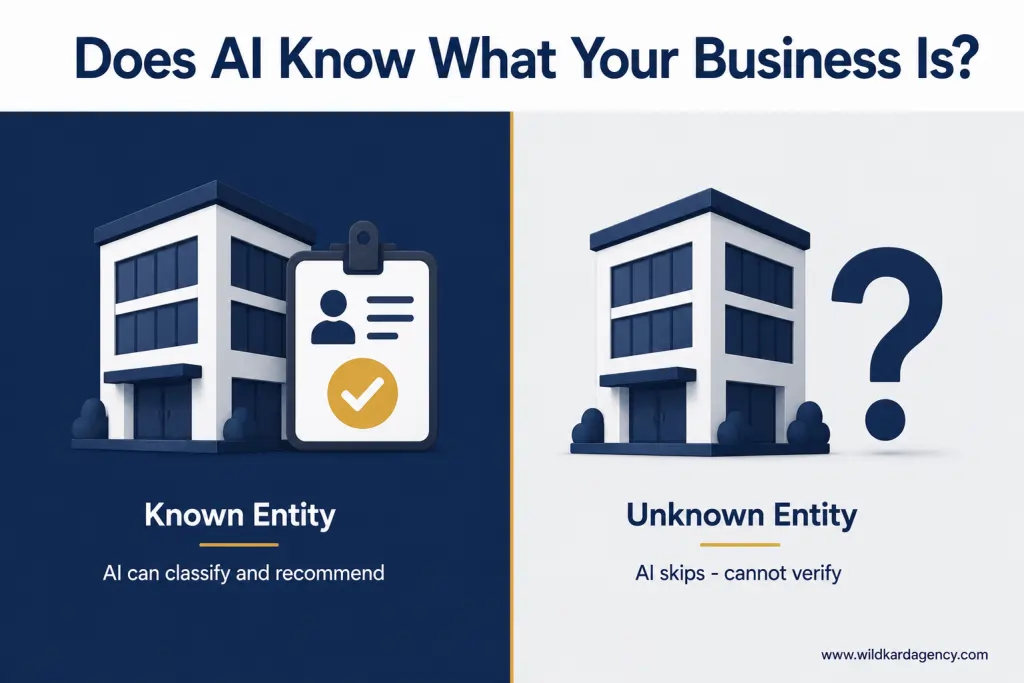
The structural fix is schema markup: JSON-LD code in your website’s source that explicitly tells AI what your business is. Research from Backlinko found that 75% of AI models prefer sites with structured data for information extraction. Without schema, you are asking AI to guess your entity from context clues. It often guesses wrong, or does not guess at all.
Beyond schema, your entity definition needs to be consistent across the web. Your business name, description, address, and service category should read identically on your website, your Google Business Profile, your LinkedIn page, and any directories where you are listed. Inconsistency signals unreliability to AI systems.
| QUICK CHECK – Do you have schema markup?Do this now: Right-click your homepage and select ‘View Page Source’. Use Ctrl+F to search for ‘application/ld+json’. If nothing appears, you have no schema markup.The fix: Implement Organization schema on your homepage, Service schema on each service page, and Article schema on every blog post. This is a one-time developer task that typically takes a few hours. Use Google’s Rich Results Test tool to verify it is working. |
Reason 3: Nobody Else on the Internet Is Talking About You
This is the most common reason a business isn’t showing up in ChatGPT results, and the hardest to fix quickly. Research by AI visibility consultant Lesli Rose found that roughly 85% of AI citations come from third-party sources – industry roundups, comparison articles, directory listings, and independent reviews – not from the business’s own website. When ChatGPT recommends a business, it is almost always pulling from what others have said about that business, not what the business says about itself.
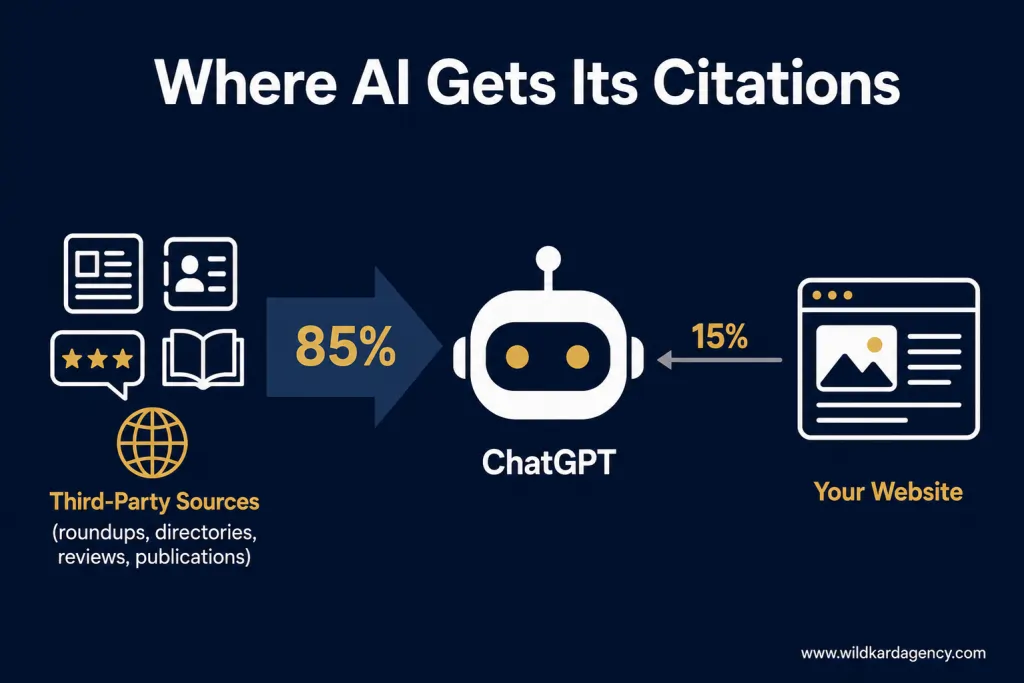
Your own website, no matter how well-written, is a single source. AI wants corroboration. It wants to see your business mentioned consistently across multiple independent sources before it feels confident enough to recommend you. Yext’s 2025 AI citation study, which analysed 6.8 million AI citations, found that 42% of AI citations come from business listings – Google Business Profile, industry directories, and local listings – confirming that structured business directory data is a significant AI visibility input.
| QUICK CHECK – How many third-party mentions do you have?Do this now: Search your business name in Google. Count how many results are from websites other than your own. Then search ‘[your service category] + [your location]’ and see if your business appears in any roundup articles, directories, or comparison posts.The fix: Claim and fully complete your Google Business Profile if you have not. Get listed on relevant industry directories. Reach out to blogs and industry publications for inclusion in roundup articles. Each independent mention is a citation signal AI uses to build confidence in recommending you. |
Reason 4: Your Content Doesn’t Answer Questions the Way AI Looks For Them
ChatGPT is built to answer questions. When it receives a query, it searches its knowledge for content that directly answers that query – not content that is tangentially related to it. If your website and blog content is structured as a description of your services rather than as direct answers to the questions your potential clients are asking, AI will skip your content and find a source that answers the question more directly.
The solution is structural. Every article needs a Direct Answer Block at the top: 2-3 sentences that answer the core question before anything else. Every service page needs a FAQ section with natural-language questions and concise answers under 80 words each. A 12-week AI visibility experiment published in Search Engine Journal found that a brand-new business with zero prior web presence appeared in 16.5% of relevant AI responses within just 6 weeks by focusing on answer-first content structure. The business had no backlinks, no press coverage, and no prior history.
| QUICK CHECK – Does your content answer questions directly?Do this now: Open your best-performing blog post or service page. Read the first paragraph. Does it directly answer the question implied by the page title, or does it warm up with background context first?The fix: Add a Direct Answer Block at the top of every article and service page. Write a FAQ section for each page with 4-5 questions your clients actually ask. Structure headings as questions (e.g. ‘What does a virtual assistant handle for a care agency?’) rather than topic labels (e.g. ‘Our Services’). |
Reason 5: You Use Vague Language Instead of Specific, Named Facts
AI systems evaluate content for credibility before deciding whether to cite it. Vague language – ‘many businesses struggle with admin,’ ‘studies show,’ ‘significant time savings’ – reads as low-credibility to AI because it cannot be verified or extracted as a quotable fact. Specific, named statistics with attributed sources read as high-credibility because they are independently verifiable.
The Princeton/Georgia Tech GEO research published at KDD 2024 found that adding verifiable statistics with named sources was the single most effective GEO strategy, improving AI citation rates by up to 40% across tested queries. The contrast is specific: ‘many businesses waste time on admin’ versus ‘a 2024 Slack/Salesforce survey of 2,000 US small business owners found the average owner loses 1.5 productive hours daily to preventable tasks.’ The second sentence gets cited. The first does not.
| QUICK CHECK – How specific is your content?Do this now: Read the last article you published. Count how many specific statistics appear with a named source attached. Count how many general claims appear without a source.The fix: Replace general claims with specific, sourced statistics wherever possible. Link to the source inline. If you cannot find a specific stat to replace a vague claim, remove the claim entirely. Unverified assertions actively reduce AI citation confidence. |
Reason 6: You Are Positioned Too Broadly for AI to Classify You
AI systems classify businesses before recommending them. When someone asks ‘which agency provides administrative support for care organizations?’, ChatGPT looks for businesses it can confidently classify in that specific category. Businesses with broad, undifferentiated positioning – ‘we help all businesses with all their digital needs’ – are harder for AI to classify confidently.
Omni Eclipse’s 2026 AI Search Visibility Report found a consistent pattern in the businesses that appeared in ChatGPT results: specific niche positioning consistently outperformed broad service positioning. AI favoured ‘buyers agent’ over ‘real estate agent’. ‘Cosmetic clinic’ over ‘general practice’. ‘Administrative support for care agencies’ over ‘virtual assistant services.’ The more specifically your positioning matches the query, the more confidently AI can classify and recommend you.
For WildKard, this means making the care agency support service explicitly named, specifically described, and prominently positioned – not buried as one of five service lines. For any business, it means asking: what is the most specific description of what we do that still captures the full value we provide?
| QUICK CHECK – How specific is your positioning?Do this now: Ask someone unfamiliar with your business to read your homepage headline and first paragraph. Ask them: ‘Who is this for?’ and ‘What specifically do they do?’ If the answers are vague, AI is having the same difficulty.The fix: Refine your positioning on your homepage and service pages to be as specific as possible about who you serve and what you do for them. Create dedicated service pages for your most specific offerings rather than grouping everything under a broad services page. |
Reason 7: Your Most Important Content Is Invisible to AI Crawlers
AI crawlers can only read plain HTML text. Content that lives inside images, JavaScript-rendered sliders, PDFs, video transcripts, or Flash elements is invisible to them. If your key service descriptions, your credentials, or your primary selling points exist only in a hero image or an animated homepage section, AI has never seen any of it.
This is a common problem for websites built primarily for visual impact. A homepage that looks impressive in a browser may be almost empty from an AI crawler’s perspective. Search Engine Journal’s GEO experiment noted that making a site machine-readable was one of the first and most impactful actions taken – specifically ensuring that key positioning, service descriptions, and credentials appeared as plain HTML text, not embedded in visual elements.
| QUICK CHECK – Can AI read your key content?Do this now: Right-click your homepage and select ‘View Page Source’. Search for key phrases from your homepage – your headline, your service description, your main value proposition. If you cannot find them in the source code, AI cannot read them.The fix: Rewrite your most important content as plain HTML text, not images or JavaScript-rendered elements. Every key claim, credential, service description, and positioning statement should be readable in your page source. |
| Not sure which of these 7 reasons applies to your business? Book a free 15-minute call with WildKard – we’ll tell you exactly which gaps are keeping you out of AI results. |
Why Most Businesses Are Invisible in AI Search: The Compounding Problem
Here is the harder truth. Very few businesses fail on just one of these reasons. Most businesses that are invisible in AI search fail on three, four, or five simultaneously. Every business invisible in AI search recommendations has at least one of these gaps – and usually several. The problems compound: schema markup without allowed crawlers means AI cannot reach the schema. Third-party citations without a clear entity definition mean AI cannot connect those citations to a recognized business. Answer-first content without schema means AI can extract information but cannot verify who it came from. ChatGPT business visibility requires multiple overlapping signals working together – not one in isolation.
ChatGPT’s recommendation logic requires multiple overlapping confidence signals before it will name a business. It needs to be able to find you (GPTBot access), identify you (entity definition and schema), verify you externally (third-party citations), and extract a direct, credible answer from your content (structured Q&A format with named statistics). If even two of these are missing, the bar for recommendation is rarely cleared.
The businesses that appear consistently in AI-generated recommendations are not necessarily the largest or the most established. They are the ones that have – often without realizing it – built enough overlapping signals for AI to recommend them confidently. Building those signals deliberately is what GEO is about.
If you want the full framework for what GEO actually involves, start with our explanation of what generative engine optimization is and why your business needs it. If you want a practical understanding of how this applies to virtual assistant and operational support services specifically, see the complete guide to virtual assistance for business owners.
Care Agencies: Why AI Invisibility Has a Specific Cost in Your Sector
For care agencies and social services organizations, the AI visibility gap has a consequence that goes beyond marketing. Families searching for disability support providers, social workers researching care placements, and professionals seeking referral options are all increasingly starting those searches in AI tools. How to appear in AI search results is no longer an optional question for care agencies – it is an operational one.
A care agency that is invisible in AI-generated results is not just missing a marketing channel. It is potentially failing to reach the families who need it most at exactly the moment they are making a decision. The agency that appears in the answer gets the first call. The one that does not exist in AI search does not get considered.
Care agencies typically fail on reasons 2, 3, and 6 simultaneously: no schema markup, almost no third-party citations beyond their initial directory listing, and positioning that says ‘we provide care services’ rather than specifically describing who they serve and what their operational support looks like.
We cover the operational pressures that compound this visibility gap in our article on why DSP burnout often starts with admin, not care delivery. At WildKard, our content and GEO work for care organizations specifically addresses all seven reasons above, structured around the care sector’s unique search context.
How to Get Your Business on ChatGPT Results: Where to Start
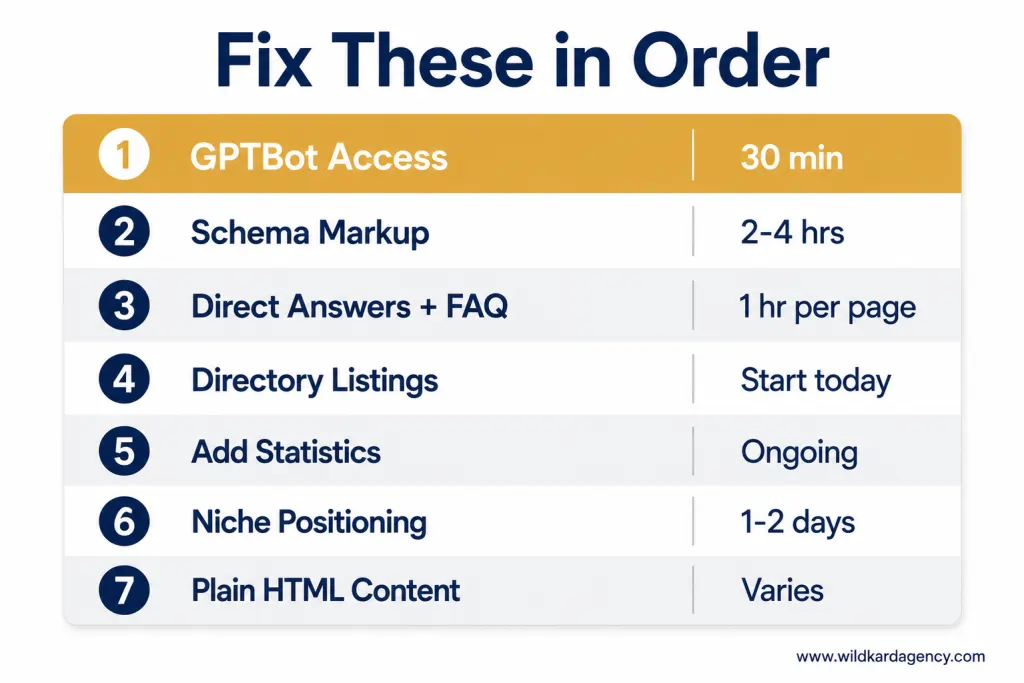
The question of how to get business on ChatGPT and visible in AI search results is answered the same way every time: fix the foundational signals first, then build outward. You do not need to address all seven reasons at once. Fix them in priority order.
| Priority | Reason | Why First | Estimated Fix Time |
| 1 | GPTBot access (robots.txt) | If AI can’t find you, nothing else matters. | 30 minutes |
| 2 | Schema markup | Foundation for everything. AI citation without entity recognition is impossible. | 2-4 hours with developer |
| 3 | Direct Answer Blocks + FAQ sections | Fastest content fix. Adds immediately citable structure to existing pages. | 1 hour per page |
| 4 | Third-party citations | Build steadily. Start with Google Business Profile and 3-5 industry directories. | Ongoing – start today |
| 5 | Named statistics in content | Update existing articles first. Then write new content this way from the start. | Ongoing |
| 6 | Niche positioning | Review and update homepage and service page copy. | 1-2 days |
| 7 | Plain HTML for key content | Audit your most important pages first. | Varies by site build |
– FREQUENTLY ASKED QUESTIONS –
Why is my business not showing up in ChatGPT results even though I rank well on Google?
Because ChatGPT visibility and Google ranking depend on different signals. Google’s algorithm prioritizes keyword relevance, backlinks, and on-page optimization. ChatGPT’s recommendation logic prioritizes entity clarity (does it know what your business is?), third-party citations (do independent sources confirm your authority?), and structured answer content (can it extract a direct, quotable answer from your site?). A 2026 study found that only 23% of Google page-1 rankings also appeared in ChatGPT recommendations. Strong traditional SEO does not guarantee AI visibility.
How do I get my business to show up on ChatGPT?
Start with the seven-step priority order in this article. Fix GPTBot access first (check your robots.txt file for any disallow rule targeting GPTBot). Then implement Organization, Service, and Article schema markup on your website. Then restructure your content to lead with direct answers and include FAQ sections. Then build third-party citation presence through directories and industry publications. Each step builds on the previous one. Most businesses see initial AI visibility improvements within 4-8 weeks of addressing the foundational issues.
Does being on Google Business Profile help with ChatGPT visibility?
Yes, significantly. Yext’s 2025 analysis of 6.8 million AI citations found that 42% of citations come from business listings – including Google Business Profile, industry directories, and local listings. A complete, actively maintained Google Business Profile with accurate service descriptions, consistent contact information, and regular reviews is one of the most accessible and high-impact AI citation signals a business can build. If you do not have a fully claimed and completed Google Business Profile, that is your first action.
How long does it take to start appearing in ChatGPT results?
It depends on which of the seven reasons are causing your invisibility. Fixing GPTBot access can produce results within weeks as ChatGPT re-crawls your site. Schema markup improvements can start influencing AI citation signals within one to two months. Building third-party citation presence is slower – expect three to six months of consistent effort before meaningful citation authority builds. The businesses that see the fastest initial results focus on fixing access and content structure first, then build citation presence over time while maintaining both.
Can a new business appear in ChatGPT recommendations?
Yes. A Search Engine Journal experiment tracked a brand-new business from zero web presence. Using answer-first content structure, schema markup, and consistent entity signals, the business appeared in 16.5% of relevant AI responses within six weeks. Age and existing authority matter less than most people assume. What matters to AI is whether it can find you, identify you, and extract a credible answer from your content. A new business that structures its content correctly from the start can outpace an established competitor that has not addressed these signals.