

| DSP burnout is most commonly attributed to low pay and emotional demands. But a significant and under-documented driver is administrative overload – shift notes, incident reports, scheduling coordination, and data entry that can consume one to two hours of every shift. When Direct Support Professionals spend meaningful portions of each shift on paperwork instead of people, the cumulative result is fatigue, disengagement, and turnover. The National Core Indicators reports a national DSP turnover ratio of 40.9% (2023 data). A 2023 peer-reviewed study in BMC Geriatrics directly links administrative burden in care settings to emotional exhaustion and intention to leave the profession. |
The Burnout Conversation Is Missing Its Biggest Clue
Ask a room full of care agency directors what’s driving DSP burnout and you’ll hear the same answers every time: low pay, emotionally demanding work, long hours, staff feeling undervalued. All of that is real. But there’s a consistent contributor that almost never makes it into the room.
It’s the paperwork. The shift notes, the incident reports, the scheduling calls, the handoff logs, the medication administration records, the compliance checklists that have multiplied across every regulatory cycle. None of these tasks are illegitimate. But together, in a role already carrying significant emotional weight, they’ve become a hidden engine of DSP burnout that the sector has been slow to name directly.
This article puts numbers to the problem. It draws on data from the National Core Indicators, ANCOR, JMIR Human Factors, and peer-reviewed research from the University of Basel – because understanding the problem is the first step to addressing it, and most agencies are still underestimating its scale.
The Scale of the Crisis – by the Numbers
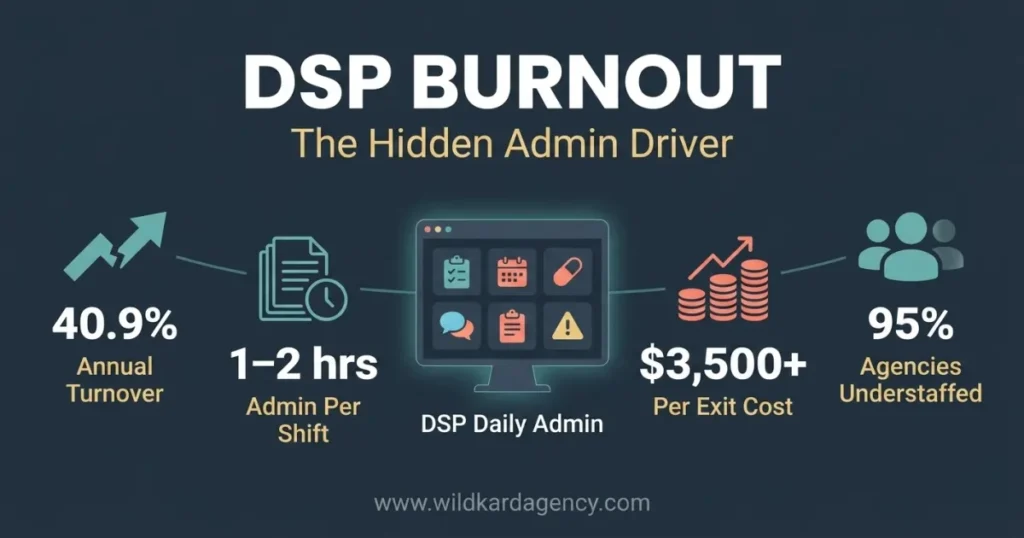
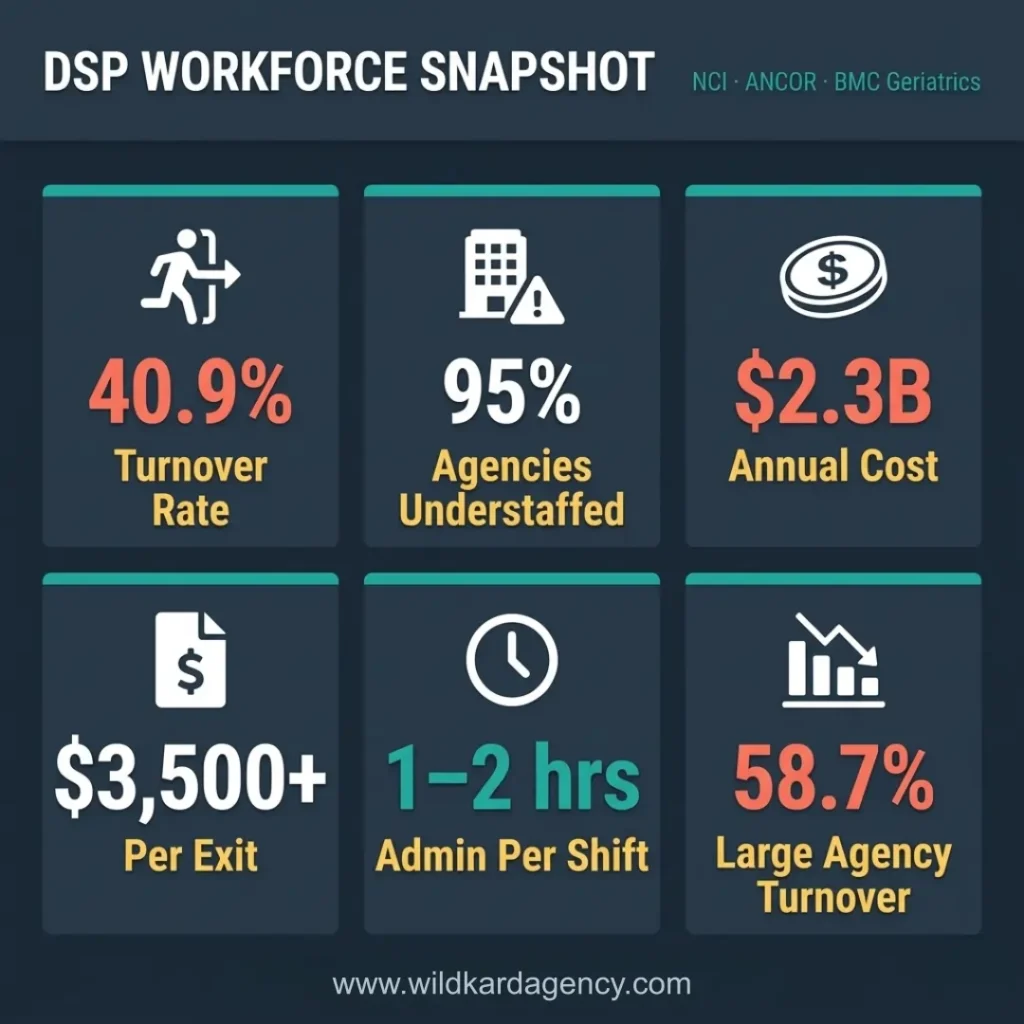
| 40.9% | National DSP turnover ratio in 2023, based on 26 states (NCI IDD State of the Workforce Survey, 2023) |
| ~50% | Turnover rate cited by the 2025 Relias/ANCOR DSP Survey Report – with some agencies losing 1-in-8 DSPs at any given time |
| 51.3% | Peak national turnover recorded in NCI 2018 data – confirming this crisis long predates the pandemic |
| $2.3B | Estimated national annual cost of DSP turnover in 2021 (Utah DSP Issue Brief 2024) |
| 95% | of IDD provider organisations reported moderate or severe staffing shortages in 2023 (ANCOR State of the Workforce Crisis 2023) |
| 58.7% | Median turnover ratio at agencies employing more than 50 DSPs – vs 39.7% at mid-sized agencies (NCI 2022 Workforce Survey) |
The 2025 Relias/ANCOR DSP Survey Report (515 DSPs surveyed nationally) found that 78% of DSPs are more likely to stay if career advancement programmes are offered – an increase from 2023. The appetite to stay is there. The structural conditions that enable it often aren’t.
What a DSP’s Administrative Workload Actually Looks Like
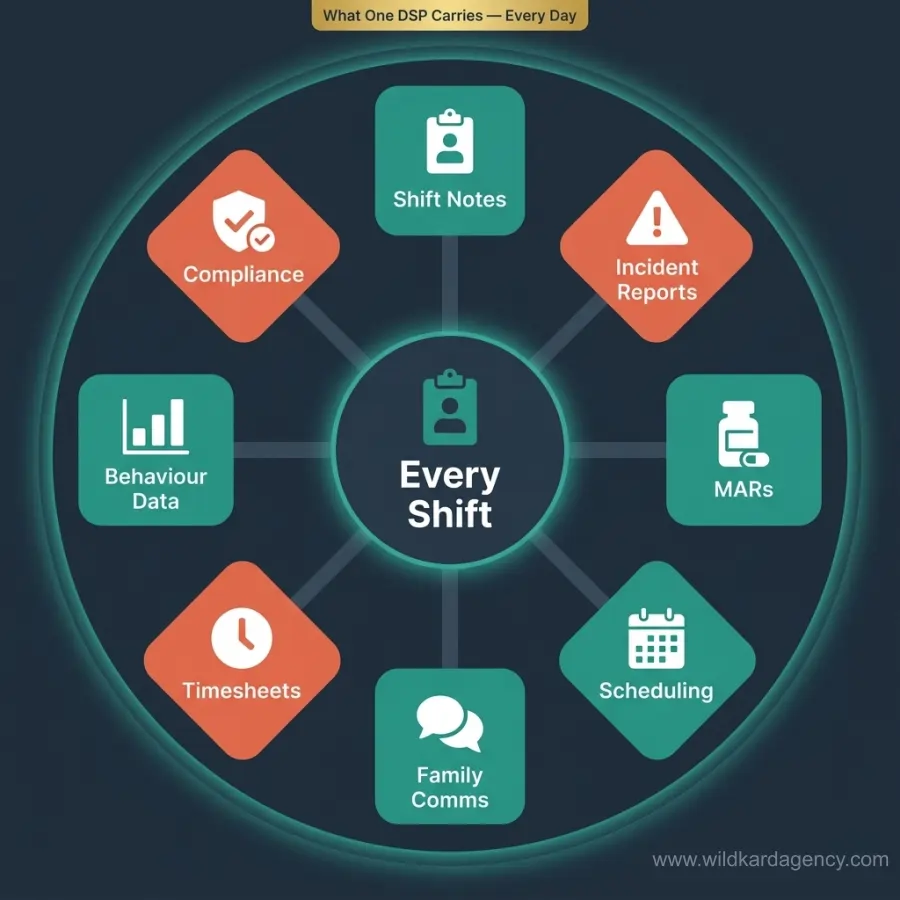
The administrative layer of a DSP’s role is extensive and largely invisible in workforce planning conversations. Each task seems minor in isolation. Together, the accumulation is the problem. A typical shift for a full-time DSP includes some combination of:
- Shift notes and daily progress documentation (often written from memory, end of shift)
- Incident report preparation and submission
- Medication Administration Records (MARs)
- Scheduling confirmations and shift cover coordination
- Communication logs for families, case managers, and care teams
- Timesheet completion and payroll corrections
- Behavioural data collection and programme tracking forms
- Handoff notes for incoming staff
- Internal compliance checklists and audit preparation materials
A 2024 study published in JMIR Human Factors examined digital tools designed to reduce DSP documentation burden. The research found that end-of-shift documentation was a significant, recurring source of friction – with DSPs writing detailed reports from memory after physically and emotionally demanding shifts, a process prone to omissions, inaccuracy, and meaningful time cost.
To put the displacement effect in context: a landmark observational study published in the Western Journal of Emergency Medicine (2020) found that for physicians, every additional minute spent on documentation was associated with 0.48 fewer minutes of patient care. The relationship is almost 1:1. In DSP settings – where documentation happens manually, at end of shift, under fatigue – the dynamic is likely similar, and possibly worse.
The Research Link Between Admin Burden and DSP Burnout
The most rigorous direct evidence on this connection comes from a 2023 peer-reviewed study in BMC Geriatrics (Ausserhofer et al., University of Basel). Conducted across multiple Swiss nursing homes, the study examined the relationship between administrative burden and four care worker outcomes:
- Job dissatisfaction
- Emotional exhaustion
- Intention to leave the current job
- Intention to leave the profession entirely
The study found statistically significant associations between high administrative burden and all four outcomes. Care workers who performed a higher proportion of administrative tasks reported greater emotional exhaustion and were more likely to express intention to leave – both the job and the profession.
The researchers framed this as a structural problem: the issue wasn’t that any single administrative task was overwhelming. It was that the cumulative volume of non-care tasks pulled workers away from the caregiving purpose that motivated their entry into the field. The formal term for this is role-person mismatch. In IDD care settings, it is chronic and compounding.
This is corroborated by a 2022 PMC-indexed study by Hall et al. (University of Minnesota Institute on Community Integration), which found administrative overload was consistently cited by both DSPs and supervisors as a source of unsustainable workload pressure. One supervisor quoted directly: “I am on-call 24/7 without any additional help or compensation” – while simultaneously managing documentation, training, scheduling, and compliance requirements.
Why Directors Often Can’t See It
The administrative burden on DSPs is genuinely difficult to observe from a director’s desk. It doesn’t surface in incident reports. It rarely comes up in formal supervision. And because each task takes only minutes, it doesn’t register as a systemic problem until the aggregate shows up in turnover data – by which point the cost has already been paid.
There’s also a professional culture element. DSPs entering the field are trained to view documentation as part of the role. Raising concerns about paperwork feels trivial against the backdrop of the much harder emotional labour they’re also carrying. So it goes unmentioned – until someone leaves.
The 2025 Relias/ANCOR DSP Survey found that fewer than 55% of DSPs feel they have a safe way to provide feedback about their supervisors. If feedback channels are inadequate for direct supervision concerns, they’re almost certainly inadequate for systemic workload feedback about documentation and administrative load.
The Financial Cost of Getting This Wrong
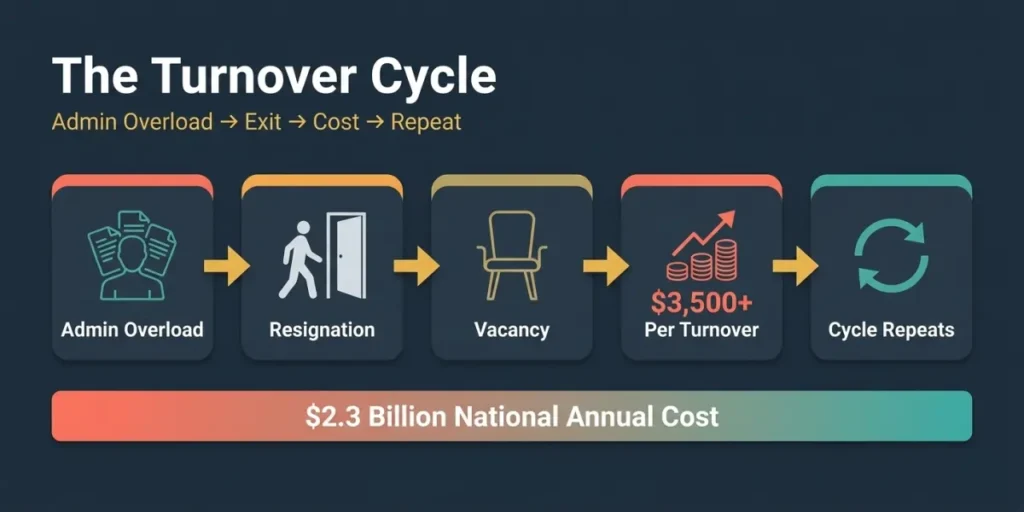
| $3,500+ | Estimated cost per DSP turnover event in a care setting – including separation, recruitment, and training (Institute on Community Integration / Impact Feature Issue on DSP Workforce Development) |
| 18% | of frontline supervisor time consumed by managing and training exiting and new DSPs – a hidden internal cost rarely quantified (same study) |
| $2.3B | Estimated national annual cost of DSP turnover in 2021 (Utah DSP Issue Brief 2024) – likely higher today given sector-wide wage increases |
These numbers only capture direct financial costs. They don’t capture the overtime paid to cover vacant shifts, the disruption to individuals receiving support, the institutional relationship knowledge that leaves with every resignation, or the compounding strain on the DSPs who stay.
According to ANCOR’s 2025 workforce data, 59% of providers intend to delay launching new programmes or services unless staffing improves. This is not just a staffing problem. It is a sustainability problem with an administrative dimension that has been consistently under-addressed.
The 90-Day Problem: When DSP Burnout Begins Before Anyone Notices
One of the most important and least-discussed findings in DSP workforce research is the early separation rate – DSPs who leave within the first 90 days. This cohort disproportionately influences annual turnover ratios, and the causes of early departure are structurally different from long-tenure attrition.
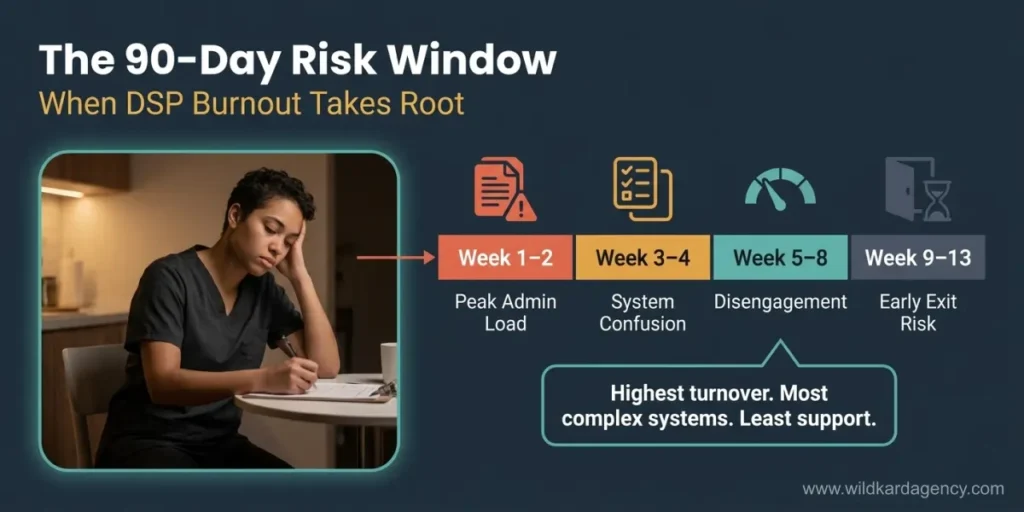
New DSPs arrive with expectations shaped by interviews and training. The job description said person-centred support work. The first week of actual shifts introduces an administrative layer they weren’t fully prepared for: new documentation systems, unfamiliar compliance requirements, handoff protocols, and the expectation that they produce detailed end-of-shift reports after emotionally demanding eight-hour shifts.
The NCI data confirms that turnover ratios are highest at larger agencies – precisely the organisations where documentation systems are most complex. For a new DSP navigating an unfamiliar environment, the documentation burden is at its peak in exactly the period when they are least equipped to absorb it. The administrative experience of onboarding is shaping retention outcomes before the agency has had a chance to demonstrate its culture.
A Gap in the Data – and Why It Matters
There is currently no large-scale, longitudinal study that precisely quantifies the number of hours DSPs spend on non-care administrative tasks per shift across diverse agency settings. The JMIR Human Factors study (2024) identified documentation burden as a significant recurring problem. The BMC Geriatrics study (2023) confirmed the association between administrative burden and burnout outcomes in care settings. But a precise “hours per shift” figure for DSPs specifically does not yet exist in the published literature.
This is itself an important finding. The sector is attempting to manage a workforce crisis without fully measuring one of its contributing factors. The agencies that do measure it – through shift time-studies, structured observation, or self-reported time logs – are consistently surprised by what they find. The number is almost always higher than leadership estimates, and more variable across sites and supervisors than most directors assume.
Frequently Asked Questions
Is admin burden really a significant factor in DSP burnout compared to pay and emotional demands?
All three factors interact. Research from BMC Geriatrics (2023) and the University of Minnesota ICI (2022) confirms administrative burden is independently associated with emotional exhaustion and intention to leave. DSPs can sustain difficult emotional work if the supporting operational environment feels manageable. When the administrative layer compounds the emotional one, the cumulative load becomes unsustainable faster.
How do we measure how much admin our DSPs are actually carrying?
The most reliable method is a structured time-study: ask a cross-section of DSPs to log how they spend each hour across one week, with categories for care delivery versus administrative tasks, without any judgment attached. Most agencies that run this exercise find the distribution is different from what leadership expected – and more variable by site and supervisor than assumed.
Our agency uses an electronic health record system. Doesn’t that reduce the documentation burden?
EHR systems can streamline some aspects of documentation. But research on EHR burden across healthcare settings consistently shows that technology adoption often shifts rather than reduces documentation load – with care workers adapting their workflows to fit system requirements rather than the reverse. The burden changes form; it doesn’t always decrease.
Are larger agencies more or less affected than smaller ones?
According to NCI 2022 Workforce Survey data, agencies employing more than 50 DSPs have a median turnover ratio of 58.7%, compared to 39.7% at mid-sized agencies. Larger agencies typically have more complex documentation systems and more sites. Scale compounds the administrative problem more often than it solves it.
What’s the first step for a director who wants to address this?
Measure it first. Before any process change, understand the current state: how much time per shift goes to non-care administrative tasks, which tasks are most time-consuming, and where variation is highest across your sites. That data then shapes which interventions – whether process redesign, delegation, or operational support – will have the most impact. Delegation is often the fastest lever, and it does not have to mean an immediate care-side hire – many agencies start by shifting non-regulated admin work to a remote operational support resource. For a broader look at how that handoff works in practice, see our complete guide to virtual assistance for business owners, which covers what to delegate first and how a 30-day handoff typically works.
WildKard works with care agencies to take the non-regulated administrative load off DSPs and operations teams, so your staff can get back to the work they signed up for. If you’d like to talk through what that could look like for your agency, get in touch with us – no pressure, just a conversation about where the admin is piling up and what could change.
| WildKard’s team includes professionals who have worked directly alongside DSP staff and house managers in care settings. We’ve seen shift notes written in car parks at the end of a long day. We’ve seen supervisors completing onboarding paperwork at midnight because there was no one else to do it. The data in this article reflects what we observed before we had the numbers to name it. That operational background informs every conversation we have with care agency directors – and it’s why we scope our support strictly within the non-regulated administrative layer, never touching the individuals being served. |