Every ranking factor, timeline, and AI-citation signal behind how to rank on Google’s first page as a small business in 2026, with a source for each claim.
You’ve probably searched your own business name, or the exact service you sell, and watched two or three competitors show up before you do. That’s not bad luck.
This guide breaks down how to rank on Google’s first page as a small business without guessing at the timeline, without pretending backlinks don’t matter, and without hiding the technical work behind vague advice. Ranking on Google’s first page generally takes three to six months of consistent, correctly targeted SEO work, though highly competitive keywords can push that to nine months or longer, according to Semrush’s study of 28,000 new websites.
The businesses that get there fastest treat ranking as three interacting systems rather than a checklist: a technical foundation, content that actually answers the query, and enough authority signals for Google to trust the page. Skip any one of them and the other two won’t be enough. This guide covers all three in the depth a small business owner actually needs to make decisions, not just recognize buzzwords.
Why “First Page” Isn’t What It Used to Be
Ranking used to mean ten blue links and a scroll. That’s not the page most searchers see anymore. AI Overviews now appear on roughly 31% of all search results pages, according to a GrowthSRC analysis of more than 200,000 keywords, and when one shows up, it pushes the first organic result further down the screen. Getting a page to rank in position one still matters. It’s just no longer the only prize on the page.
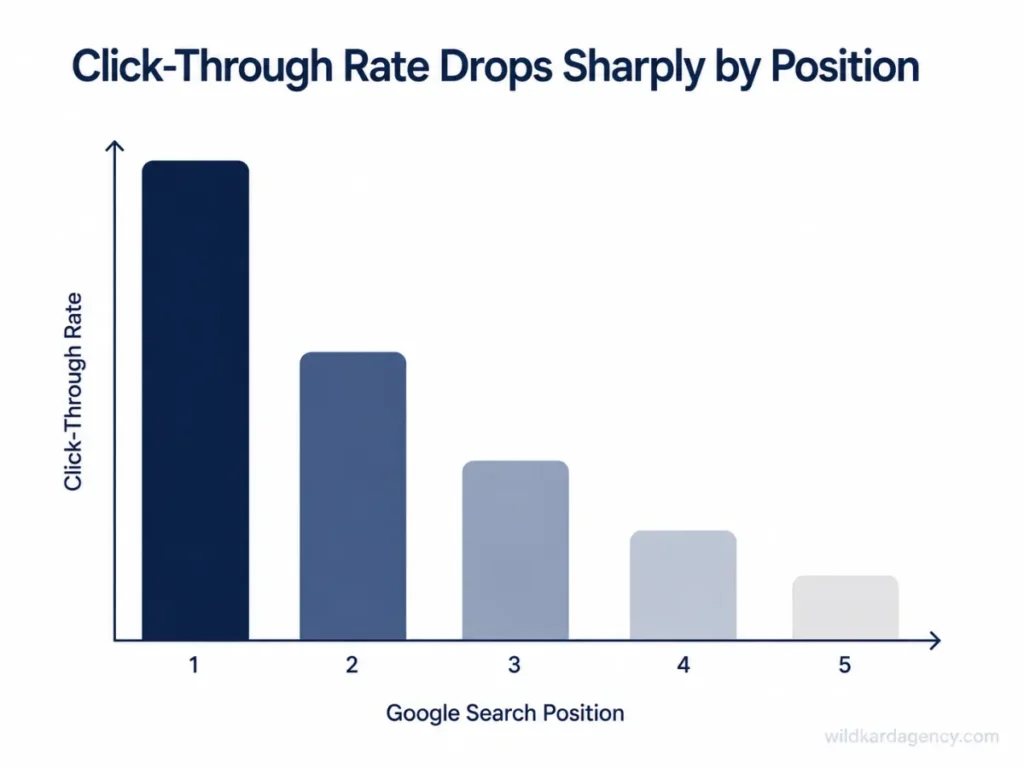
The math on that prize hasn’t changed much. First Page Sage’s 2026 click-through data puts position one at 39.8% of all clicks, position two at 18.7%, and position three at 10.2%. Everything below that point is fighting over what’s left.
Which raises the real question. If the reward is that concentrated at the top, what actually decides who gets there?
What Actually Controls Your Ranking
Google has said publicly that its algorithm weighs more than 200 signals. For a small business site, those signals collapse into three practical categories, and each one carries a different relative weight.
- Technical foundation. Crawlability, mobile experience, page speed, HTTPS, and a clean sitemap. None of this makes a page rank on its own, but it can quietly stop a page from ranking at all. Core Web Vitals live in this category, covered in detail below.
- Content relevance. The page has to answer the specific question behind the keyword, not a related question. A page written for “virtual assistant services” won’t rank for “how much does a virtual assistant cost” even though the words overlap. Search intent is that specific.
- Authority signals. Backlinks, reviews, and citations function as a trust score. A brand-new domain with no backlinks starts the race well behind an established competitor publishing the same quality of content.
In practice, the sites that stall out almost always have the same gap: strong content sitting on a technically weak foundation, or a technically sound site with content too generic to stand out from the ten other businesses competing for the same term. The next three sections go deep on each category, starting with the one small business owners most often underestimate.
How Many Backlinks You Actually Need
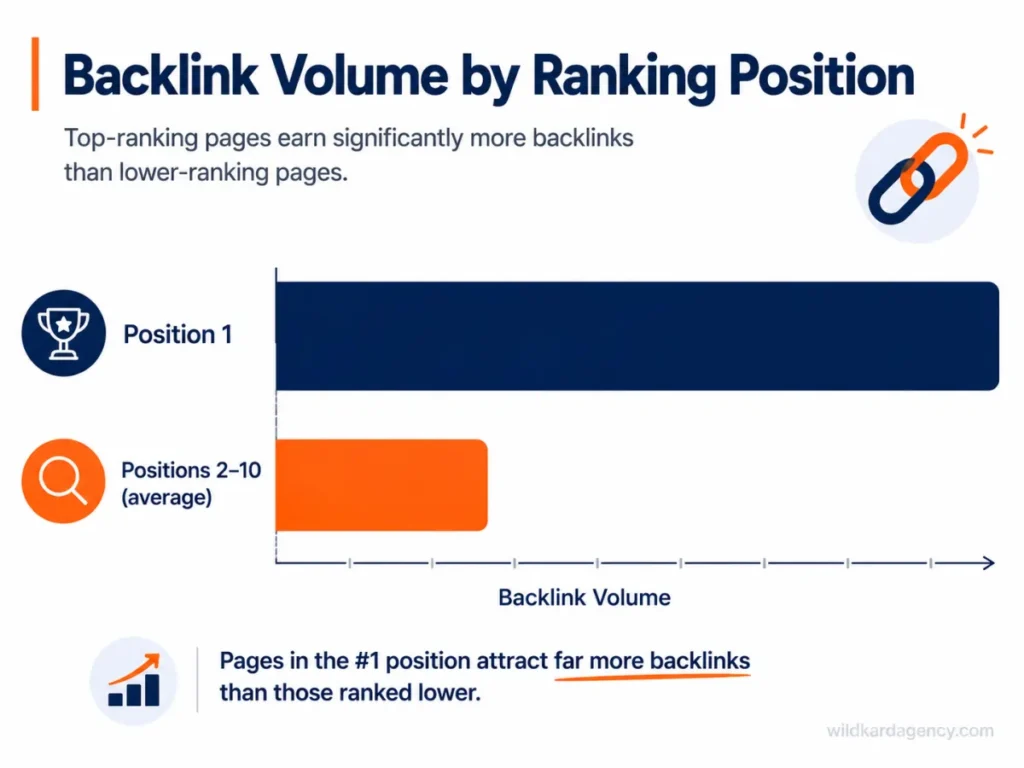
Backlinks remain part of the ranking system, though their overall weight has narrowed over time. Backlinko’s analysis of 11.8 million search results found the number one Google result carries 3.8 times more backlinks than results in positions two through ten, and referring domains showed the strongest correlation with ranking of any backlink metric measured.
For competitive, commercial keywords, the bar is higher than most small business owners expect. An Internet Marketing Ninjas study found that 95% of websites ranking in the top 10 for commercial keywords had at least 1,000 backlinks, and WebFX’s 2026 study puts the median referring domain count for page-one rankings at 907 across 15 industries.
Long-tail, lower-competition keywords tell a different story. Some pages reach page one with a single quality backlink, which is exactly why the 90-day plan later in this guide starts with long-tail terms before layering in more competitive ones.
The metric that matters most is referring domains, not raw backlink count. In COLAB DXB’s audit of 100 sites across 5 niches, a site with 40 links from 38 different domains consistently outranked a site with 200 links from 12 domains, because domain diversity signals broad endorsement rather than one publisher repeating itself.
Core Web Vitals: The Technical Floor Google Won’t Rank Around
Google measures three Core Web Vitals: Largest Contentful Paint (LCP) under 2.5 seconds, Interaction to Next Paint (INP) under 200 milliseconds, and Cumulative Layout Shift (CLS) under 0.1.
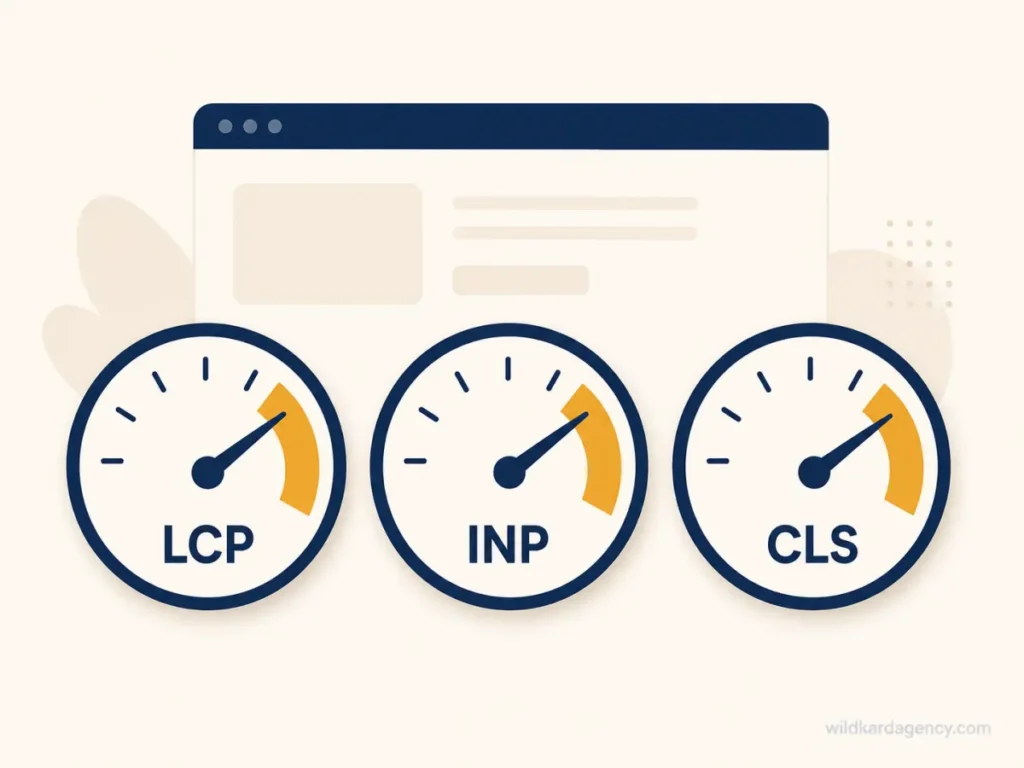
These function as a tie-breaker, not a dominant ranking factor. When two pages have comparable content quality and authority, White Label Coders’ analysis found Core Web Vitals can be the difference between position three and position eight. A page with excellent content and mediocre vitals will typically still outrank a page with perfect technical scores and thin content.
The business case reaches past rankings. In one of Google’s own case studies, the retailer Rakuten 24 improved LCP and saw a 53.37% increase in revenue per visitor, with no other variable changed. A one-second delay in load time can cost roughly 7% of conversions on its own.
For a small business building or rebuilding a site, this is the argument for getting the technical foundation right the first time rather than retrofitting it later. Our guide to conversion-focused websites covers what that foundation looks like in practice, beyond just the three vitals above.
What Counts as Comprehensive Content
Longer content correlates with more traffic, but length by itself isn’t the mechanism. Content over 3,000 words earns three times more traffic, four times more social shares, and three and a half times more backlinks than the 1,400-word average, according to AIOSEO’s 2026 report. Comprehensive content with a high Content Grade meaningfully outperformed thin content in Backlinko’s same 11.8-million-result study cited above.
The mechanism is coverage, not word count for its own sake. A page that thoroughly answers every sub-question a searcher actually has, pricing, timelines, common mistakes, exceptions, earns more links and citations than a page padded with repetition to hit a target length.
That coverage standard is also what Google’s own quality raters are trained to look for. Google’s Search Central documentation frames the underlying question as “who, how, and why”: who created the content, how it was made, and why. Content built to fully serve a real question, rather than to rank for a keyword, tends to satisfy both raters and readers at once.
For a small business, one genuinely exhaustive page usually outperforms five thin ones. WildKard’s own SEO and GEO guide is built on the same cluster model referenced throughout our content marketing approach: fewer, deeper pages that fully answer a topic, linked together, rather than many shallow ones competing with each other.
The Realistic SEO Timeline for Small Businesses
There’s no way around this part: ranking takes months, not days. Google’s own John Mueller has said rankings fluctuate more in a site’s first year, while the algorithm gathers enough signal to place content with confidence.
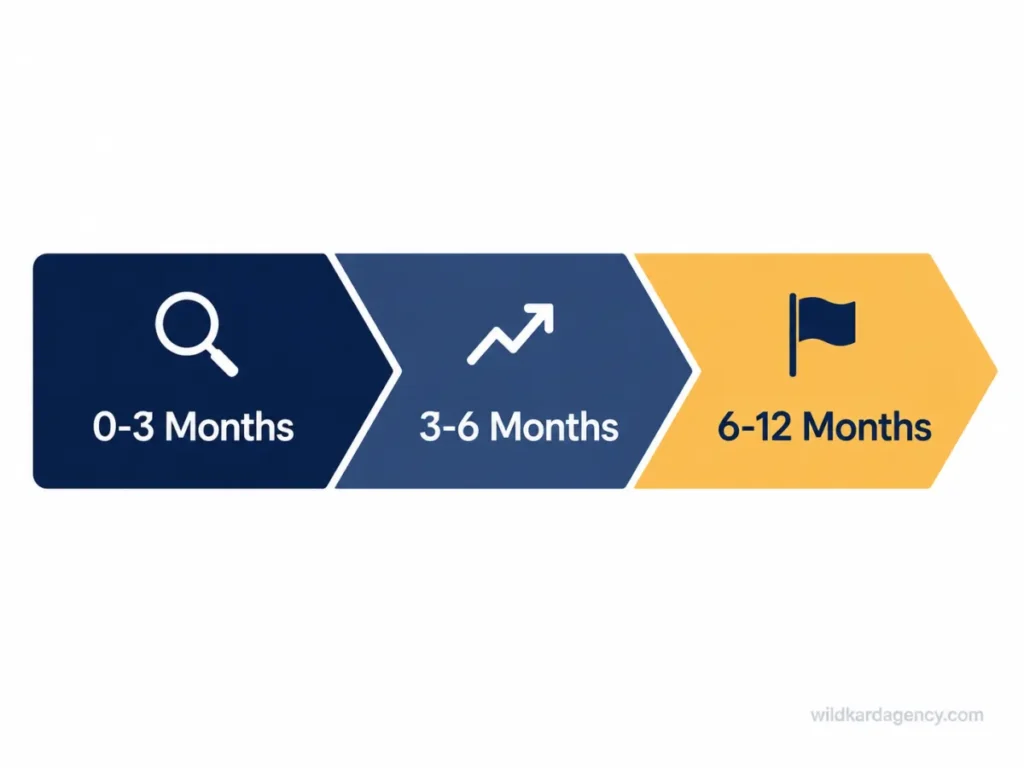
| Timeframe | What’s Happening | What to Expect |
| 0-3 months | Google indexes the site and starts testing content placement across low-competition terms. | Movement on long-tail keywords. Rankings may fluctuate as Google gathers trust signals. |
| 3-6 months | Content and early backlink signals start compounding. | Most small businesses see their first genuine page-one movement in this window. |
| 6-12 months | Domain authority accumulates through consistent publishing and outreach. | Competitive, high-volume keywords start to move. Consistency matters more than volume here. |
Nothing in that table changes if the business is impatient. Sites that publish once and stop, or that change strategy every six weeks, reset the clock more often than they realize. Consistency is what the timeline actually rewards.
If your site is technically sound but still invisible for the terms your business depends on, that gap between “live” and “found” is exactly what WildKard’s content and SEO team works on. Get in touch and we’ll walk through where your site currently stands.
The Local Pack and Your Google Business Profile: A Faster Path
For any business with a physical location or service area, “first page” often means the Local Pack, the three map-linked listings above the organic results, before it means classic blue links. Google Business Profile signals account for 32% of local pack ranking weight, more than any other single factor, according to Whitespark’s research.
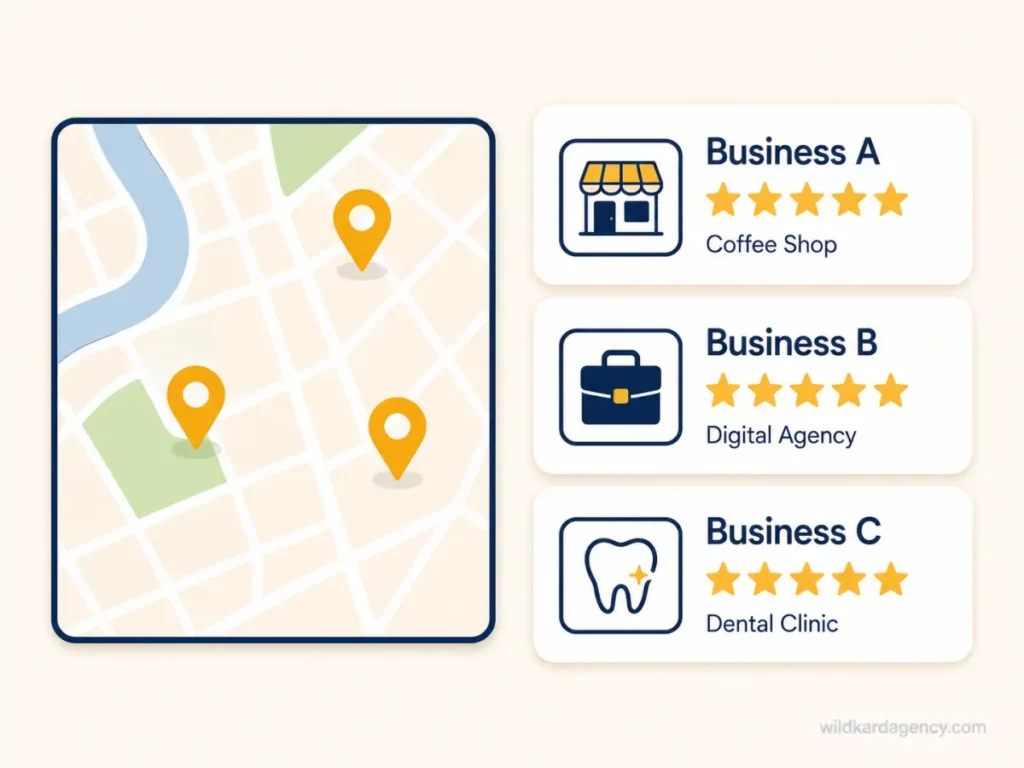
The opportunity here is bigger than most owners realize. Only 44% of local businesses appear in the Local Pack for their primary keyword, per BrightLocal’s data, meaning more than half the field isn’t even competing for the most visible real estate on the page. Distance still matters, 70% of Local Pack spots go to businesses within one to three miles of the searcher, but category accuracy, review volume, and profile completeness are all within a business’s direct control.
This is also the fastest-moving part of SEO. A fully optimized Google Business Profile can start influencing local visibility within weeks, well ahead of the three-to-six-month organic timeline above.
What AI Overviews Change About Ranking
A first-page ranking used to guarantee a click. In 2026, it increasingly guarantees a mention instead. When an AI Overview answers the query directly, the searcher may never scroll to the organic results below it.
The pages AI systems pull from aren’t always the ones sitting in position one. 52% of sources cited in Google’s AI Overviews rank somewhere in the top 10 organic results, not necessarily first, according to AIOSEO’s report. Backlink authority carries over into AI citation too: pages with strong referring-domain profiles get pulled into AI-generated answers more often, since these systems lean on the same trust signals search engines already use.
We’ve mapped the specific reasons a site never earns an AI citation in this breakdown, where most businesses fail on at least three of seven diagnosable issues at once. And if the distinction between the two systems is still fuzzy, our SEO vs. GEO guide lays out exactly what each one is optimizing for.
Common Mistakes That Keep Small Business Sites on Page Two
- Blocking crawlers by accident. A misconfigured robots.txt file can block Googlebot or AI crawlers like GPTBot without anyone noticing for months, quietly capping visibility before content even gets a chance to compete.
- Chasing link volume over domain diversity. 200 links from 12 domains loses to 40 links from 38 domains, as covered above. Volume without diversity signals repetition, not endorsement.
- Treating Core Web Vitals as a launch-day checklist. Vitals drift as themes, plugins, and content get added. A site audited once at launch and never again usually fails at least one metric within a year.
- Publishing once and stopping. SEO rewards consistency more than volume. A single burst of content followed by silence resets momentum instead of building it.
- Writing for the keyword instead of the question behind it. Matching words without matching intent is the single most common reason a technically sound, well-linked page still doesn’t rank.
A Realistic 90-Day Plan
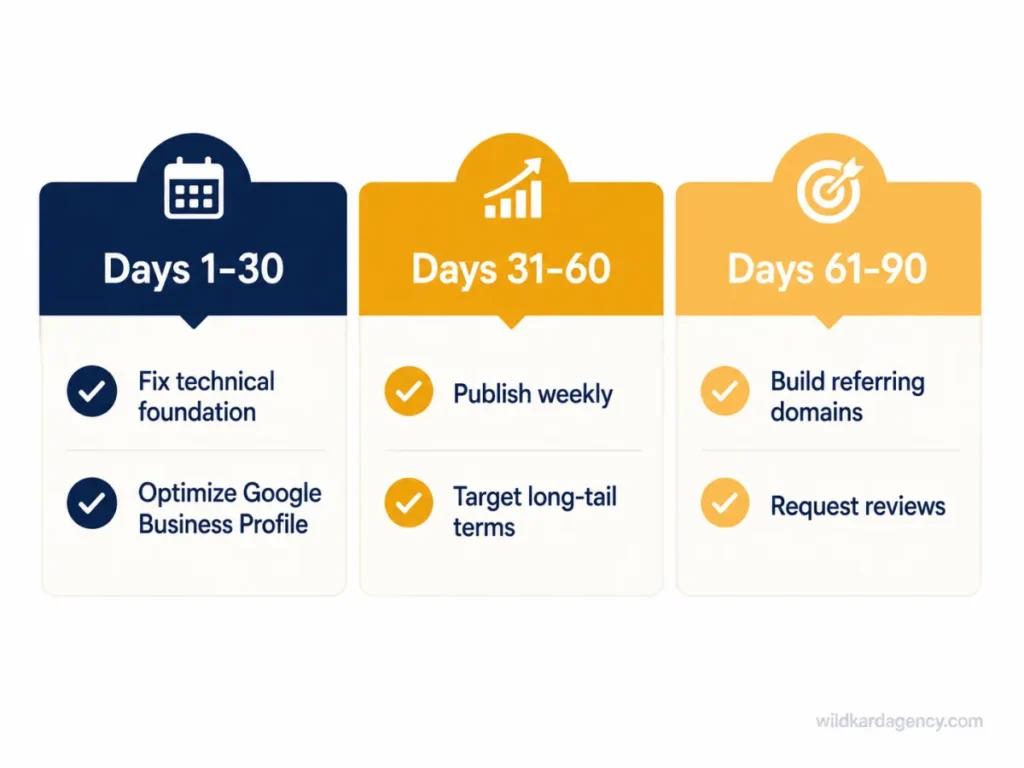
Days 1-30: Fix the Foundation
Audit crawlability, mobile speed, and HTTPS. Submit a clean sitemap through Google Search Console. Claim and fully optimize the Google Business Profile if the business serves a physical location or service area, since this is the highest-leverage move available in the first month.
Days 31-60: Publish for Intent, Not Volume
Publish content matched to real search intent, one to two pieces a week, starting with long-tail, lower-competition terms the business can realistically win before moving up to harder keywords.
Days 61-90: Build Authority
Pursue backlinks through outreach and guest contributions, prioritizing domain diversity over raw count. Request reviews consistently, and check that the business name, address, and phone number match across every directory listing.
Ongoing: Measure the Right Signals
Rankings are a lagging indicator. Google Search Console shows impressions and average position weeks before those numbers turn into clicks, so a term climbing from position 34 to position 14 is real progress even before it shows up in traffic. Review Search Console weekly for the first 90 days, audit referring domains monthly, and check Core Web Vitals field data quarterly rather than only at launch.
The Complete Checklist for How to Rank on Google’s First Page as a Small Business
- Fix crawlability, mobile speed, HTTPS, and sitemap submission before publishing more content.
- Claim and fully optimize a Google Business Profile if the business serves a location.
- Match content to search intent, not just keyword wording.
- Build one exhaustive page per topic instead of five shallow ones.
- Target long-tail keywords first, then layer in competitive terms as authority builds.
- Prioritize referring domain diversity over raw backlink count.
- Keep Core Web Vitals under threshold on an ongoing basis, not just at launch.
- Publish consistently rather than in bursts.
- Track impressions and average position in Search Console weekly, not just traffic.
- Expect three to six months for initial movement, six to twelve for competitive terms.
Everything above is what actually determines how to rank on Google’s first page as a small business in 2026. It isn’t a trick or a single fix. It’s the compounding result of a site Google can crawl, content that actually answers the question, and enough trust signals that Google is comfortable putting the page in front of searchers. Businesses that treat all three as one connected system get to page one faster than businesses chasing any single tactic alone.
Frequently Asked Questions
Q: How long does it really take to rank on Google’s first page?
A: Most small business sites with no major technical issues reach the first page in three to six months, based on Semrush’s study of 28,000 new websites. Highly competitive keywords or an unoptimized site can push that to nine months or longer. Google’s own team has confirmed rankings fluctuate more in a site’s first year while the algorithm gathers trust signals.
Q: How many backlinks do I actually need?
A: It depends on keyword competition. For commercial keywords, 95% of top-10 sites had at least 1,000 backlinks in one study, with a median of 907 referring domains across industries. For long-tail, lower-competition terms, some pages rank with a single quality backlink. Referring domain diversity matters more than raw backlink count either way.
Q: Do Core Web Vitals really affect rankings?
A: Yes, but as a tie-breaker rather than a dominant factor. When content quality and authority are comparable between two pages, Core Web Vitals can be the difference between position three and position eight. Strong content with weak vitals will usually still beat weak content with perfect vitals.
Q: Is the Google Business Profile more important than my website for ranking?
A: For local searches, yes. GBP signals control 32% of local pack ranking weight, more than any single website factor. But GBP and website SEO aren’t interchangeable. The Local Pack and standard organic results are ranked separately, so a strong profile alone won’t rank a business in the regular blue links.
Q: How long should my content actually be?
A: Long enough to fully answer the question and nothing added past that. Content over 3,000 words earns three times more traffic on average, but the mechanism is comprehensive coverage, not length for its own sake. A shorter page that fully answers a narrow question can outperform a padded 3,000-word page.
Q: Does ranking on Google still matter if AI Overviews are taking clicks?
A: It matters differently. 52% of sources cited inside Google’s AI Overviews already rank in the top 10 organic results, so ranking well remains the most reliable path to being cited by AI systems too, even when the click doesn’t land on the traditional blue link.

If you’d rather have someone handle the technical audit, content calendar, and Google Business Profile work directly, get in touch and we’ll show you exactly where your site stands today.