

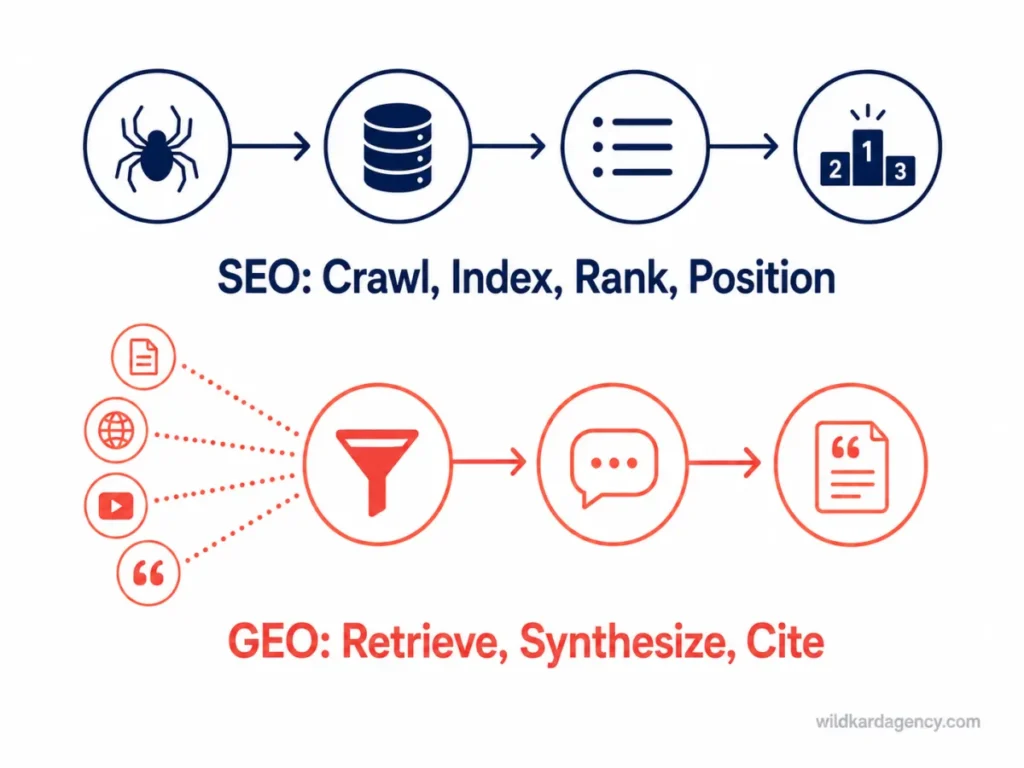
The difference between SEO and GEO comes down to what each one is actually optimizing for. SEO gets your page ranked inside Google’s own index, a list Google controls and updates on its own schedule. GEO gets your business cited inside an answer an AI system generates on the spot, pulling from dozens of sources at once, not from a stored ranking at all.
That’s not a small distinction, and it’s not two names for the same job. Nine months ago, ranking well and getting cited by AI were close enough to the same outcome that most agencies treated GEO as an SEO footnote. New data says that’s no longer true, and the gap is widening fast. Our SEO and GEO guide for business owners covers both disciplines end to end; this piece exists to settle the one question that guide gets asked most: are they actually the same thing?
SEO, Defined Without the Jargon
Search engine optimization is the practice of getting a page found, crawled, understood, and ranked by a traditional search engine, almost always Google, so it shows up when someone types a matching query.
Everything under the SEO umbrella exists to serve that one pipeline: keywords tell Google what a page is about, backlinks and site structure signal trust and authority, and page speed and mobile usability affect whether Google is willing to rank the page at all. The output is a position, first, fifth, fortieth, on a results page Google fully controls.
GEO, Defined Without the Jargon
Generative engine optimization is the practice of getting a business mentioned, quoted, or recommended inside an answer that ChatGPT, Perplexity, or Google’s own AI Overview writes in response to a question, rather than a link on a results page. We go deeper on the mechanics in our full breakdown of generative engine optimization, but the short version is enough to work from here.
The mechanism is fundamentally different. An AI answer engine doesn’t consult a pre-built ranking. At the moment someone asks a question, it retrieves information from many sources, including your site, competitor sites, Reddit threads, YouTube videos, and review platforms, then synthesizes an answer and decides which of those sources earned a citation. There is no fixed position to climb toward. There’s a synthesis process to earn a place inside.
The Data Proving These Two Are Pulling Apart
Here’s the number that should end the “SEO and GEO are basically the same thing” debate for good. Ahrefs analyzed 863,000 keywords and 4 million AI Overview citations and found that only 38% of pages cited inside Google’s AI Overviews also ranked in the organic top 10 for that same query. In mid-2025, that overlap was 76%.
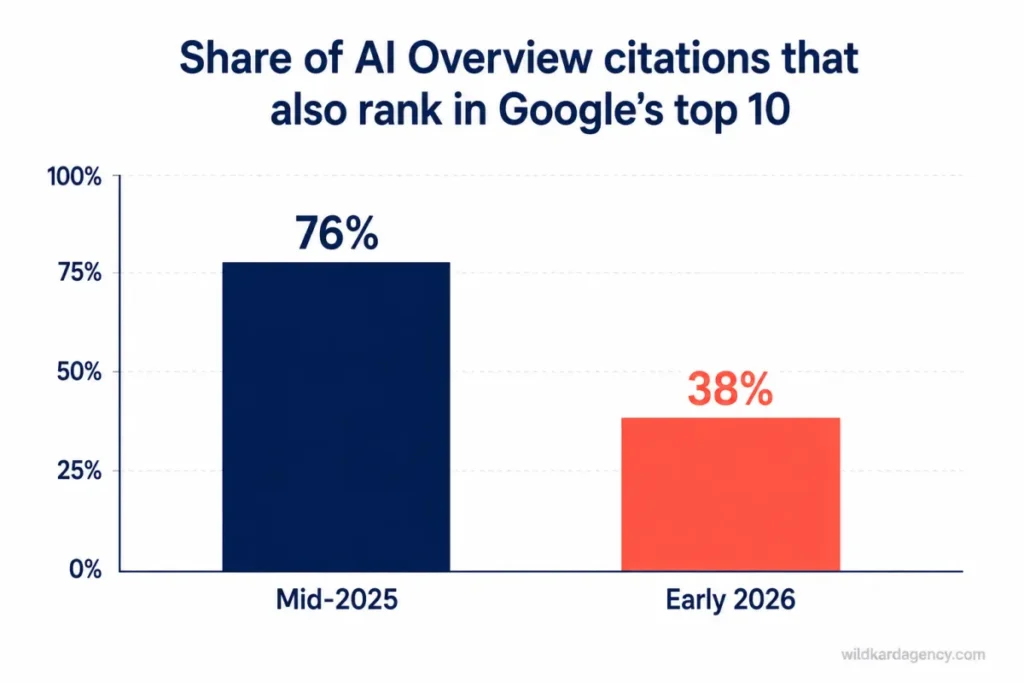
Read that again slowly, because it’s the whole argument. A year ago, if you ranked in Google’s top 10, you had roughly a coin-flip-plus chance of also being cited by the AI Overview sitting above those results. Today, more than 6 in 10 AI citations come from pages that never made the top 10 at all, some from pages that don’t rank in the top 100. Whatever Google’s AI systems are now looking for, it has stopped being a close cousin of the ranking algorithm.
Want to know exactly where your content is losing AI citations it should be winning? Book a free 15-minute visibility review.
Where SEO and GEO Still Genuinely Overlap
None of this means the two disciplines have nothing in common, and treating them as total strangers wastes just as much effort as treating them as identical. Understanding the difference between SEO and GEO isn’t about picking a side.
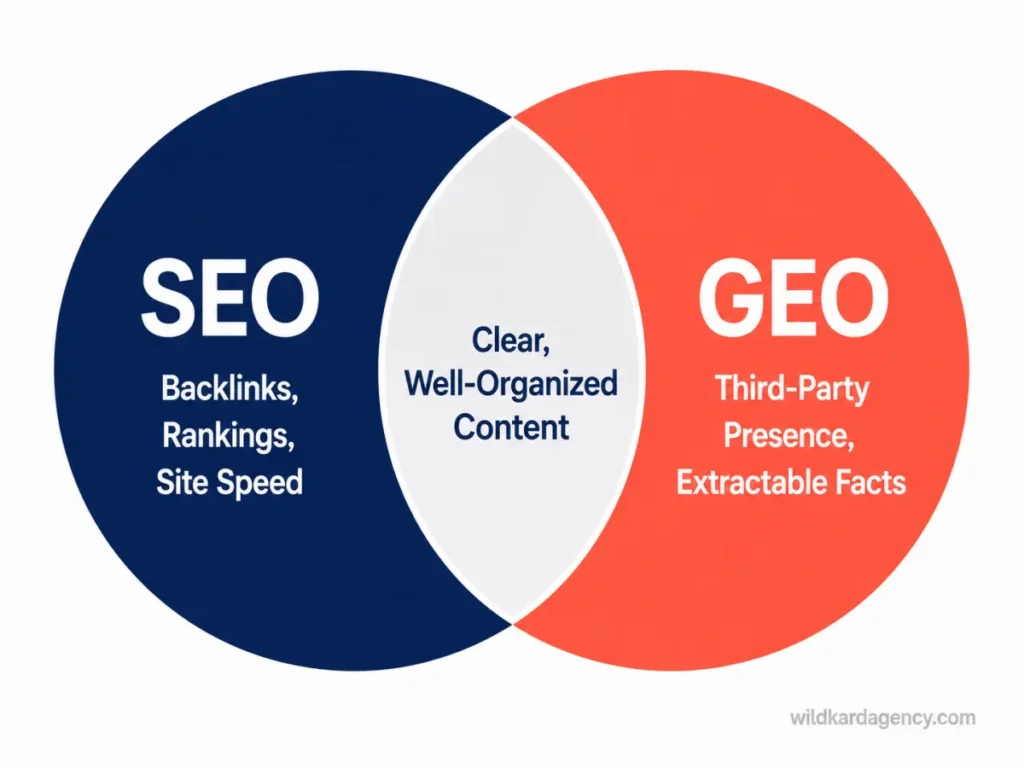
Clear, well-organized content still helps both. A page that answers a specific question directly, in plain language, with a real fact or statistic attached, is easier for Google to rank and easier for an AI system to extract and quote. Fast, mobile-friendly, technically sound websites still matter to both, because a page an AI crawler can’t read cleanly is a page it can’t cite, the same way a slow page is a page Google is reluctant to rank.
The overlap is the foundation. The divergence starts above that foundation, in the specific signals each system weighs once the basics are covered.
What GEO Asks For That SEO Never Did
Three requirements separate a page built for AI citation from a page built only to rank.
- Extractable, self-contained facts: a sentence an AI system can lift and quote accurately without needing the surrounding paragraph for context
- Presence beyond your own domain: citations increasingly come from third-party mentions on forums, review sites, and video platforms, not just your website
- Consistent entity details everywhere: your business name, description, and key facts need to match across every source an AI system might pull from, or it has no confident version of you to cite
That third point is the one most small businesses get wrong first. A site can have excellent on-page content and still lose the citation because a directory listing, an old press mention, or a social bio describes the business slightly differently. AI systems weigh agreement across sources more heavily than any single well-written page.
Why AI-Sourced Traffic Is Worth Chasing Even at Lower Volume
A fair objection at this point: AI answer engines send far less traffic than Google search does, so why invest in a channel that’s smaller by volume?
Because the visitors it does send convert differently. Monitoring data from Lantern shows AI-referred visitors converting at meaningfully higher rates than standard Google clicks, and Pew Research’s behavioral tracking helps explain why: someone who reaches your site through an AI citation has already had their initial question answered and chose to click through anyway, a stronger intent signal than a cold search click. Fewer visitors, but visitors who arrive further along in the decision. It’s also why a business can rank respectably and still feel invisible; we mapped the specific failure points behind that gap here.
Ready to build content that earns both a Google ranking and an AI citation? Get in touch. Free 15-minute call, no pitch.
SEO Tasks vs. GEO Tasks: A Practical Checklist
If you’re deciding where to spend the next hour of content work, this is the honest split.
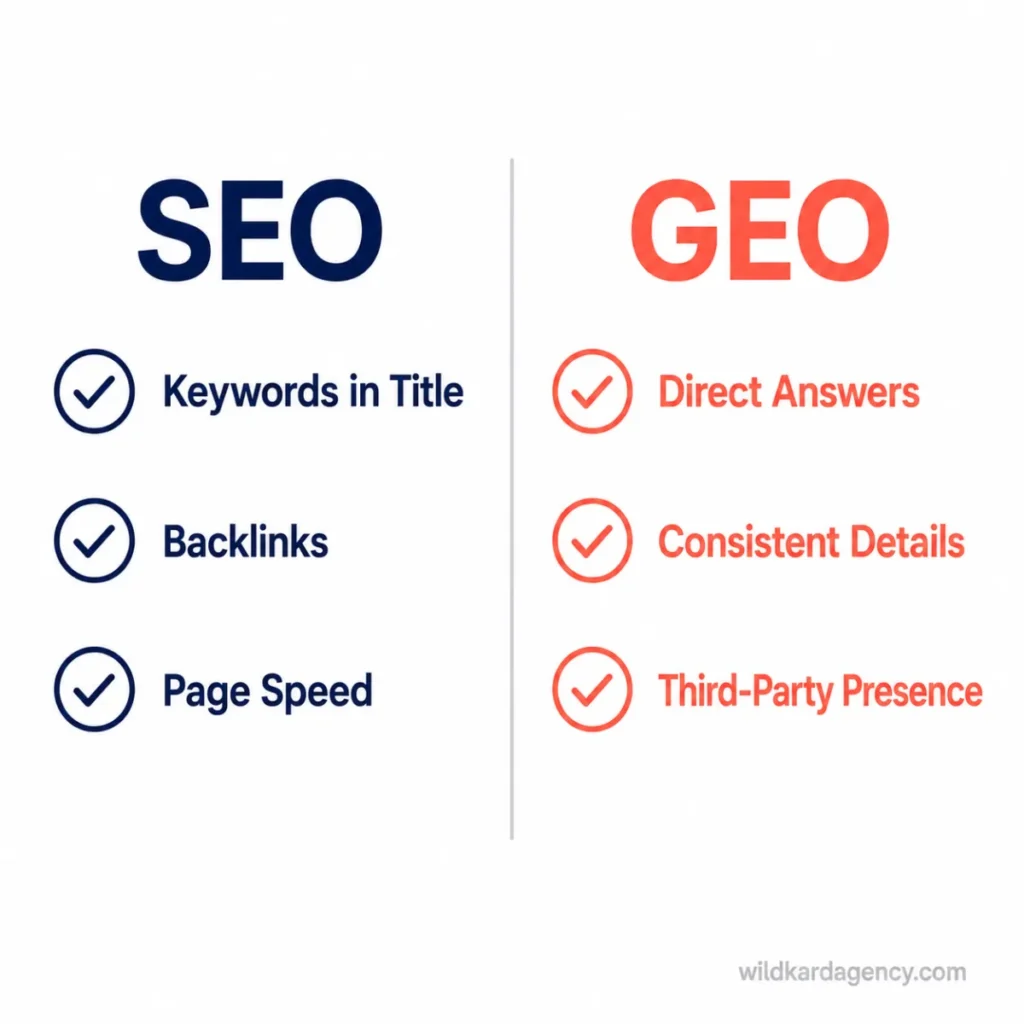
- SEO: target keyword in the title, H1, and first 100 words; internal links from related pages; a clean, crawlable URL structure
- SEO: backlinks from relevant, credible sites; page speed and mobile usability fixes; an updated XML sitemap
- GEO: a direct, self-contained answer to the core question within the first two sentences of the page
- GEO: identical business name, description, and key facts across your website, directories, and social profiles
- GEO: a presence on the third-party platforms AI systems actually cite, review sites, relevant forums, and video, not just your own domain
Notice how little the two lists actually overlap. That’s the honest picture behind “the difference between SEO and GEO,” and it’s why a content plan built only around traditional keyword research leaves real AI visibility on the table.
FAQ
Q: What is the main difference between SEO and GEO?
A: SEO optimizes a page to rank inside Google’s own search index. GEO optimizes a business to be cited inside an answer an AI system generates in real time from multiple sources. One earns a position; the other earns a mention.
Q: Does ranking well on Google guarantee AI Overview citations?
A: No, and increasingly less so. Ahrefs found that only 38% of AI Overview citations now come from top-10 ranking pages, down from 76% a year earlier. Top rankings help, but they no longer guarantee a citation.
Q: Do I need a completely separate content strategy for GEO?
A: No. Strong, well-organized SEO content is still the foundation. GEO adds specific requirements on top of it: self-contained extractable answers, and consistent business details across sources beyond your own website.
Q: Which matters more for a small business right now, SEO or GEO?
A: Both, but for different reasons. SEO still drives the higher volume of traffic today. GEO drives a smaller but higher-intent stream, and it’s the channel growing fastest, which makes ignoring it now the more expensive mistake long term.
Q: What’s the single fastest fix to improve GEO without a full content rebuild?
A: Audit your business name, description, and core facts across your website, Google Business Profile, directories, and social bios, and make every version identical. Inconsistent details are the most common reason AI systems skip a business that otherwise has strong content.
Ready to close the gap between where you rank and where you get cited? Send us a message and we’ll set up a free strategy call