

| A virtual assistant for a care agency handles the non-regulated administrative work sitting between your direct support professionals and the people they support: scheduling, documentation formatting, correspondence, compliance paperwork, and onboarding admin. A VA does not deliver care, administer medication, or make clinical decisions. Most agencies feel the difference within two to three weeks, once the scheduling and documentation backlog actually clears. |
Your program director is buried in scheduling conflicts before 9am. Your office manager is three days behind on incident report formatting. Your DSPs are picking up the slack because nobody else has time to chase the paperwork that keeps your agency compliant.
None of that is care work. It’s admin work wearing a care agency’s badge, and it’s the reason a virtual assistant for a care agency keeps coming up in conversations between directors who are tired of choosing between compliance and capacity.Virtual assistant for care agency services help providers reduce administrative work, improve efficiency, and give DSPs more time to focus on quality client care.
This article breaks down exactly where that help fits, where it stops, and what the first weeks of working with one actually look like.
What a Virtual Assistant Can Actually Do for a Care Agency
A virtual assistant handles the operational layer that surrounds care delivery, not the care itself. That distinction matters, and it’s the first thing worth getting clear before anything else.
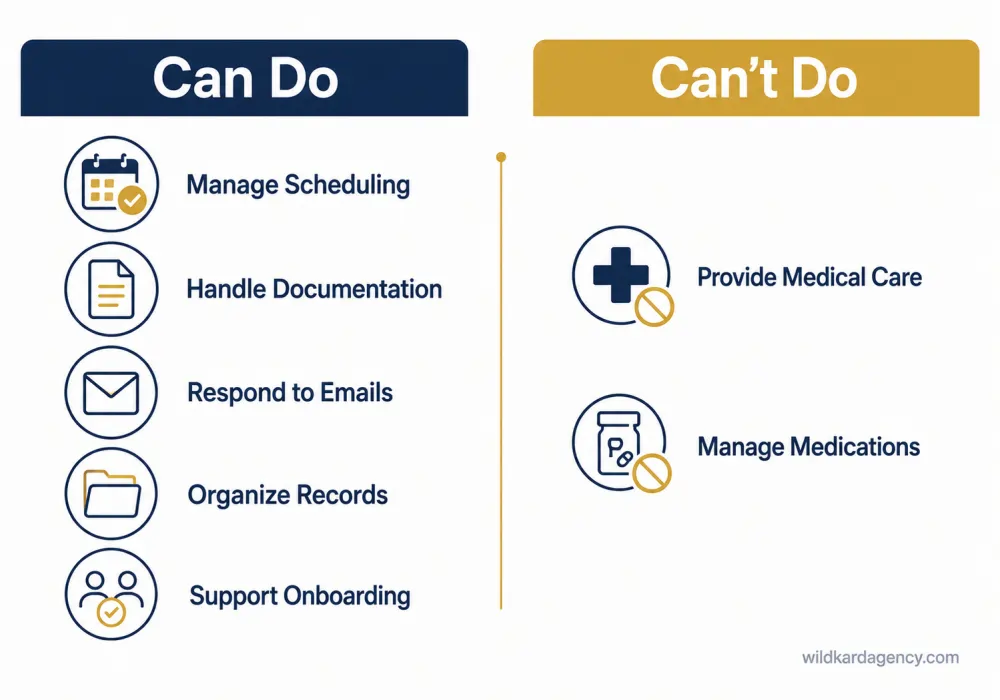
In practice, the work usually falls into five categories:
- Scheduling and shift coordination. Building and adjusting DSP schedules, tracking availability, and managing the back-and-forth of shift swaps.
- Documentation formatting. Cleaning up shift notes, incident reports, and progress records into the structure your funding source or state agency requires, without touching clinical content.
- Correspondence. Managing email inboxes, drafting routine communications to families, vendors, and referral sources, and keeping response times fast.
- Compliance paperwork. Preparing renewal documents, tracking certification expiration dates, and assembling audit-ready files ahead of a state review.
- Onboarding administration. Handling the paperwork side of bringing on a new DSP: forms, scheduling orientation, and coordinating background check submissions.
None of this requires a caregiving credential. It requires someone who understands the rhythm of a care agency well enough not to slow it down. For the full picture of what non-regulated support can cover across a care agency’s operations, see our complete guide to administrative support for social services agencies.
Where a Virtual Assistant’s Role Stops (And Why That Line Protects You)
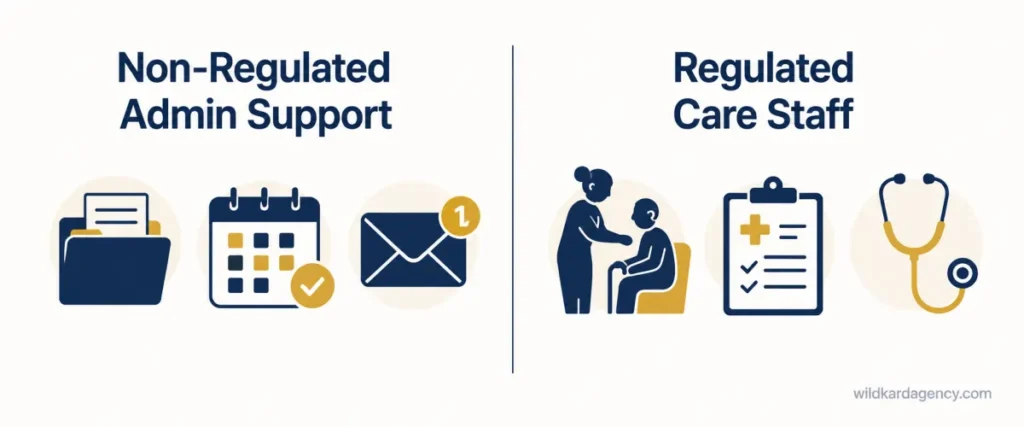
A virtual assistant does not provide direct support, administer medication, or make any decision that affects a client’s care plan. This is not a limitation to work around. It is the boundary that keeps your agency’s licensure and compliance status intact.
Anyone touching protected health information, clinical documentation content, or client-facing care decisions needs to be a credentialed, regulated staff member under your state’s specific requirements. A non-regulated admin support role exists specifically outside that line. It exists to remove the paperwork burden sitting on top of your DSPs and supervisors, not to replace any of them.
This is also why the working relationship needs a clear scope of work from day one. Every task list should be reviewed against your state’s specific IDD and DODD requirements before anything begins, so there is never ambiguity about who is doing what.
The 2025 Workforce Crisis Data Care Agency Directors Need to See
ANCOR’s most recent national survey paints a sharper picture than “DSPs are burned out.” In late 2025, ANCOR surveyed 469 community-based I/DD providers across 48 states and found that 88 percent had experienced moderate or severe staffing shortages in the past year. That isn’t a hiring problem contained to a few agencies. It’s the operating condition for nearly the entire field.
The downstream effects are the part most directors feel before they see the data. 62 percent of providers reported turning away new referrals because they didn’t have the staff to take them on, and 36 percent saw more frequent reportable incidents tied directly to turnover and vacancy rates. Lost referrals mean lost revenue. Reportable incidents mean compliance exposure.
Layer funding pressure on top of that and the math gets tighter still. Federal Medicaid cuts totaling roughly $1 trillion, signed into law in mid-2025 reconciliation legislation, are squeezing the budgets many I/DD providers depend on, right as staffing shortages are already straining capacity.
Wages compound the problem in a way most industries don’t face. DSP wages have stagnated at $12 to $13 an hour at the median for years, and providers don’t set their own reimbursement rates. Medicaid does. Agencies can’t simply pay their way out of a staffing shortage even if they wanted to.
This is exactly why non-regulated admin support has become a lever agencies can actually pull. You can’t control your Medicaid reimbursement rate. You can control where your credentialed staff’s hours go. Moving documentation formatting, scheduling, and compliance paperwork off a DSP’s plate doesn’t require a rate increase. It requires a decision.
The Real Reason This Matters: DSP Burnout Starts With Admin
Zoom in from the industry-wide numbers to a single agency, and the mechanism becomes clear. Turnover is a workload problem, and admin is a bigger piece of that workload than most agencies account for.
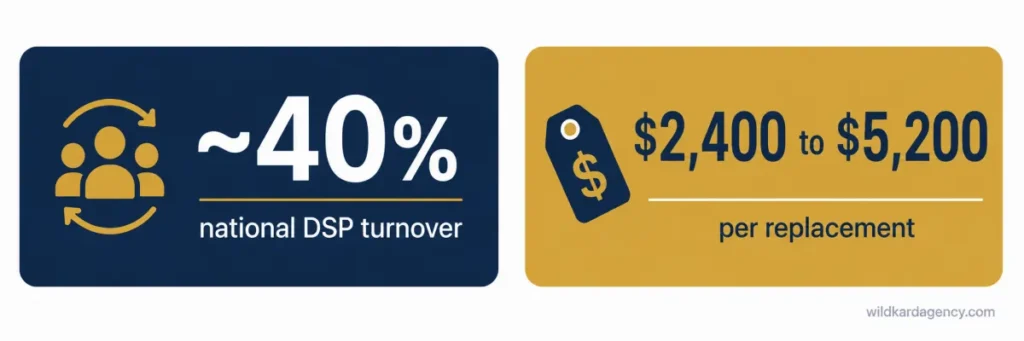
Turnover among direct support professionals has hovered just under 40 percent nationally for years, with some states running considerably higher. Every exit costs an agency real money. Replacing a single DSP typically runs between $2,400 and $5,200 once separation, training, and lost productivity are factored in.
The connection to admin is direct, not incidental. Research on DSP workload has found that documentation requirements are a significant driver of DSP overload and stress, and that the burden compounds further whenever turnover forces remaining staff to document more to orient new hires. Fewer hands on paperwork means more hours spent on it by the people who should be delivering care instead.
We’ve covered this pattern in depth in Why DSP Burnout Often Starts With Admin, Not Care Delivery. The short version: every hour a DSP spends formatting a shift note is an hour they aren’t spending with the person they were hired to support.
| If admin backlog is already showing up as staff turnover, book a free 15-minute strategy call and we’ll walk through exactly what a handoff would look like for your agency. |
What Working With a WildKard Virtual Assistant Actually Looks Like

Our team includes former DSPs and house managers, so the onboarding conversation starts from lived experience, not a generic intake form. We’ve sat in the chair your staff are sitting in now, which changes what we ask and how fast we get useful.
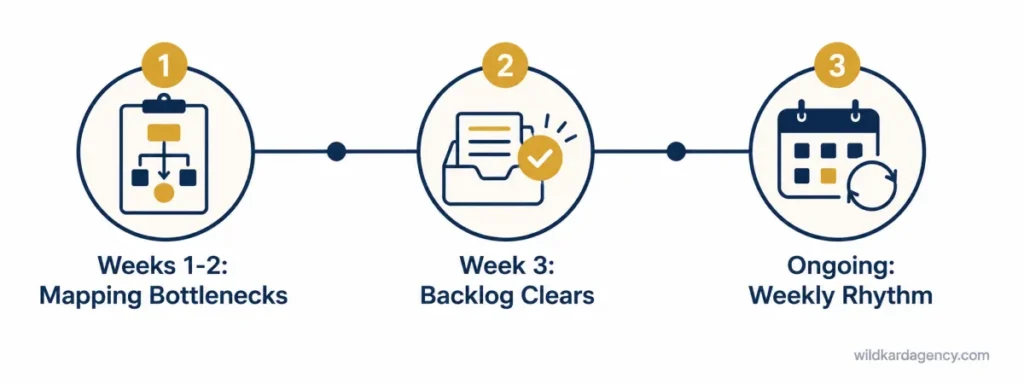
The first two weeks are typically spent mapping your current admin bottlenecks: where scheduling breaks down, which documentation is chronically late, and what compliance deadlines are closest. From there, your VA takes on a defined set of tasks with a clear weekly rhythm, so nothing sits in a gray area of “who’s handling this.”
By week three, most agencies see the backlog start to clear rather than grow. That’s the point where a director stops reacting to admin fires and starts running the agency ahead of them instead.
Frequently Asked Questions
Why does this matter more right now than it did a couple of years ago?
Federal Medicaid cuts and a staffing shortage affecting 88% of providers nationally mean agencies have less room to absorb inefficiency than before. Handing off non-regulated admin work is one of the few capacity levers a director can pull without waiting on funding or wage changes.
Can a virtual assistant access client records?
Only non-clinical, non-regulated information covered by a clear scope of work and any required confidentiality agreement. Anything touching protected health information or clinical care content stays with your credentialed, regulated staff. This boundary is set before work begins, not figured out along the way.
How is this different from hiring another office administrator?
A virtual assistant costs less than a full-time hire, requires no desk space or benefits, and scales up or down with your agency’s actual admin volume. You get support without adding a fixed headcount to your payroll.
Will a virtual assistant understand DODD or state IDD compliance requirements?
A good one will already understand the rhythm of a regulated care environment, and will confirm your state’s specific requirements with you directly rather than assuming they transfer from state to state. Ask about this before you start.
How quickly can a virtual assistant actually help with DSP burnout?
Most agencies see scheduling and documentation backlogs start clearing within two to three weeks. The turnover impact takes longer to show up in the numbers, but it starts with DSPs getting their time back sooner than that.
What tasks should we hand off first?
Start with whatever is most overdue right now, usually scheduling conflicts or a documentation backlog. Clearing the most visible bottleneck first builds trust in the process before expanding into compliance paperwork and correspondence.
| If your agency is choosing between compliance and capacity more often than it should be, that’s not a staffing problem you have to solve by hiring another full-time DSP. Book a free 15-minute strategy call with WildKard and we’ll show you exactly what non-regulated admin support looks like for your team. |