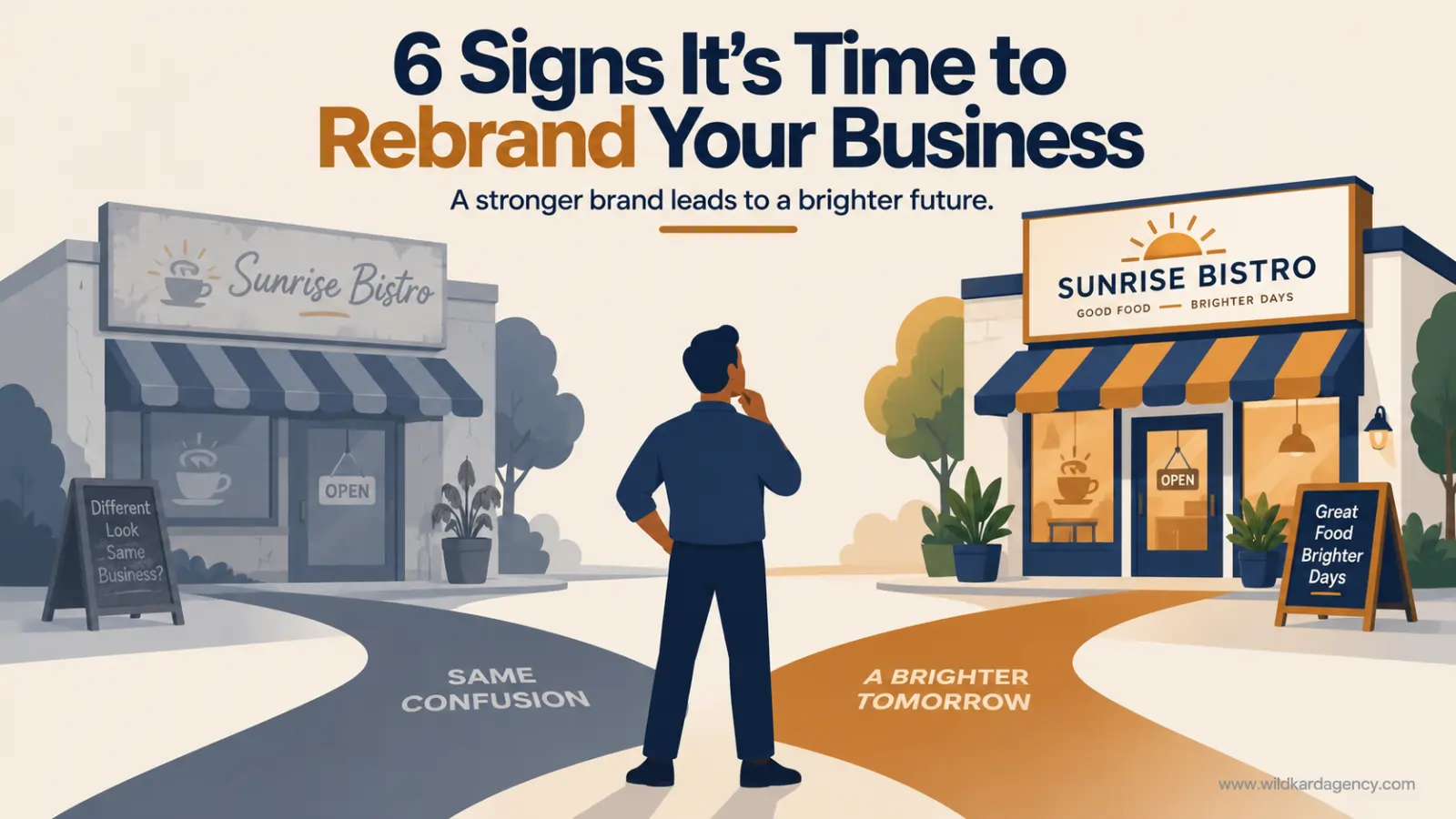

| Brand identity for small businesses is the complete, consistent system, visual, verbal, and structural, that makes a business instantly recognizable and trustworthy across every place a customer encounters it. Done well, it has real measurable upside: businesses in Lucidpress’s 2019 State of Brand Consistency Report, surveying roughly 400 brand management professionals, reported revenue gains as high as 33% from consistent branding. Done poorly, it is expensive and reversible damage: Nielsen research puts the rebrand failure rate at roughly 40%, and a mishandled rebrand can cut sales by 20% within weeks, as Tropicana’s infamous 2009 packaging change demonstrated. This guide covers what genuinely separates the two outcomes, what a real brand identity includes beyond a logo, and a factor most branding guides still ignore entirely: how AI answer engines decide which brand to recommend. |
Branding Has Real ROI. Almost Half of Rebrands Still Fail to Capture It
Most branding content picks one side of this story. Either branding is a magical revenue lever backed by an unbroken string of impressive percentages, or it is a vanity expense founders should skip in favor of anything measurable. Neither framing survives contact with the actual data.
The upside is real. Brand management professionals surveyed for Lucidpress’s 2019 State of Brand Consistency Report reported revenue gains as high as 33% from consistent branding, up from 23% in the 2016 edition. Worth being precise here: this is professionals’ reported estimate of consistency’s impact, not an independently measured causal study, a distinction several sites repeating this stat quietly drop.
The downside is just as real, and gets mentioned far less often. Nielsen research puts rebrand failure, meaning the rebrand did not deliver a positive return, at roughly 40%. Tropicana’s infamous 2009 packaging redesign is the textbook case: sales fell 20% within weeks, forcing the company to revert to the old design within two months. The lesson is not that branding does not work. It is that branding executed without strategy and testing is a coin flip, and coin flips are expensive at $10,000 to $75,000 a rebrand.
Why Most Rebrand Failures Trace Back to the Same Mistake
Tropicana’s failure, and most others like it, share a pattern: the visual change happened before anyone tested whether customers would recognize the product on a shelf. Packaging changed, brand recognition broke, and sales followed. The strategic groundwork, understanding what customers actually associate with the brand before touching it, got skipped in favor of moving straight to design.
This is the single most avoidable failure mode in branding, and it explains why brand refreshes (updating an existing identity) carry meaningfully less risk than full rebrands (changing name, message, and visual system together). A refresh keeps the recognition anchors customers already rely on. A full rebrand removes all of them at once, which is exactly where that 40% failure rate concentrates.
| Brand Refresh | Full Rebrand | |
| What changes | Colors, logo cleanup, fonts | Name, message, full visual system |
| Typical cost | Lower end of $10K-$75K range | Upper end, sometimes beyond |
| Right for | Businesses whose brand feels dated but still fits | Businesses whose brand actively misrepresents them now |
| Risk if rushed | Low, most assets stay the same | High, this is where the 40% failure rate concentrates |
The Factor Most Branding Guides Still Ignore: AI Visibility
Brand consistency used to matter primarily for human recognition, the same logo, colors, and tone across every touchpoint so a customer instantly knows they are looking at your business. That is still true. But there is a newer mechanism worth understanding: AI answer engines like ChatGPT and Perplexity increasingly decide which businesses to recommend based partly on how clearly and consistently a brand describes itself across the web.

This is the same entity-clarity principle covered in our guide to Generative Engine Optimization: AI tools build an understanding of what a business is from consistent signals across its site and the wider web. A brand that describes itself differently on its homepage, its About page, and its social profiles is not just confusing to a human visitor. It is genuinely harder for an AI system to confidently cite as an answer, because the system cannot resolve which version of the brand’s story is accurate.
| If your brand doesn’t feel consistent across your site yet, that is worth fixing before a logo refresh even gets discussed. Book a free 15-minute call and we will show you exactly where the gaps are. wildkardagency.com/request |
How to Avoid Becoming the Next Cautionary Case Study
The specific failure mode behind Tropicana, and most rebrand failures like it, is testable in advance, which makes it genuinely avoidable rather than a matter of luck. Before any visual change goes live everywhere at once, a small business can do three things a large company sometimes skips under launch-date pressure.
• Show the new identity to a handful of existing customers before launch and ask one question: can you still tell this is us? If the honest answer is no, the recognition anchors are gone, not just refreshed
• Launch in one channel first, a single social profile or an email header, rather than every touchpoint simultaneously. A quiet failure in one place is recoverable. A loud failure everywhere at once is what happened to Tropicana
• Keep the old assets ready to restore for 30 to 60 days after launch. Reverting quickly, the way Tropicana ultimately did, costs far less than defending a change that clearly is not working
None of this requires a large budget or a formal research firm. It requires treating the rebrand as a decision worth testing rather than a reveal worth rushing.

What Actually Goes Into Brand Identity for Small Businesses
A brand identity for small businesses is not a logo file. It is a system, and a real one covers all of the following, in this order.
• Positioning: what you actually do, for whom, and why that is different from the alternative, decided before any visual work starts
• Voice and messaging: how the brand sounds in writing, consistent enough that a customer could recognize your copy blind
• Visual identity: logo, color palette, typography, and imagery style, built to work across every real-world use case, not just a polished mockup
• Guidelines: a short, actually usable document, not a 40-page PDF nobody opens, that keeps every future piece of content on-brand
• Application: templates for the specific materials the business actually uses, social graphics, email headers, proposals, not a generic asset library
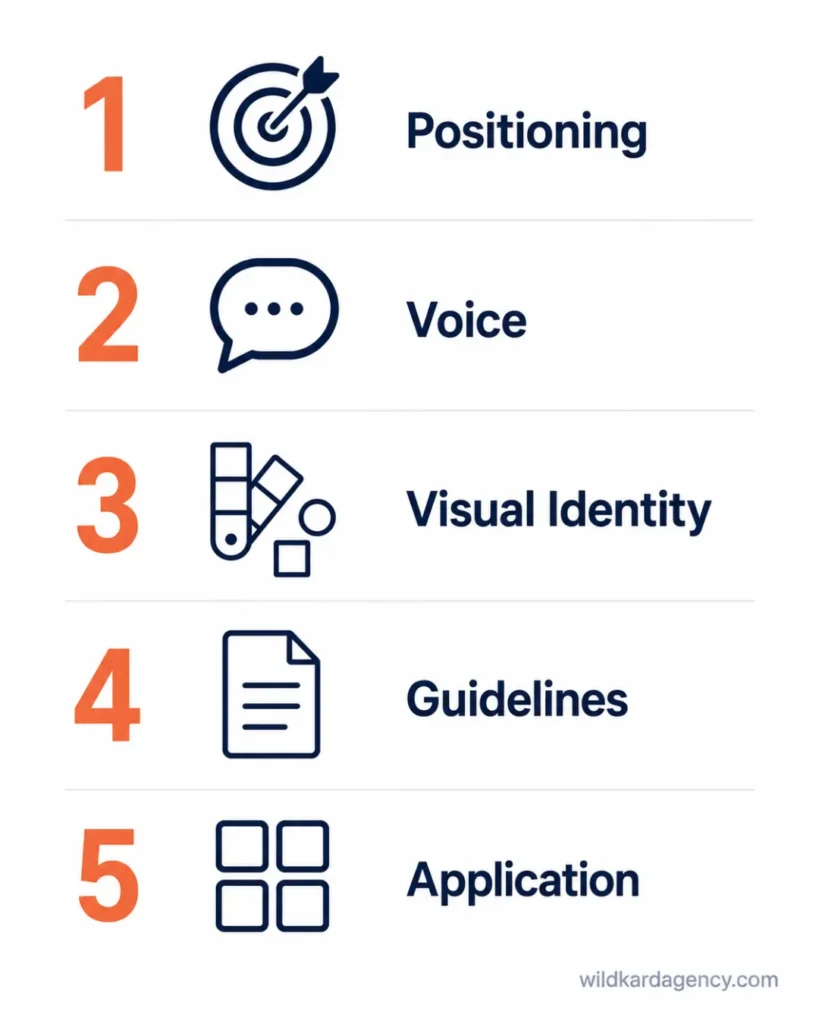
Skipping straight to the visual identity step, which is what most DIY branding and cut-rate logo services do, is precisely the pattern behind Tropicana-style failures. The visual work is the part people notice. The positioning work is the part that determines whether the visual work actually helps. This is also where brand identity and content strategy overlap directly: the same voice and positioning work that anchors a brand identity is what makes content marketing for service businesses actually sound consistent post to post, instead of like five different writers guessing at the tone.
What It Costs and How Long It Takes
A brand refresh, keeping the name and core identity but updating the visual execution, typically sits at the lower end of the $10,000 to $75,000 range most agencies quote for 2026, per current rebranding cost benchmarks. A full rebrand, changing name, message, and visual system together, sits at the higher end, and can take anywhere from a few months to over a year depending on how many touchpoints need updating.
For a small business, the more realistic and lower-risk starting point is almost always a refresh: keep what customers already recognize, fix what is actually dated or inconsistent, and reserve a full rebrand for the specific case where the current brand is actively misrepresenting the business today, not just looking a little tired.
Frequently Asked Questions
Does branding actually increase revenue for a small business?
The data suggests it can. Brand management professionals surveyed for Lucidpress’s 2019 report estimated revenue gains up to 33% from consistent branding. This is a self-reported estimate from industry professionals, not an independently measured outcome, so treat it as a strong directional signal rather than a guarantee.
Why do so many rebrands fail?
Nielsen research puts the rebrand failure rate at roughly 40%, and most failures share a pattern: the visual identity changes before the underlying positioning and customer recognition have been properly tested. Tropicana’s 2009 packaging redesign, which cost the company 20% of sales within weeks, is the clearest documented example.
Should a small business do a brand refresh or a full rebrand?
A refresh, updating the visual execution while keeping the core name and identity, carries meaningfully less risk and is the right starting point for most small businesses. A full rebrand is only justified when the current brand actively misrepresents the business today, not simply when it looks a little dated.
How does branding affect visibility in AI tools like ChatGPT?
AI answer engines build their understanding of a business from consistent signals across its website and the wider web. A brand that describes itself differently across its homepage, About page, and social profiles is harder for an AI system to confidently cite, since there is no single clear version of the brand’s story to reference.
What does a brand identity actually include beyond a logo?
Positioning, voice and messaging, visual identity, usable guidelines, and real-world application templates. A logo is one visible output of that system, not the system itself, which is why logo-only branding projects rarely produce the results a full identity process does.
| If you are trying to figure out whether your business needs a refresh, a full rebrand, or neither yet, we will give you a straight answer in a free 15-minute call. wildkardagency.com/request |