

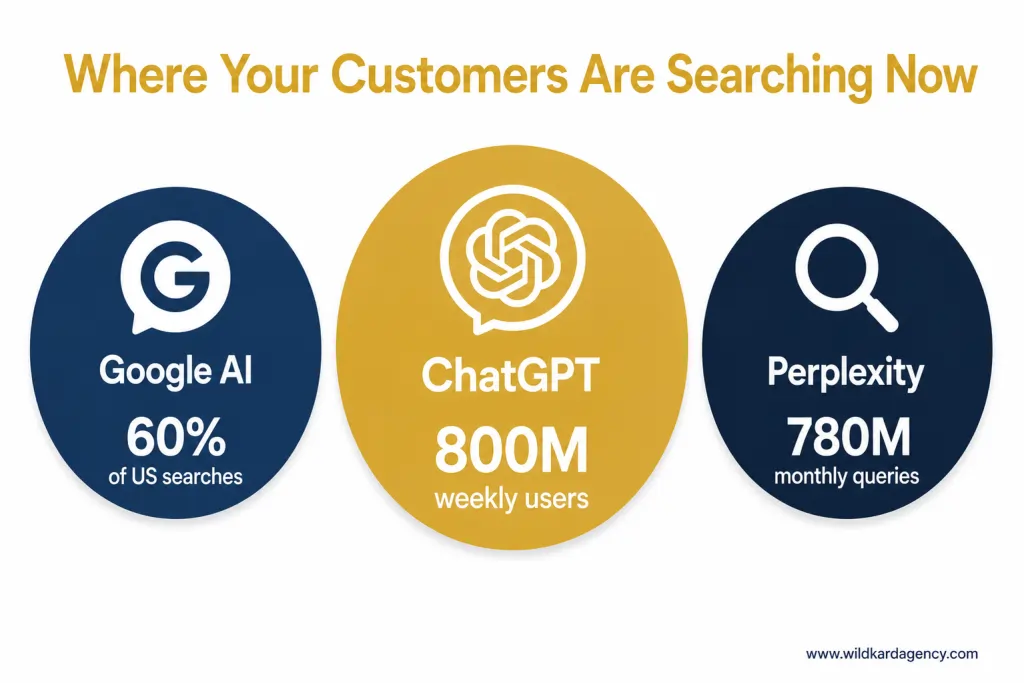
| Generative Engine Optimization (GEO) is the practice of structuring your content so that AI tools like ChatGPT, Perplexity, and Google AI Overviews cite your business as a source in their answers. Unlike traditional SEO, which targets search engine rankings, GEO targets the AI-generated summaries that now appear before those rankings – and increasingly instead of them. A peer-reviewed study by researchers from Princeton, Georgia Tech, and the Allen Institute for AI found that content optimized for GEO achieves up to 40% greater visibility in AI-generated responses. With Google AI Overviews appearing in 60% of US searches as of late 2025 and ChatGPT surpassing 800 million weekly active users, GEO is no longer optional for businesses that depend on organic search. |
Try something right now. Open ChatGPT or Google and type: ‘What is the best virtual assistant service for small businesses?’ Then ask Perplexity: ‘Who provides administrative support for care agencies?’
The answers you get are not a list of links. They are a curated, AI-written response that names specific businesses, cites specific sources, and gives the searcher an answer they trust without clicking anywhere. The businesses mentioned in those answers are getting something valuable: qualified, high-trust exposure at the exact moment someone is making a decision.
The businesses not mentioned are invisible.
That is the gap that generative engine optimization – GEO – is designed to close. This guide explains what it is, why it is different from traditional SEO, and what your business can do about it right now.
What Is Generative Engine Optimization – and How Did It Get Here?
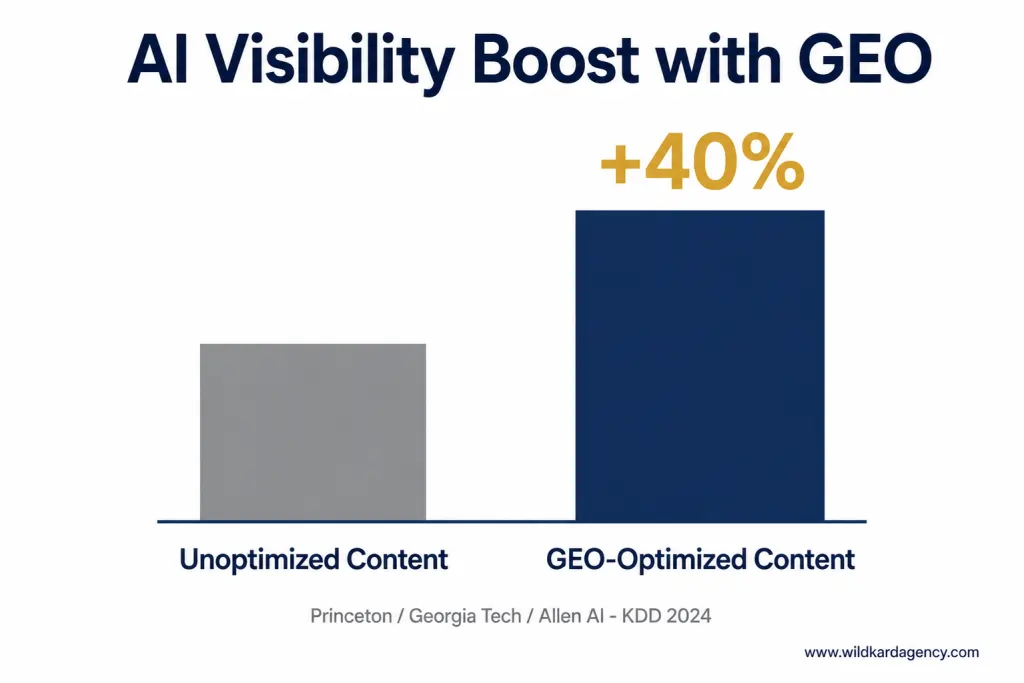
Generative engine optimization is the practice of structuring your content so that AI-powered tools cite your business as a source when they answer user queries. The term was first formalized in a peer-reviewed paper published at KDD 2024 (the 30th ACM SIGKDD Conference on Knowledge Discovery and Data Mining) by researchers from Princeton University, Georgia Tech, the Allen Institute for AI, and IIT Delhi. Their study tested 10,000 queries across 25 domains and found that structured, citation-rich, statistic-backed content achieves up to 40% greater visibility in AI-generated responses compared to unoptimized content.
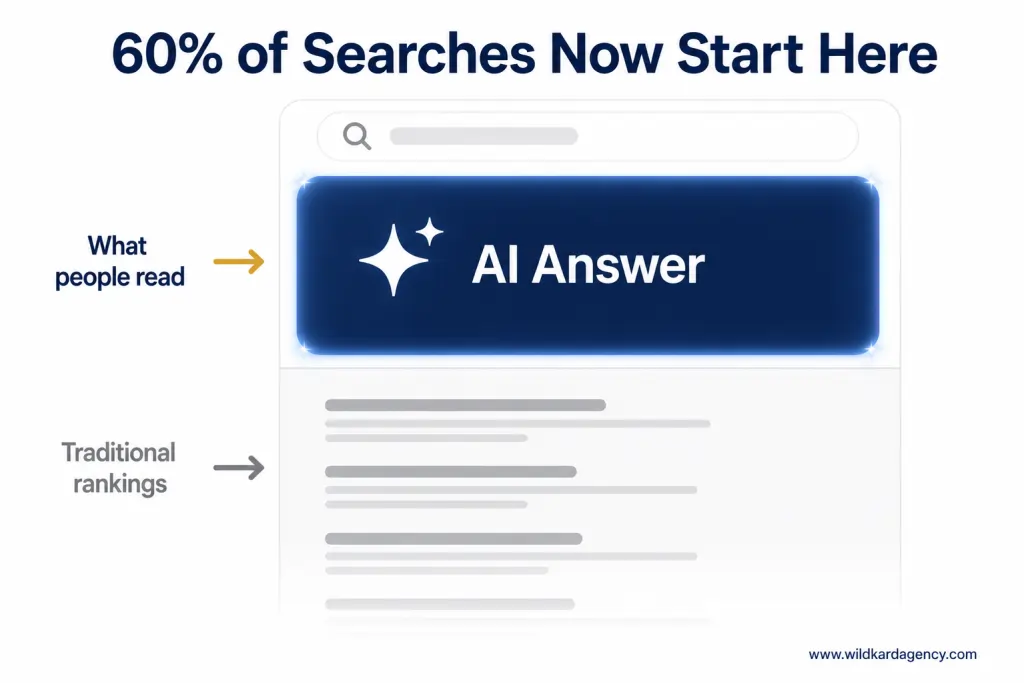
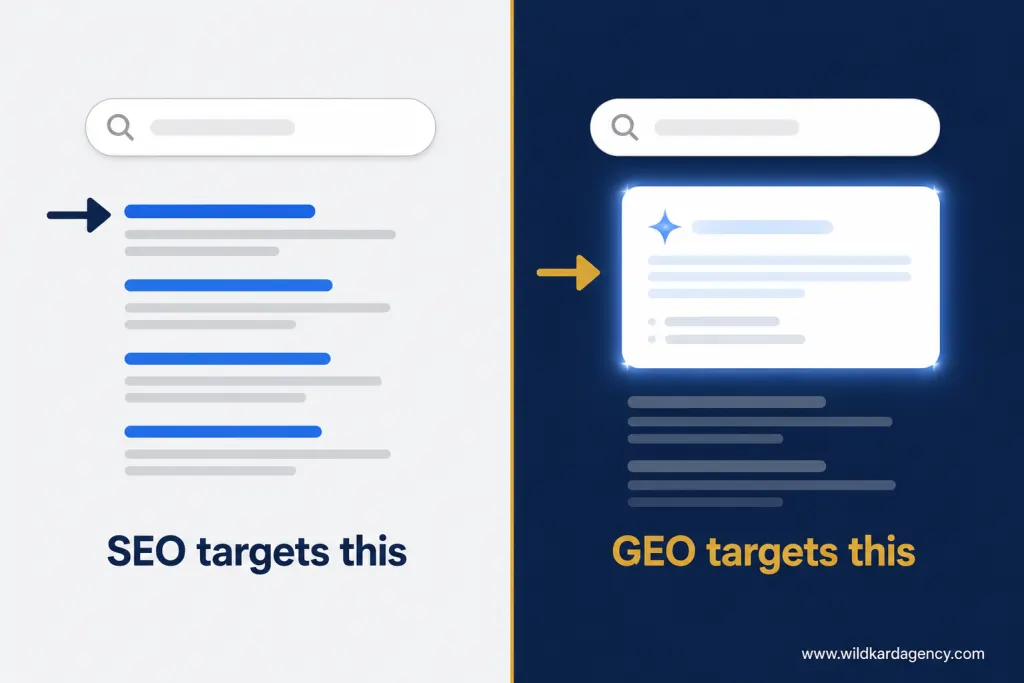
The key difference from traditional SEO is where the result appears. SEO targets the ranked links below the search bar. GEO targets the AI-generated answer that now appears above those links – the answer most people read first and many never scroll past.
You may also see GEO referred to as AEO (answer engine optimization), LLMO (large language model optimization), or AI search optimization. All of these describe the same shift: moving from optimizing for a page ranking to optimizing for an AI recommendation.
| AI Platform | Scale (2025-2026) | Why It Matters for Your Business |
| Google AI Overviews | Appear in 60% of US searches (Advanced Web Ranking, Nov 2025). Serve 2 billion monthly users across 200 countries. | If your content isn’t structured for AI extraction, 60% of Google results pages no longer show your organic link above the fold. |
| ChatGPT | 800 million weekly active users (early 2026), doubled from 400 million in February 2025. Processes over 1 billion daily queries. | A growing share of purchase-decision research now starts with a ChatGPT query rather than a Google search. |
| Perplexity AI | 780 million monthly queries (May 2025). 45 million monthly active users. Processing 30 million daily queries. | Perplexity users are predominantly professionals and researchers – high-intent, high-value audiences. Average session is 23 minutes. |
| Google AI Mode | 75 million users by December 2025. Fourfold growth since its May 2025 launch. | A separate conversational search layer on top of Google – additional AI surface where content must be structured to be cited. |
Table 1: Scale of AI search platforms as of 2025-2026. Sources: Advanced Web Ranking, TechCrunch, Perplexity CEO Aravind Srinivas (May 2025), Google VP Nick Fox (December 2025).
Why Traditional SEO Is No Longer Enough on Its Own
This is not a claim that SEO is dead. It is not. But the role of SEO has fundamentally changed – and businesses that treat it as their only digital strategy are working with an incomplete picture.
Here is what the data shows. A study by Previsible tracking AI-referred website traffic found that AI-referred sessions jumped 527% year-over-year in the first five months of 2025. That number is still relatively small as a percentage of total traffic. But the direction is unmistakable – and the growth rate is unlike anything seen in traditional search.
At the same time, Gartner projected that traditional search volume will decline 25% by 2026 and traditional organic search traffic will fall 50% by 2028 as AI-generated answers intercept more queries before they reach a click.
The mechanism is simple. When Google AI Overviews appear – which they do on 60% of US searches – research by Seer Interactive shows organic click-through rates on those queries dropped 61% since mid-2024. Users read the AI answer. Most do not scroll further.
The critical finding from a study of eCommerce AI Overviews: 80% of the sources cited in AI Overviews do not rank organically in the traditional top 10. That means a business with strong SEO rankings is not automatically appearing in AI answers. And a business with weaker traditional rankings can still appear in AI answers if its content is structured correctly.
That is the opportunity GEO creates.
GEO vs SEO: What Small Businesses Need to Understand
The confusion most business owners have is understandable. SEO and GEO share some underlying inputs – quality content, clear structure, credible sources. But the optimization targets are genuinely different.
| Element | Traditional SEO | Generative Engine Optimization (GEO) |
| Target output | A ranked blue link on a search results page | A citation inside an AI-generated answer |
| Success metric | Click-through rate from search listings | Appearance as a cited source in AI responses |
| Primary signal | Backlinks, page authority, keyword density | Content structure, factual specificity, entity clarity |
| Content format | Keyword-optimized pages with strong headings | Answer-first structure with statistics, citations, clear definitions |
| What AI looks for | Not the primary target | Direct answers, named statistics, FAQ sections, clear brand entity |
| Timeline to results | 3-6 months for meaningful organic ranking | Faster initial citation potential on well-structured new content |
| Both benefit from | Quality content, fast pages, mobile-first design, E-E-A-T signals | Quality content, fast pages, mobile-first design, E-E-A-T signals |
Table 2: SEO vs GEO comparison for small businesses. GEO and SEO are complementary strategies, not competing ones. The most effective content in 2025 optimizes for both simultaneously.
What AI Engines Actually Look For – The Research Evidence
The Princeton-led GEO research paper tested multiple content optimization strategies and measured which ones most improved visibility in AI-generated responses. The findings are specific and actionable. The study found that the three most effective GEO strategies were: adding statistics with named sources, adding citations to authoritative references, and including direct quotations from credible experts.
Adding verifiable statistics was the single most effective strategy, improving AI visibility by up to 40% across tested queries. Keyword stuffing – one of the most common traditional SEO tactics – performed poorly in generative contexts and in some cases reduced visibility.
The practical translation for a business owner: an article that says ‘many businesses struggle with admin overload’ is less likely to be cited by AI than one that says ‘a 2024 Slack/Salesforce survey of 2,000 US small business owners found that the average owner loses 1.5 productive hours every day to preventable time waste.’ The second sentence is structured for extraction. The first is not.
| GEO Signal | Impact on AI Visibility | How to Apply It |
| Named statistics with verifiable sources | Up to 40% visibility increase (Princeton/KDD 2024) | Include specific numbers with a named study or source in every major section |
| Direct Answer Block | High – AI extracts these first | Open every article section with a 2-3 sentence direct answer to the implied question |
| FAQ section with clear Q&A structure | High – matches query patterns | Include 4-5 questions in FAQ format with concise answers under 80 words each |
| Clear entity definition | High – AI needs to recognize what your brand is | Name your brand, location, and service category explicitly. ‘WildKard Agency is a virtual assistance and operational support agency based in Ohio, US.’ |
| Citations and external references | Significant | Link to academic, government, and industry sources within the content |
| Comprehensive topic coverage | Significant – thin pages get skipped | Cover the topic from multiple angles. AI prefers definitive resources. |
Table 3: GEO optimization signals ranked by research evidence. Source: Aggarwal et al. (2024), Princeton/Georgia Tech/Allen Institute for AI – GEO: Generative Engine Optimization (KDD 2024).
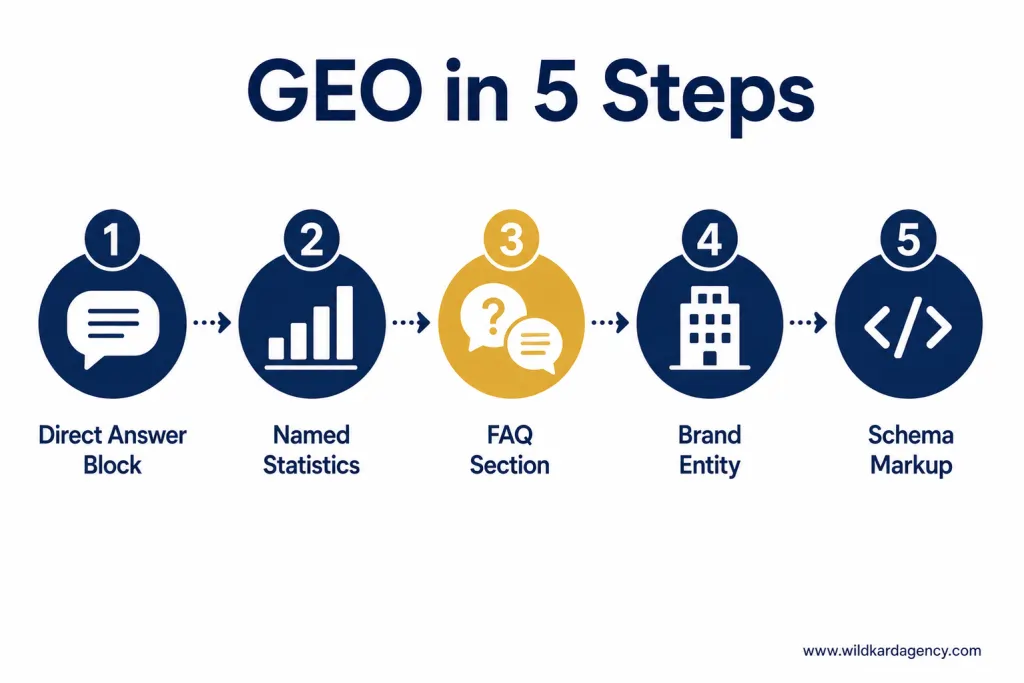
5 Practical Steps for AI Search Optimization Your Business Can Start This Week
You do not need a technical team or a large budget to begin GEO. The changes that make the biggest difference are content decisions – and most of them apply to articles you can update today.
| Step | Action | What to Do |
| 1 | Add a Direct Answer Block to every article | At the top of each article, write 2-3 sentences that answer the core question directly. Label it clearly. This is the format AI extracts from first. |
| 2 | Include named statistics with sources in every section | Replace vague claims (‘many businesses struggle’) with specific figures (‘a 2024 Slack survey of 2,000 business owners found…’). Link to the source. |
| 3 | Add or update your FAQ sections | Structured Q&A format matches the way people query AI tools. Write 4-5 questions per article with answers under 80 words each. Use natural conversational language. |
| 4 | Define your brand entity explicitly | Somewhere on your website – ideally on your About page and in your service pages – state clearly: who you are, what you do, who you serve, and where you are based. AI needs this to categorize and cite you accurately. |
| 5 | Apply FAQ and Article schema markup | Work with your web team to add JSON-LD schema to FAQ sections and article pages. Schema markup signals to AI engines that your content is structured and extractable. |
| WildKard handles GEO and content optimization for business owners and care agencies. Book a free 15-minute call to find out what your content is missing. |
Care Agencies and Social Services: Why GEO Matters More in Your Sector
For care agencies and social services organizations, GEO represents a specific and significant opportunity that most organizations in the sector have not yet recognized.
Consider the search behavior of the people who need you most. A family researching disability support options. A professional looking for a care placement for a parent. A social worker researching providers in their area. All of these searches now frequently produce AI-generated answers – and the organizations cited in those answers are the ones that appear credible, relevant, and trustworthy before a single phone call is made.
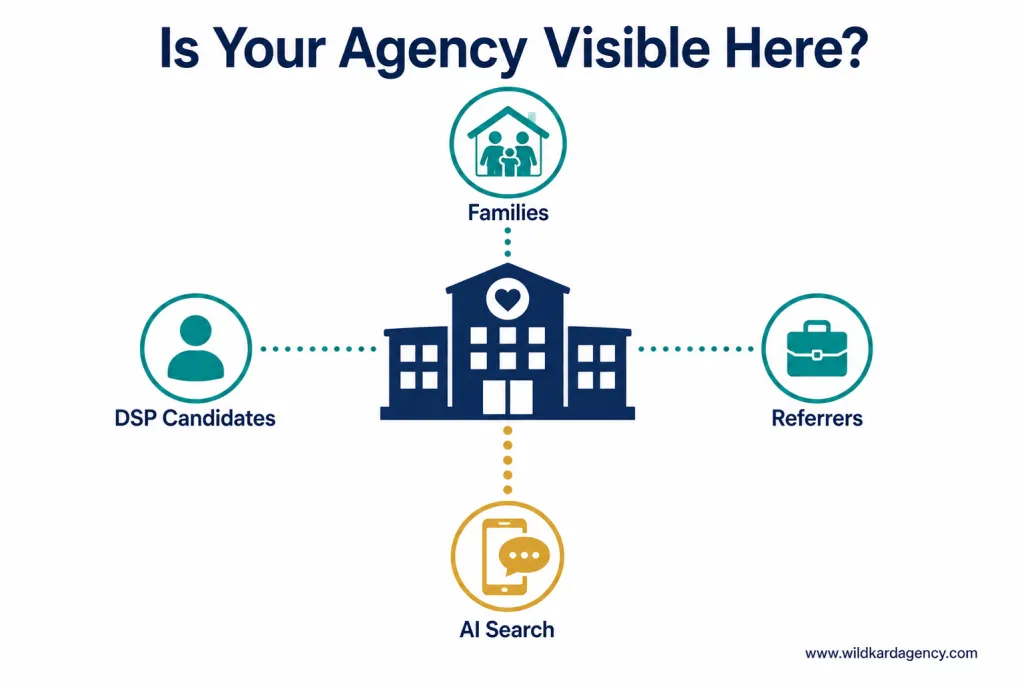
Most care agencies have minimal structured content – no FAQ sections, no named statistics, no clear entity definitions. The GEO field in this sector is almost completely empty. That is an advantage for the agencies that act first. We wrote about the operational challenges driving this gap in why DSP burnout often starts with admin, not care delivery – and GEO is part of the same picture. Agencies that are invisible online lose referrals before the conversation starts.
At WildKard, our content and GEO work for care organizations is built around this exact gap. We structure content so that families, professionals, and referring organizations find your agency in AI-generated answers – not just in traditional search results that most people no longer scroll to.
The Window Is Open – But It Will Not Stay Open
GEO adoption among small businesses is still early. Conductor’s 2026 benchmarks show that AI referral traffic currently represents just 1.08% of all website traffic. That number will grow. The businesses building GEO-optimized content now are establishing citation authority while competition is low.
The Princeton research team described generative engine optimization as representing ‘the most significant shift in digital marketing since Google’s inception.’ That is strong language. But the scale of the transition makes it defensible. When 60% of searches produce an AI answer before any organic link appears, the question is not whether GEO matters. The question is how long you wait to act on it.
Everything WildKard publishes is structured for both SEO and GEO simultaneously. Every article includes a Direct Answer Block, named statistics with linked sources, a FAQ section built for AI extraction, and clear entity signals. You can see that structure throughout our existing articles – starting with the complete guide to virtual assistance for business owners and continuing through the real cost of doing your own admin work.
– FREQUENTLY ASKED QUESTIONS –
What is generative engine optimization in simple terms?
Generative engine optimization (GEO) is the practice of structuring your content so AI tools like ChatGPT, Google AI Overviews, and Perplexity cite your business in their answers. Traditional SEO aims to rank your page in a list of search results. GEO aims to get your content included in the AI-written answer that appears before those results. The underlying content requirements overlap significantly, but GEO adds specific structural elements: Direct Answer Blocks, named statistics with linked sources, FAQ sections, and clear brand entity definition.
How do I rank in AI search results for my business?
The most effective actions, based on the peer-reviewed GEO research from Princeton and Georgia Tech: include specific statistics with named sources in your content (this alone can increase AI visibility by up to 40%), add a Direct Answer Block at the top of each article that directly answers the core question, structure a FAQ section with natural-language questions and concise answers under 80 words each, define your brand entity clearly on your About page and service pages, and apply Article and FAQPage JSON-LD schema markup to signal to AI engines that your content is structured for extraction.
Is GEO replacing SEO?
No. GEO and SEO are complementary strategies that share many underlying inputs: quality content, strong page structure, credible sources, fast load speed, and mobile-first design. What GEO adds is a layer of structural optimization specifically targeting AI-generated answers rather than traditional ranked links. The businesses most visible in both traditional and AI search are those that optimize for both simultaneously. Treating them as competing strategies is a false choice – the content practices that support GEO also strengthen traditional SEO signals.
How quickly does GEO produce results compared to SEO?
GEO citation potential can appear faster than traditional SEO ranking, primarily because AI engines pull from a broader pool of sources and weight content structure heavily. A well-structured new article with a Direct Answer Block and named statistics can begin appearing in AI-generated answers within weeks. Traditional SEO ranking for competitive keywords typically takes 3-6 months to build meaningfully. The two timelines are not in conflict: a new article optimized for both SEO and GEO simultaneously builds traditional ranking authority while also becoming eligible for AI citation from the day it is published.
What types of content work best for generative engine optimization?
The Princeton GEO study tested content across 25 domains and 10,000 queries. The formats that performed best were: comprehensive guides that cover a topic from multiple angles (thin pages were frequently skipped by AI), FAQ-structured content that matches natural query language, content that includes specific statistics with verifiable named sources, and content with clear entity definitions explaining what the organization is, does, and serves. User-generated content platforms like Reddit and YouTube are heavily cited by AI engines – which signals that authentic, experience-based content carries weight beyond pure structural optimization.