

| You need a virtual assistant when administrative, scheduling, and operational tasks are consistently consuming time you should spend on revenue-generating or strategic work. The clearest signs: you’re missing follow-ups, working outside business hours on non-core tasks, turning down opportunities because you lack bandwidth, or spending more than 2 hours a day on work someone else could handle. A 2024 Slack/Salesforce survey of 2,000 US small business owners found the average owner loses 1.5 productive hours every day to preventable time waste – with admin ranking as the second most common culprit. |
Most Business Owners Know They Have an Admin Overwhelm Problem. They Haven’t Fixed It Yet.
The problem isn’t awareness. Most founders can name three tasks they’d hand off tomorrow if they could. The hesitation is something else – uncertainty about timing, cost, or whether the admin overwhelm in their business is really bad enough to justify outside help.
This list cuts through that. If you’ve ever asked yourself “do I need a virtual assistant” and talked yourself out of it, read it carefully. If you recognise yourself in four or more of these signs you need a virtual assistant, the question isn’t whether to hire one. It’s how much longer you’re going to wait.
Admin overwhelm rarely announces itself. It builds quietly until a founder is working from their inbox instead of their calendar. For a deeper breakdown of what delegation actually looks like in practice, see our complete guide to virtual assistance for business owners. For now, here’s how to spot the moment you’re in it.
The Clearest Signs You Need a Virtual Assistant Right Now
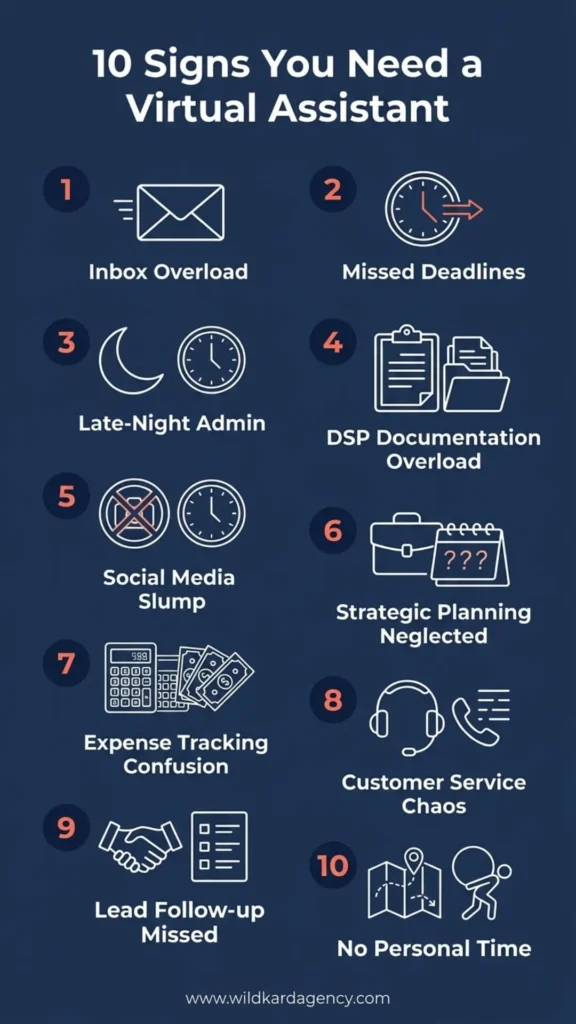
Sign 1. Your inbox runs you – not the other way around.
You start every morning behind. Replies take longer than they should. Things fall through the gaps. A VA handles inbox triage, drafts responses, and flags urgent items. According to the Agility PR time management survey, 33% of entrepreneurs name email as the single biggest time drain on their business.
Sign 2. Scheduling takes longer than the actual meetings.
Back-and-forth emails to agree a time, rescheduling, reminders you have to send yourself, calendar conflicts you only spot too late – none of this requires your judgment. It requires someone reliable to handle it. A VA coordinates your calendar end-to-end, including prep reminders and post-meeting follow-ups.
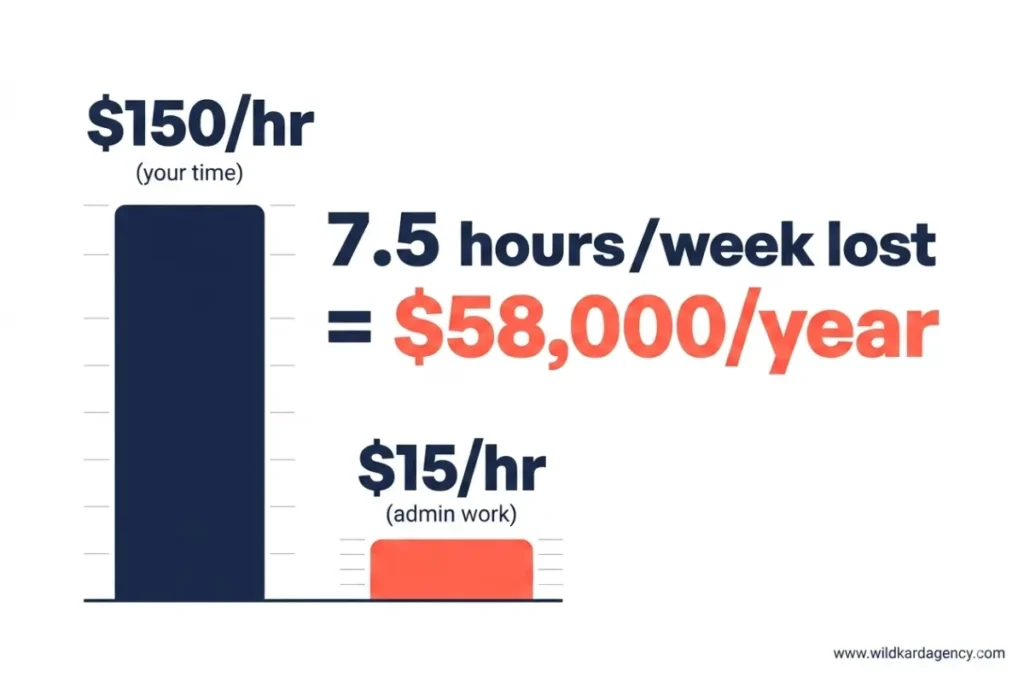
Sign 3. You’re doing $15/hour work on a $150/hour schedule.
Data entry. Formatting. Updating spreadsheets. Researching suppliers. These tasks aren’t beneath you – they just cost too much when you’re the one doing them. The Slack/Salesforce 2024 survey found small business owners lose an average of 7.5 hours per week to preventable tasks. At $150/hour, that’s over $58,000 in lost productive value annually.
Sign 4. You’ve missed a follow-up, a deadline, or an opportunity because you were overwhelmed.
This one matters more than the others. When operational overload starts costing you actual business – missed leads, late deliverables, forgotten client check-ins – the cost of not delegating becomes measurable. A VA closes those gaps before they become losses.
Sign 5. You’re working evenings or weekends on tasks that aren’t your core work.
If you’re catching up on admin after hours, your daytime workload already exceeds what you can manage alone. A VA extends your effective capacity without extending your actual hours. That 1.5 hours of wasted daily time, reclaimed, is 7.5 hours back per week.
Recognising yourself in these? Book a free 15-minute call and we’ll map out exactly what you could hand off.
Sign 6. You have repeatable tasks that follow the same steps every time.
Weekly reports. Monthly invoicing. Social scheduling. Onboarding checklists. If a task follows a predictable process, it can be documented and delegated. Repeatable work is the easiest category to hand off – and often the most time-consuming to keep.
Sign 7. Your business growth has stalled because you don’t have capacity.
You’ve turned down work. Delayed a launch. Put off a proposal because you didn’t have bandwidth to service it. This is the most expensive sign on the list – because the cost is opportunity, not just time. The 2026 VA Industry Report notes that 41% of US small businesses now use at least one VA, primarily to remove exactly this bottleneck.
Sign 8. You spend more time coordinating than actually doing.
Chasing contractors, following up with clients, tracking deliverables across a dozen email threads – this is coordination, and it eats hours. It’s work a VA can absorb entirely. You make the decisions. The VA handles the follow-through.
Signs 9 and 10: For Social Services and Care Agencies
The following two signs are specific to directors and operations managers at DODD-certified agencies and care organisations. The admin pressure in care settings looks different – and the cost of ignoring it is different too.
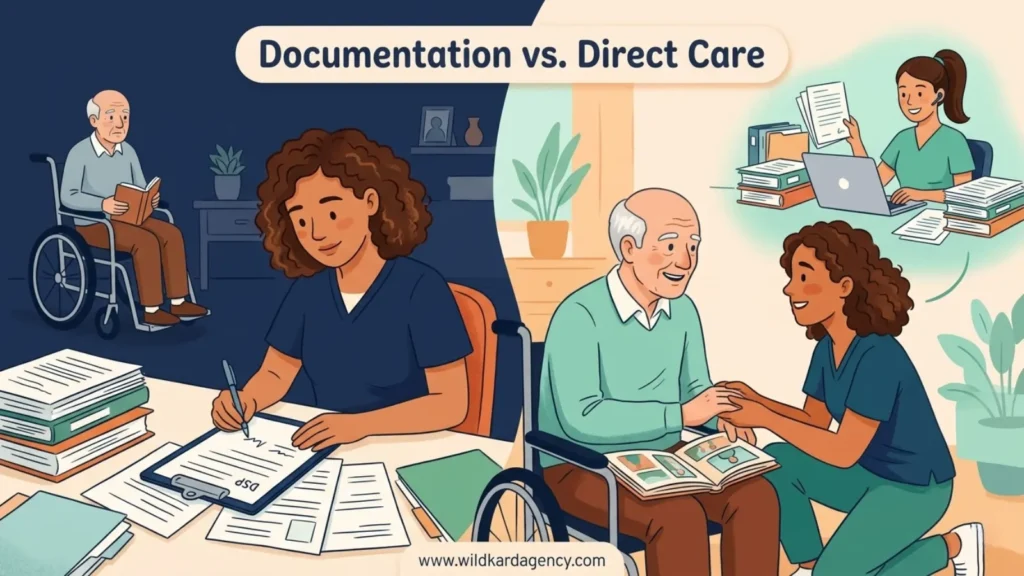
Sign 9. Your DSPs are handling documentation instead of delivering care.
When Direct Support Professionals spend portions of each shift on shift notes, incident reports, scheduling coordination, and compliance paperwork, that time comes directly out of care delivery. A 2024 JMIR Human Factors study specifically identified end-of-shift documentation as a significant, recurring friction point for DSPs – contributing to fatigue and reduced job satisfaction. A VA absorbs the non-regulated administrative layer so your staff can focus on the work they were hired to do. We go deeper on this pattern in why DSP burnout often starts with admin, not care delivery.
Sign 10. Your operations manager is the bottleneck for every new hire.
Every DSP hire passes through the same person – who also manages incident documentation, scheduling, compliance prep, and staff communications. When one person carries that load, you don’t have a staffing problem. You have a capacity problem. The NCI IDD State of the Workforce data shows turnover is highest at larger agencies – precisely where operational complexity is greatest. A VA takes onboarding coordination, document preparation, and process management off that plate.
When to Hire a VA: What Happens If You Wait?
There’s no perfect month to start. But there is a pattern. The question of when to hire a VA almost never gets a clean answer – because the owners asking it are already stretched past the point where they have time to properly evaluate it. Owners who wait for a quieter season to delegate business tasks usually find the quiet season never arrives – because the admin load is what’s keeping it busy in the first place.
The tasks don’t go away. They pile up. The missed follow-ups compound. The opportunity cost grows. The person best positioned to grow your business keeps spending prime hours on work that should have been delegated months ago.
The VA cost is fixed and predictable. The cost of not delegating is invisible – until it isn’t. And by then, you’ve already paid it. If the signs you need a virtual assistant are showing up in your business, the math on waiting almost never works out in your favour.
What a Virtual Assistant for Small Business Owners Actually Does First
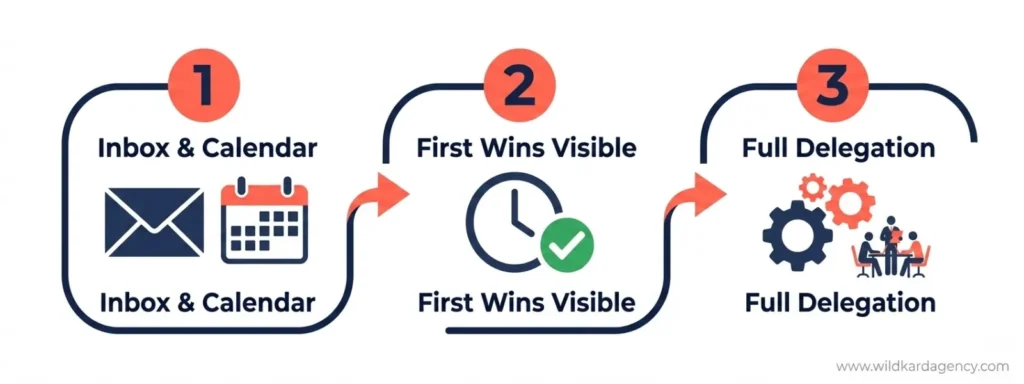
Onboarding a virtual assistant for small business owners doesn’t start with a long handover document. It starts with a short list – usually inbox, calendar, and one recurring report – and grows from there once trust is established.
At WildKard, the first task we take on for a new client is almost always inbox or calendar – the two areas owners describe as “the thing I never get on top of.” Within the first two weeks, most clients can already point to specific hours back in their week. That early win is what makes the next round of delegation easier – once an owner sees one task handled well, the next three or four follow within weeks, not months.
None of this requires a perfectly documented process on day one. It requires a starting point. See our virtual assistance services for how WildKard structures that first handoff.
Frequently Asked Questions
Do I need a virtual assistant if I only recognise two or three signs?
If you recognise three clearly, you’re ready. If you recognise five or more, you’ve probably been ready for a while. The threshold isn’t about a specific number – it’s about whether the cost of not acting is already measurable in your business.
I don’t know what to hand off first. Where do I start?
Start with one category: inbox or calendar. These are the highest-friction tasks for most owners and the easiest to hand off with clear expectations. Add one task at a time. Most clients have a full, natural delegation list within 60 days.
Can a VA handle care agency admin without understanding the sector?
For non-regulated administrative tasks, a capable VA can work effectively with good documentation and onboarding. That said, a VA with direct care sector experience – understanding DODD compliance context, knowing what shift documentation looks like, having worked alongside DSPs – will be significantly more effective from day one.
Sign 3 mentions $150/hour. What if my rate is lower?
The math still holds at any rate above VA cost. If your effective hourly rate is $60 and a VA costs $800/month, you need to reclaim roughly 14 hours per month to break even. Most clients identify that within the first two weeks. Everything after that is pure gain.
If any of these signs hit close to home, let’s talk. A 15-minute call is all it takes to map out what a handoff could look like.