

| This SEO and GEO guide for business owners covers both systems you now need to get found online. SEO earns your business a ranked position in Google’s results. GEO earns your business a citation inside AI-generated answers from ChatGPT, Perplexity, and Google AI Overviews. Both matter because 68% of Google searches now end without a single click to any website, and AI Overviews reduce the click-through rate of the number one Google result by roughly 60%. Realistic Google rankings take 3 to 6 months for most small business keywords, while GEO citations can appear faster because AI engines reward clearly structured, well-sourced content immediately. Most small businesses invest $1,500 to $5,000 a month in professional SEO and GEO work. This guide covers what actually moves both, what it costs, and a realistic timeline for results. |
Ranking on Google Used to Be the Whole Game. It Is Not Anymore
For twenty years, the advice for business owners was simple. Rank on Google’s first page, and the traffic follows. That advice is now only half true.
68% of Google searches ended without a single click to any website in early 2026, up from 60% in 2024, according to SparkToro’s 2026 clickstream analysis of Similarweb data. Some of that gap is Google answering the question itself. A growing share of it is AI. When an AI Overview appears above the traditional results, the number one organic listing loses roughly 60% of its click-through rate, per Ahrefs data cited in that same study.
At the same time, ChatGPT now has roughly 900 million weekly active users, and visitors who arrive at a website from an AI-generated answer convert at roughly 23 times the rate of traditional organic traffic, per a BrightEdge study of 1,200 websites, because the AI has already done part of the qualifying work before they ever click through.
This is the reality behind this SEO and GEO guide for business owners. Google rankings still matter. But they are no longer the only system deciding whether your business gets found. This guide covers what actually drives Google rankings in 2026, what makes AI engines cite you, what both cost, and a realistic timeline for results.
SEO vs GEO: What Each One Actually Does for a Business Owner
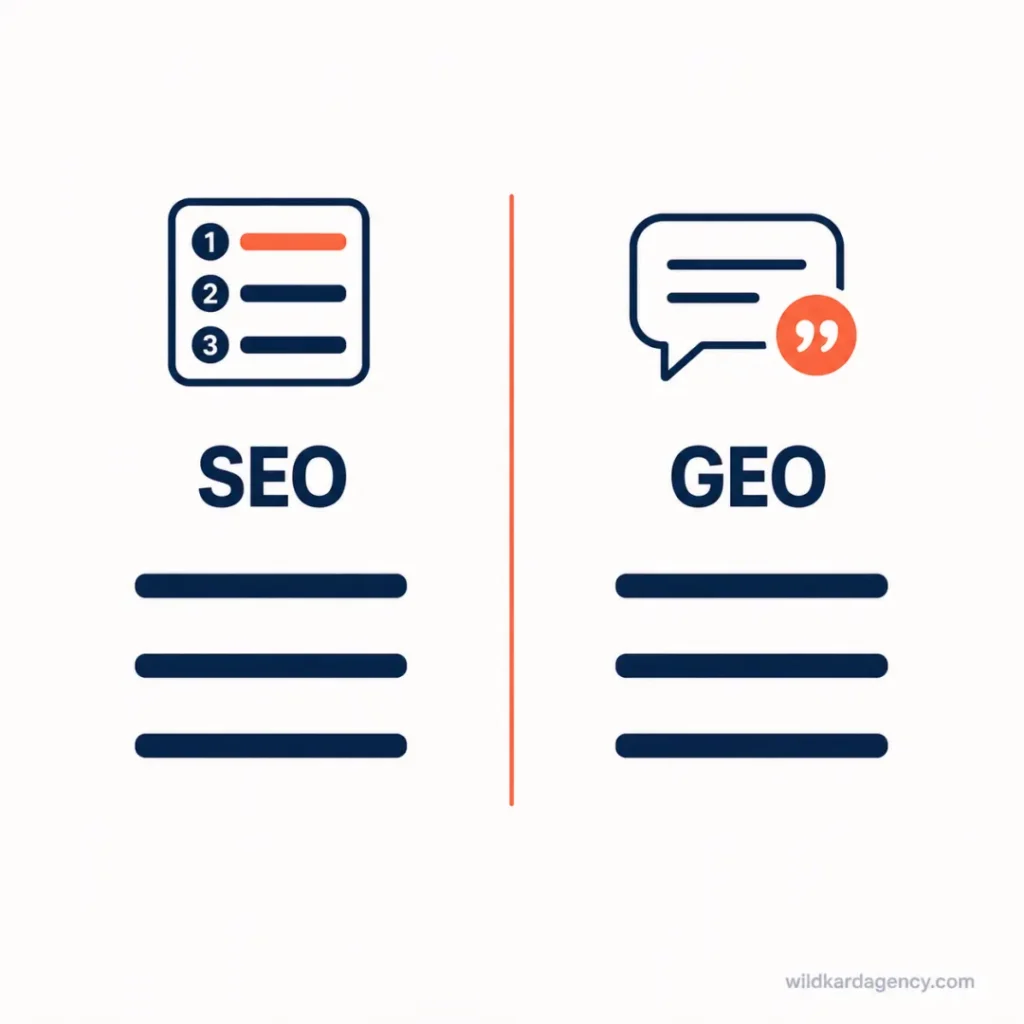
SEO, search engine optimization, earns your business a ranked position in Google’s list of results. GEO, Generative Engine Optimization, is the practice of structuring your content so that AI tools like ChatGPT, Perplexity, and Google AI Overviews cite your business as a source in their answers. One gets you a position on a page. The other gets you named inside the answer itself.
Neither replaces the other. SEO builds the foundation, crawlable pages, clear structure, topical depth, that GEO then builds on top of. A business with strong SEO and no GEO strategy still shows up on Google but stays invisible in AI-generated answers. A business chasing GEO with a thin, poorly structured site rarely earns citations at all, because AI engines still rely heavily on the same signals of quality and trust that Google does.
| SEO | GEO | |
| Goal | A ranked position in Google’s results | A citation inside an AI-generated answer |
| Measured by | Rankings, impressions, organic clicks | Citation frequency across AI platforms |
| Rewards | Keywords, backlinks, domain authority, page speed | Structured content, direct answers, verifiable facts, schema |
| Competing for | One of 10 blue links on a results page | One of a handful of sources an AI chooses to cite |
| Timeline | 3-6 months typical, longer for competitive terms | Can shift within weeks once content is restructured |
If your business has noticed traffic holding steady while enquiries quietly decline, it is worth checking why your business might not be showing up in ChatGPT results, since that is often the first visible symptom of this gap.
The 5 Google Ranking Factors That Actually Matter in 2026
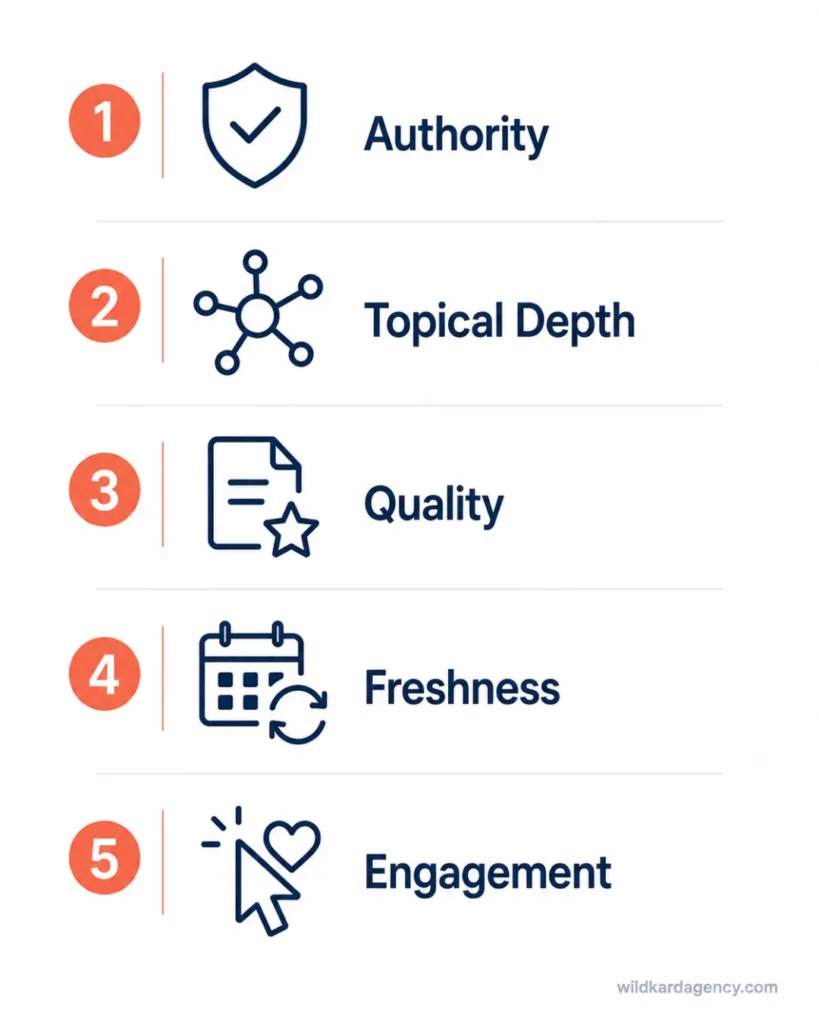
The May 2024 Google Content Warehouse API leak exposed more than 14,000 internal ranking attributes, and gave the SEO industry its clearest look yet at what Google actually measures. WordStream’s 2026 analysis groups those attributes into five buckets that matter most for a small business.
1. Domain authority
How much overall trust Google has assigned your site as a whole. This builds slowly, through consistent publishing, technical health, and genuine backlinks, not shortcuts.
2. Topical authority
Whether your site covers a subject deeply enough that Google treats you as a genuine resource on it, rather than a single page competing in isolation. This is the entire logic behind a pillar and cluster content structure.
3. Document quality
Google increasingly scores content for what the 2026 research calls content effort, original data, custom examples, expert input, and material that is meaningfully different from what already ranks. Thin, generic pages are filtered out under Google’s Helpful Content system.
4. Freshness
Pages that are reviewed and updated on a regular schedule outperform pages left untouched for years. Quarterly updates to your highest-value pages is a reasonable standard for most small businesses.
5. Engagement
Click-through rate, dwell time, and repeat visits all signal to Google whether a page actually satisfied the person who clicked on it. This is one more reason a page needs to be genuinely useful, not just technically optimized, and it is closely tied to the technical foundation covered in our guide to building a high-converting website: a slow, poorly structured site undermines every ranking factor above it, no matter how good the content is.
| 40.8% | Of new pages that do reach Google’s top 10 achieve it within their first month, but only for low-competition, long-tail keywords, per Ahrefs ranking timeline data. |
| 1.74% | Of all newly published pages reach the top 10 within their first year at all, which is why keyword selection matters more than publishing volume, per the same Ahrefs data. |
| 3.8x | More backlinks the average number one Google result has compared to positions 2 through 10, confirming backlinks remain a top ranking factor, from Backlinko’s analysis of 11.8 million search results. |
| 25-30% | Share of clicks the number one organic position still captures when no AI Overview is present, per 2026 CTR benchmark data, making that position worth fighting for. |
Backlinks remain part of this picture too. The average number one Google result has roughly 3.8 times more backlinks than pages ranking in positions 2 through 10, according to Backlinko’s analysis of 11.8 million search results. Quality and relevance matter far more than raw link count.
What Makes AI Engines Cite You Instead of a Competitor
AI engines like ChatGPT and Perplexity do not rank pages the way Google does. They retrieve and synthesize passages of content to construct an answer, then cite a handful of sources. Getting cited depends on a different, more specific set of signals than traditional SEO alone, which is the exact gap this SEO and GEO guide for business owners is built to close.
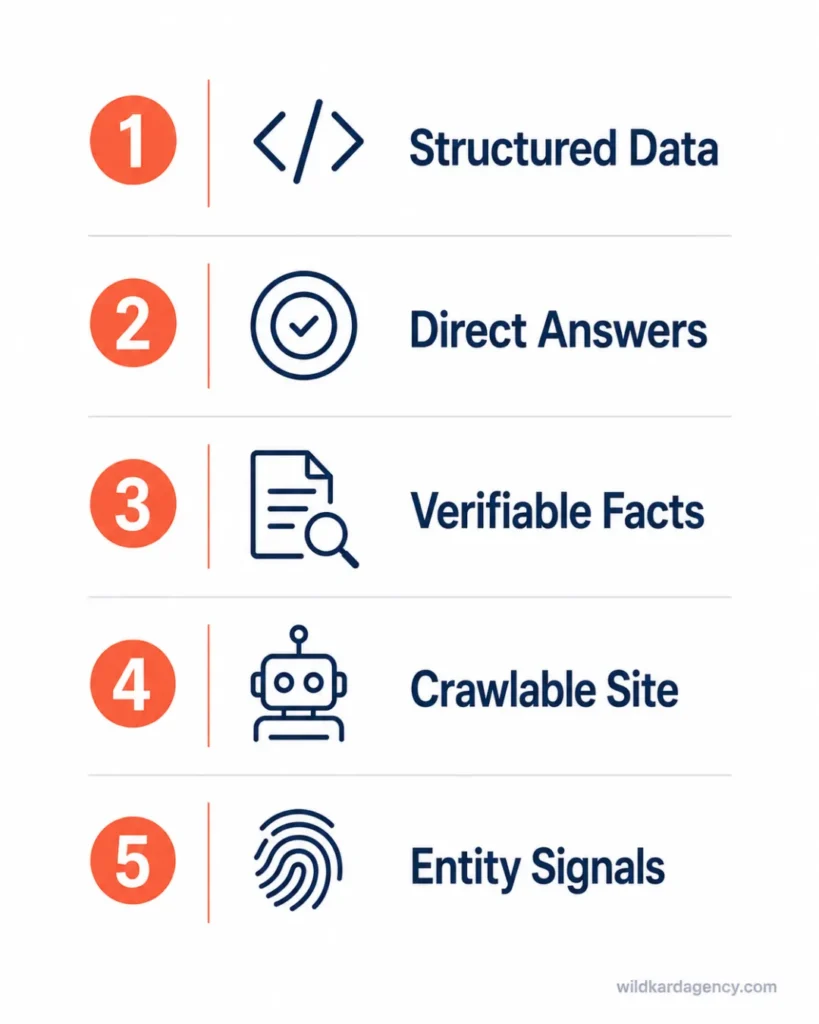
• Structured data and schema markup that clearly identifies what your business is and does
• Direct, answer-first content near the top of the page, not buried under paragraphs of setup
• Named sources, real statistics, and verifiable facts the AI can cite with confidence
• A crawlable site that AI bots are not accidentally blocked from, a surprisingly common technical failure
• Consistent entity signals, your business name, service, and location described the same way across your site and the wider web
We cover the full diagnostic for this in our guide to why a business might not be showing up in ChatGPT results, which walks through the seven most common, fixable reasons a well-built site still gets skipped by AI engines.
| If you are not sure whether your site is even visible to AI crawlers, we can check it in a free 15-minute call. wildkardagency.com/request |
A Realistic Timeline: How Long SEO and GEO Actually Take
This is where most SEO advice sets business owners up to be disappointed. Low-competition, long-tail keywords can move within weeks. Competitive, high-value terms take significantly longer, and no honest provider promises otherwise.
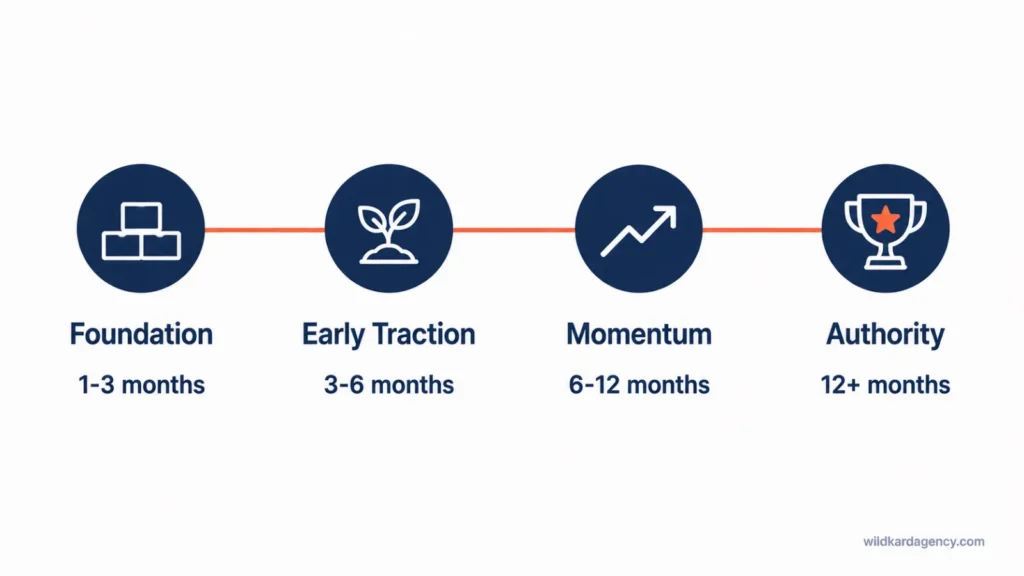
Months 1-3: Foundation
Technical fixes, on-page optimization, and the first wave of content go live. Google begins indexing. Rankings, where they appear at all, are unstable and often invisible outside Search Console.
Months 3-6: Early traction
Long-tail and low-competition keywords start moving into the top 20 to 30, and some reach page one. This is the phase where most small businesses see their first real organic enquiries.
Months 6-12: Momentum
Core service pages and moderately competitive terms gain ground. Content published in month one has had time to age, earn links, and build the engagement signals Google rewards.
12+ months: Authority
Competitive head terms become realistically winnable. Domain authority compounds, and the cost per enquiry from organic search typically drops well below paid acquisition by this stage.
40.8% of new pages that do reach Google’s top 10 get there within their first month, but that figure applies only to low-competition, long-tail keywords, per Ahrefs timeline data. Across all new pages published, only 1.74% reach the top 10 within their first year at all. The difference between those two numbers is almost entirely keyword selection, which is why a realistic strategy targets achievable terms first and builds toward competitive ones.
What SEO and GEO Actually Cost for a Small Business
SEO pricing is one of the least transparent parts of digital marketing, largely because “SEO” can mean anything from light local optimization to a full technical, content, and authority program. Here is what 2026 market data actually shows.
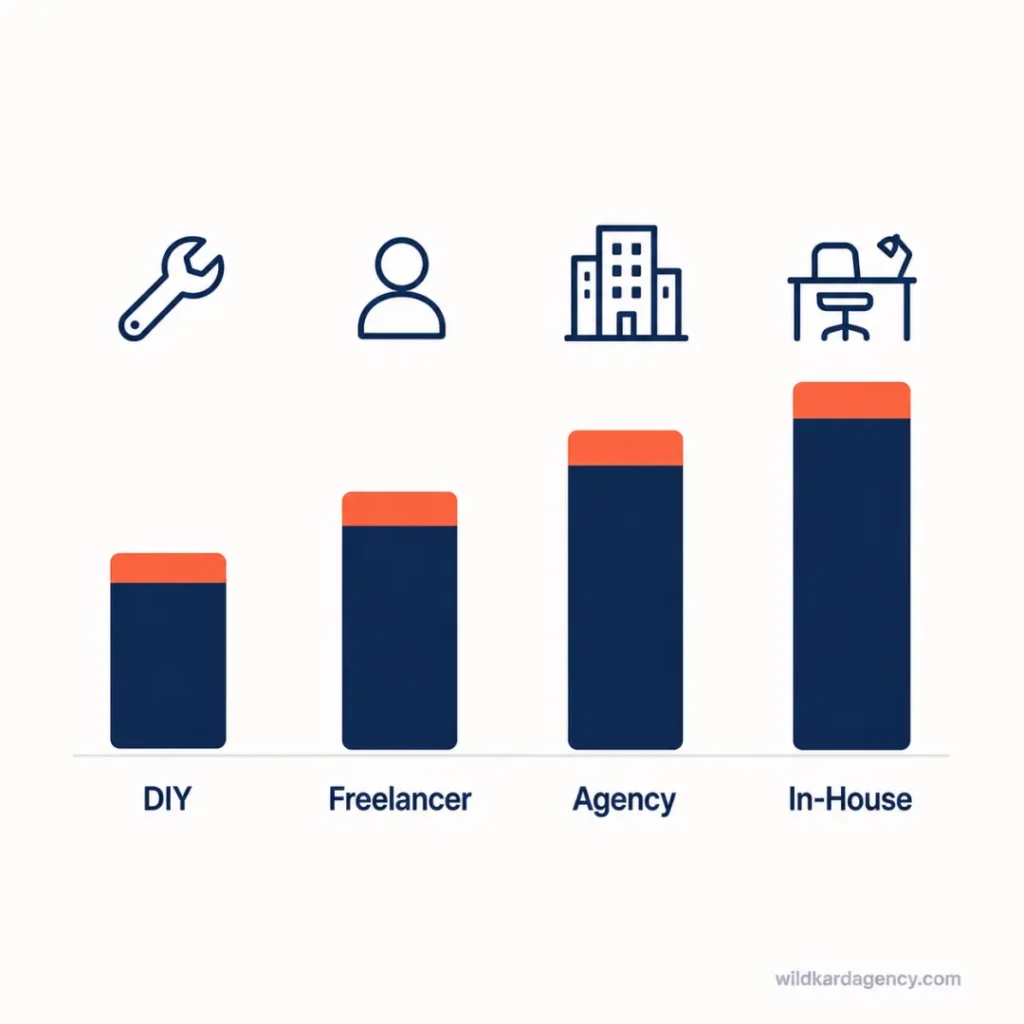
• DIY with tools only: $100 to $500 a month in software (Ahrefs, SEMrush), plus your own time, which is the real cost
• Freelancer: $300 to $2,000 a month, strong for narrow scopes, limited by one person covering technical, content, and authority work at once
• Agency retainer: $1,500 to $5,000 a month for most small businesses, the range where comprehensive SEO and GEO work together
• In-house specialist: $70,000 to $90,000 a year in salary alone, before tools and overhead, before you have covered every discipline SEO now requires
Across 2026 industry surveys from Ahrefs and Clutch, the average small business SEO retainer sits between $2,500 and $3,200 a month. Budgets under roughly $500 a month rarely fund enough real work to move rankings, regardless of what is promised. Most providers now fold GEO into the same retainer rather than pricing it separately, since the two increasingly rely on the same underlying content quality.
A Practical Way to Start: How We Approach This at WildKard
Every piece of content we publish is built around a pillar and cluster structure, one comprehensive guide per core topic, supported by five focused cluster articles that each target a specific question and link back to the pillar. This is not a theoretical framework. It is the same structure this article is part of, and it is deliberately built to satisfy both Google’s topical authority signals and the passage-level retrieval that AI engines rely on.
Every article we publish, including this one, follows a fixed protocol: a direct answer near the top for both readers and AI systems, named and hyperlinked statistics rather than vague claims, FAQ sections structured for schema markup, and internal links that build a genuine topic cluster rather than a scattered blog. That protocol is why this guide itself is built the way it is, and it is the same protocol behind every SEO and GEO guide for business owners we publish going forward.
Frequently Asked Questions
What is the difference between SEO and GEO?
SEO earns your business a ranked position in Google’s list of results. GEO earns your business a citation inside AI-generated answers from tools like ChatGPT, Perplexity, and Google AI Overviews. This is the core distinction this SEO and GEO guide for business owners is built around: GEO builds on top of strong SEO rather than replacing it, and both are needed to be found across the full range of how people now search.
How long does SEO take to work for a small business?
Most small businesses see early traction on long-tail keywords within 3 to 6 months, with more competitive terms taking 6 to 12 months or longer. Some low-competition pages can reach page one within weeks. Anyone promising fast rankings for competitive terms is setting an unrealistic expectation.
How much should a small business spend on SEO and GEO?
Most small businesses invest between $1,500 and $5,000 a month for comprehensive SEO and GEO work, with the 2026 industry average sitting closer to $2,500 to $3,200 a month. Budgets under roughly $500 a month rarely fund enough real work to move rankings meaningfully.
Do I need to choose between SEO and GEO?
No. The strongest 2026 strategies combine both, since GEO relies on much of the same content quality, structure, and technical health that SEO already requires. Treating them as separate budgets or separate strategies usually wastes effort that could compound across both.
Why is my website ranking on Google but not showing up in ChatGPT?
Google rankings and AI citations are decided by different systems. Common reasons include AI crawlers being blocked in your robots.txt, missing schema markup that fails to clearly identify your business, and content that is not structured in a direct, answer-first format AI systems can retrieve easily.
| This SEO and GEO guide for business owners covers the foundation. If you want to know exactly where your business stands on both Google and AI search right now, we will show you in a free 15-minute call, no pitch. wildkardagency.com/request |