
| Website traffic but no enquiries almost always means a conversion problem, not a traffic problem. The seven most common causes are traffic that does not match buying intent, an unclear value proposition, a weak or buried call to action, missing trust signals, slow load times or a poor mobile experience, contact forms with too much friction, and slow response once an enquiry does come in. The average website converts only 2.9% of visitors, and most small business sites sit below that. Fixing these seven factors is almost always more cost-effective than buying more traffic, because it turns visitors you are already paying for into enquiries instead of losing them silently. |
You Are Not Imagining It. Traffic Is Not the Same as Enquiries
You check the analytics and the numbers look fine. Sessions are up. Rankings are holding. The blog post you published last month is pulling in visitors every week. And yet the contact form sits empty and the phone does not ring.
This is one of the most common and most misread problems in small business marketing. The instinct is almost always to chase more traffic, more ads, more posts, more keywords. But website traffic but no enquiries is rarely a traffic problem. It is a conversion problem, and pouring more visitors into a site that is not built to convert them just produces more of the same result, at a higher cost.
If you want the full picture of what a converting site actually looks like, our guide to building a high converting website for small business covers the foundation. This article is the diagnostic. Here are the seven most common, research-backed reasons your traffic is not turning into enquiries, and exactly what to do about each one.
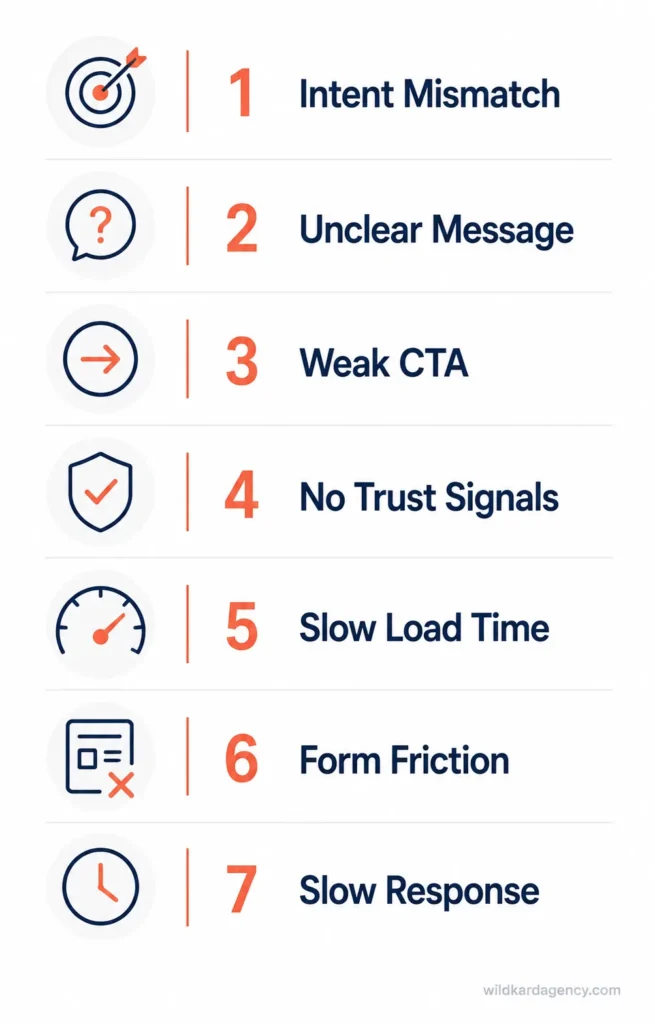
The 7 Reasons You Have Website Traffic But No Enquiries
1. Your traffic does not match buying intent
Someone searching “what is a virtual assistant” is researching. Someone searching “virtual assistant agency near me” is close to hiring one. If most of your traffic lands on broad, informational content and never reaches a page built to convert, your visit count climbs while your enquiries stay flat.
The fix: audit which pages are pulling in the most traffic, then check whether that traffic matches commercial or transactional intent. Content built around comparisons, pricing, and specific problems tends to convert at a meaningfully higher rate than broad educational posts.
2. Your value proposition is not clear in the first few seconds
Visitors decide whether to stay or leave within seconds of landing on a page. If a visitor cannot tell what you do, who it is for, and why it matters to them almost immediately, they leave, and no amount of good copy further down the page gets read.
The fix: your headline should state the outcome you deliver, not a vague description of your industry. “We handle your admin so you get your evenings back” tells a visitor more in one line than “comprehensive virtual assistance solutions” ever will.
3. Your call to action is weak, buried, or competing with itself
Calls to action placed above the fold see 102% higher click-through rates than ones buried further down the page, according to Nielsen Norman Group eye-tracking research. Pages with five different competing buttons, download this, watch that, book a call, sign up, read more, perform worse than pages with one clear next step.
The fix: pick a single primary action per page. Make the button copy specific to the outcome, “Get Your Free Website Audit” outperforms a generic “Submit” every time, because it answers what is actually in it for the visitor.
4. There are no visible trust signals near the point of decision
97% of consumers read reviews before contacting a business, according to BrightLocal’s 2026 research, and trust signals placed near a call to action can lift conversions by 15 to 34%. A site with no testimonials, no named clients, and no visible credibility markers is asking a stranger to take a leap of faith.
The fix: place a real testimonial, a client name where possible, or a specific credential directly beside your primary call to action, not buried on a separate page nobody visits.
| 2.9% | Average website conversion rate across industries in 2026. Most small business websites convert below this (aggregated 2026 benchmark data) |
| 102% | Higher click-through rate for calls to action placed above the fold versus below it, per Nielsen Norman Group eye-tracking research |
| 97% | Of consumers read reviews before contacting a business; trust signals placed near a call to action can lift conversions by 15-34% (BrightLocal, 2026) |
| 7.2% | Drop in conversions for every 1 second of added page load time; pages loading under 2.5 seconds convert 31% higher than slower ones (Portent / 2026 web performance data) |
| 7x | More likely a business is to qualify an enquiry if it responds within 1 hour versus later, according to the widely cited Oldroyd/Harvard Business Review response-time study |

| If you are not sure which of these seven is actually costing you enquiries, we will tell you in a 15-minute call, no pitch. wildkardagency.com/request |
5. Your site is slow, especially on mobile
Every additional second of load time drops conversions by roughly 7.2%, and pages loading under 2.5 seconds convert 31% higher than slower ones. Mobile traffic now makes up the majority of most small business sites, yet mobile pages are consistently slower and harder to navigate than their desktop equivalents.
The fix: run your site through a speed testing tool and treat anything under a 70 mobile score as an active conversion leak, not a minor technical detail to get to later.
6. Your contact form asks for too much, too soon
Long forms with dropdowns, text areas, and unnecessary fields reduce completion rates. A visitor willing to reach out is showing real intent. Asking them to fill in eight fields before they can send a two-line enquiry is friction that costs you the contact entirely.
The fix: strip your primary enquiry form down to name, email, and a single open message field. Ask qualifying questions after the first contact, not before it.
7. You respond too slowly once an enquiry does come in
This is the reason most businesses never check. The average B2B response time is 42 hours, and firms that respond within an hour are roughly 7 times more likely to qualify an enquiry than those that wait even slightly longer. A slow reply after all the work of earning the enquiry undoes everything that came before it.
The fix: build a same-day, ideally same-hour, response standard into your process, and test your own contact form monthly to confirm it still actually reaches someone.
3 Quick Ways to Increase Website Enquiries This Week
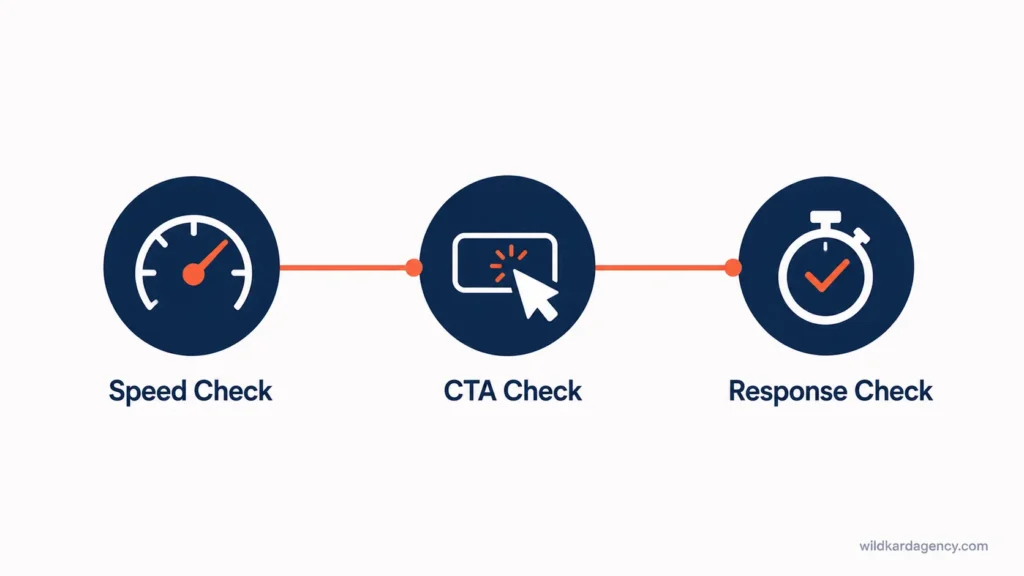
Before touching design or copy, these three checks catch the highest-impact leaks fastest, and none of them require a developer.
Run a speed test on your homepage from a phone, not a laptop. Anything under a 70 mobile score is losing you visitors before they read a word. Count the calls to action on your homepage. If there are more than two, remove the rest. Then submit a real test enquiry through your own contact form and time how long it takes for a human to respond.
How to Fix a Website That Is Not Converting Before You Buy More Traffic
It is tempting to treat website traffic but no enquiries as a reason to spend more on ads or content. In most cases, that just increases the number of visitors leaving through the same gap. Fixing conversion first, then scaling traffic, produces a far better return than doing it the other way around.
None of these seven fixes require a full rebuild. They require an honest audit of where visitors are actually dropping off, and the discipline to fix the highest-impact issue first. Speed and call-to-action clarity typically show results within one to two weeks of a fix going live.
Frequently Asked Questions
Why does my website get traffic but no enquiries?
Website traffic but no enquiries almost always comes from a mismatch between what your traffic is searching for and what your page offers, an unclear value proposition, a weak call to action, missing trust signals, slow load times, friction-heavy contact forms, or slow response once an enquiry arrives. It is almost always a conversion issue, not a traffic issue.
What is a good website conversion rate for a small business?
The average across industries is around 2.9%. For service businesses, 2 to 5% is considered healthy, and 5% or higher on a focused landing page is strong. If your site converts below 1%, that signals a significant, fixable problem rather than normal variation.
Should I fix conversion or get more traffic first?
Fix conversion first. A site converting at 1% that improves to 3% triples its enquiries from the same traffic, at no additional acquisition cost. Sending more visitors to a site that is not converting usually just increases the number of people leaving without contacting you.
How fast should I respond to a new website enquiry?
Within one hour during business hours. Research on B2B response times found businesses that respond within an hour are roughly 7 times more likely to qualify the enquiry than those that respond even slightly later. Speed to first response is one of the highest-leverage, lowest-cost fixes available.
Can slow page speed really cost me enquiries?
Yes. Each additional second of load time can reduce conversions by roughly 7.2%, and pages loading under 2.5 seconds convert meaningfully higher than slower ones. Since mobile traffic makes up the majority of most small business sites, mobile speed specifically deserves priority attention.
| If your website is getting traffic but the enquiries are not showing up, we will audit it against these seven factors and tell you exactly what to fix first. Book a free 15-minute call, no pitch. wildkardagency.com/request |