
The six signs it’s time to rebrand your business, and what a rebrand actually costs in 2026.
Somewhere in the last year, you’ve probably wondered if your brand is holding you back. A prospect went quiet after visiting your website. A competitor with a weaker offer keeps winning the pitch. Whether these are real signs it’s time to rebrand your business, or just a rough patch, is a question most owners sit with for months before doing anything about it.
That hesitation is expensive. A brand problem doesn’t announce itself the way a broken website does. It just quietly costs you deals, one at a time, until the pattern is too obvious to ignore.
The short answer: your business needs a rebrand when how you look and sound no longer matches the business you actually run, and that mismatch is costing you deals, credibility, or clarity inside your own team. Six signs make that call for you instead of a gut feeling: outgrowing your original story, a shrinking close rate, hesitating on your own materials, an identity that breaks outside print, a team that can’t describe you consistently, and weaker competitors out-positioning you in search and AI answers. If two or more of these are true right now, a rebrand isn’t vanity. It’s overdue maintenance.
Six Signs It’s Time to Rebrand Your Business (Not Just Refresh the Logo)
These six signs are specific to small, service-based businesses, not the mergers-and-international-expansion signs written for companies ten times your size. Each one ties to something measurable: a rate, a hesitation, a hire. Go through them honestly before you read any further.
None of them, on its own, is proof you need to spend five figures on new branding. A single sign is worth noting and watching. Two or more, especially when they’ve been true for more than a few months, is the pattern this article is actually about.
Your Business Outgrew the Name You Started With
Most small businesses pick a name and a visual identity in year one, usually before the business has fully become what it is. A firm that started doing logo design ends up running full digital marketing. A virtual assistant service ends up specializing in care agency admin support.

The name freezes the moment it’s chosen. The business keeps moving.
That gap is invisible to you because you live inside the business every day. It’s the first thing a stranger notices. If your company name or story describes a narrower service than what you actually sell today, prospects are quietly assuming you can’t do the bigger thing, before you get a chance to tell them otherwise.
That mismatch alone won’t sink a pitch. But it stacks with the next one.
Picture a virtual assistant service that started out handling inbox management and scheduling for solo founders. Two years in, the same team is running full care-agency admin support: shift-note formatting, onboarding paperwork, compliance correspondence. Nothing on the website, the name, or the one-line pitch mentions any of it.
A DODD provider who needs exactly that support scrolls past without a second look, because nothing in front of them signals it. The service exists. The story never caught up to it.
Your Close Rate Is Dropping and Your Price Hasn’t Changed
If the same offer, the same pricing, and the same sales conversations are converting less often than they did a year ago, the product usually isn’t the problem. The prospect’s exposure to your brand is the variable that changed.
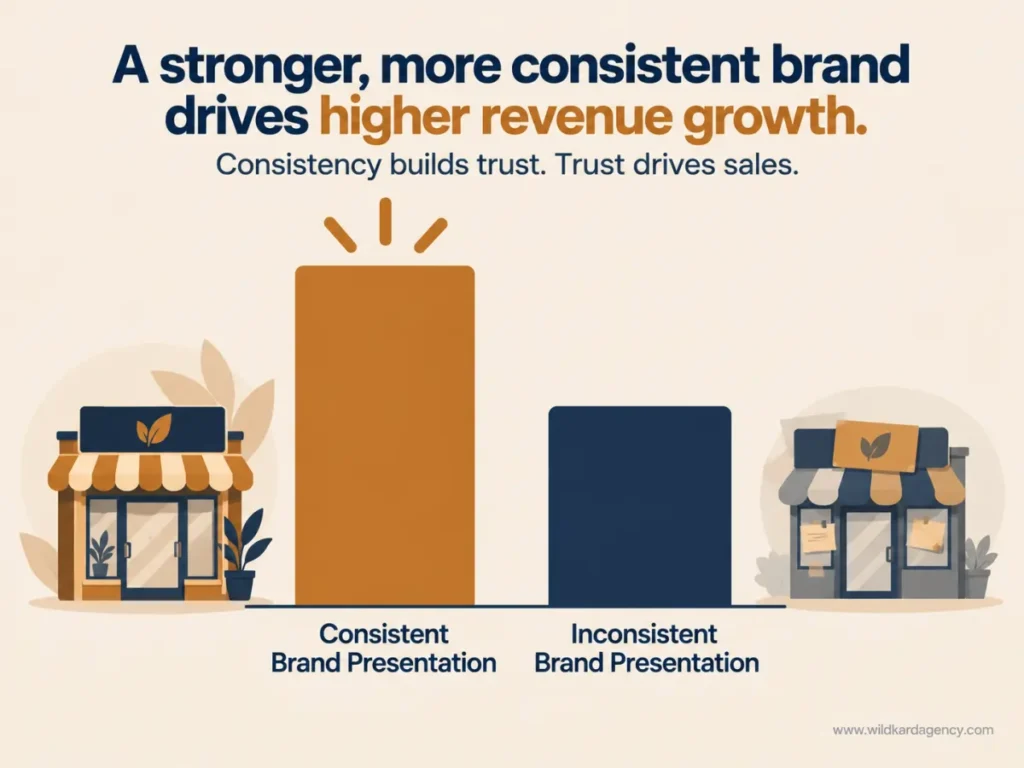
Consistent branding across every touchpoint is tied to real revenue movement: businesses with strong brand consistency report projected revenue gains of around 23% in 2026, according to Alden Marketing’s 2026 branding ROI analysis. That effect runs in reverse too. Inconsistent or dated branding taxes every deal a little, whether or not the prospect can say why they hesitated.
Every prospect who requests a proposal has already looked you up. Somewhere between the discovery call and the signature, they check your website, your LinkedIn, maybe a Google review or two. None of that research shows up as a line item on your sales tracker, but it’s happening on every deal.
A brand that reads as smaller or less credible than the pitch just given adds a quiet trust tax to every conversation. You don’t see it as a lost deal. You see it as “they went quiet.”
If what they find online doesn’t match the professionalism of your pitch, the mismatch quietly becomes the deciding factor, before your proposal is even opened.
You Wince Before You Send Someone Your Own Website
There’s a specific moment that tells you everything: someone asks for your website, and you hesitate before sending the link. Maybe you send your LinkedIn instead. Maybe you warn them the site is “getting an update soon.” That hesitation is data. If you’re managing perception around your own materials in real time, every prospect who visits without that warning is having the exact reaction you’re trying to prevent.
It’s the same instinct behind avoiding handing out a business card that feels dated. If you wouldn’t want a stranger to see it without an explanation attached, don’t wait for that stranger to be a paying client.
Watch for the smaller versions of this too: rewriting an email signature link so it points to a LinkedIn profile instead of the homepage, reusing a two-year-old proposal template because the current one still has the old tagline, or telling a referral partner “don’t worry about the site, just call me directly.” Each one is a small workaround. Together they’re a full-time job managing a brand you don’t trust yet.
Your Identity Falls Apart the Moment It Leaves Print
A logo built for a business card in 2015 was never tested against a 400×400 pixel social avatar, a video call thumbnail, or a dark-mode phone screen. Most small business identities were designed once and never stress-tested outside their original format.
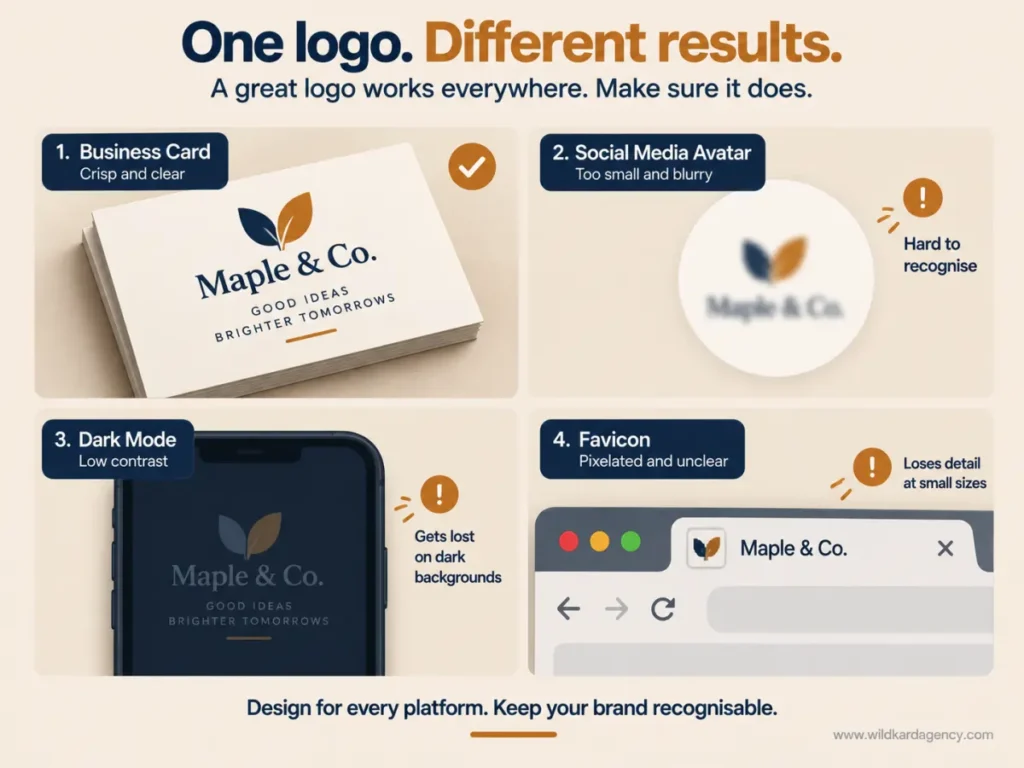
Run this test: shrink your logo to app-icon size. Drop it on a black background. Read it out loud from six feet away, on a phone screen.
If it turns into a smudge, loses its contrast, or needs a caption to explain what it is, the identity isn’t failing your prospects on purpose. It was simply never built for where most people see it first: on a phone, in a feed, in a fraction of a second.
Check the places most owners never think to look: the tiny favicon in a browser tab, the profile photo on your Google Business Profile, the thumbnail on a WhatsApp Business account, the background on a video call. Each one crops, shrinks, or recolors your identity differently. If even one of them looks broken, amateur, or unrecognizable next to the others, that’s the version of your brand showing up in more places than your actual website does.
A New Hire Can’t Explain What You Do the Same Way Twice
Ask three people on your team what the business does, in one sentence. If you get three different answers, or a paragraph instead of a sentence, the brand isn’t a logo problem. It’s a positioning problem, and the logo is just where it shows up first.
Positioning that isn’t written down anywhere gets reinvented by whoever answers the phone that day. Every version is a little different, and every version trains a slightly different expectation into a different prospect.
This shows up hardest during hiring and onboarding. A new team member with no documented positioning to reference either copies whatever the last person said, guesses, or asks you directly, every single time a prospect asks a slightly different version of the same question. That’s ramp-up time your business pays for repeatedly instead of once.
Weaker Competitors Are Winning the Search Results and the AI Answers You Should Own
Here’s a sign almost no rebranding checklist mentions, because it’s new: your competitors, running a genuinely weaker service, are the ones showing up when someone asks ChatGPT or Google’s AI Overview for a recommendation in your category.
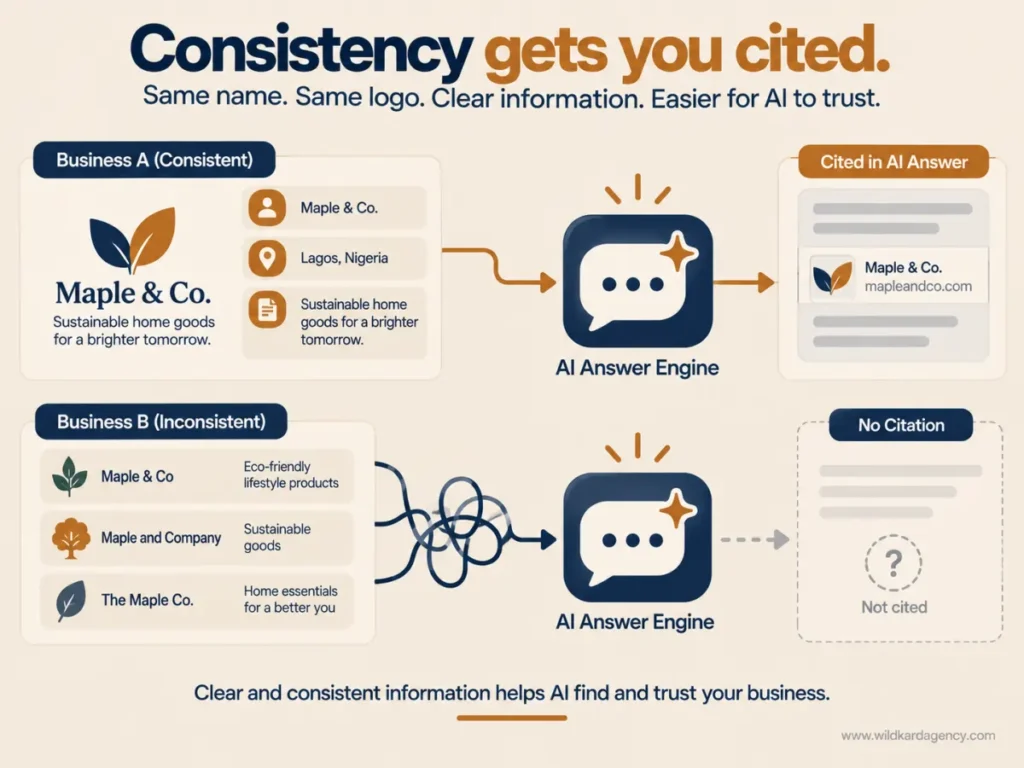
AI answer engines pull from clear, consistently structured, consistently named entities. A brand that’s changed its name once, uses three different logo variants across platforms, or has no consistent “about” language anywhere gives these systems nothing solid to cite. A confusing brand isn’t only a human problem anymore. It’s a machine-readability problem, and it costs visibility you can’t win back with better copy alone.
If you’ve read our ChatGPT visibility guide, an inconsistent brand identity is one root cause that guide doesn’t fully cover, because it’s a branding fix, not a technical SEO fix.
The fix isn’t just visual consistency either. It includes structured entity data (schema markup that names your business, your services, and your location the same way everywhere), a single canonical “about” description used across your website, LinkedIn, and directory listings, and a name that doesn’t change between your homepage, your Google Business Profile, and your email signature. AI systems reward the entity they can describe with confidence, and confidence starts with consistency, not cleverness.
This matters more every quarter, not less. As more buyers start a search by asking an AI tool for a recommendation instead of typing a query into Google, the businesses with the clearest, most consistent brand signal are the ones that get named first. A brand that’s still communicating an old name, an outdated service list, or a story the company has already outgrown isn’t just invisible to a human reader skimming quickly. It’s actively confusing the system that’s increasingly doing the recommending on the reader’s behalf.
If two or three of these signs sound familiar, you don’t have to guess anymore. Reach out and we’ll walk through exactly where the gap is, before you spend a dollar on new design work.
Logo Redesign vs. Rebrand: Why Small Businesses Confuse Them
A logo redesign changes one visual asset. A rebrand changes the thinking underneath it: positioning, messaging, sometimes the name itself, with the visual identity as one output of that work, not the whole project.
Confusing the two is how businesses end up disappointed twice: once when a cheap logo swap doesn’t move the close rate at all, because the underlying positioning problem was never touched, and again when they assume a “real” rebrand must mean starting over completely, so they avoid fixing a name or story that genuinely needs it.
Refresh or Full Rebrand? Quick Reference
| If your situation is… | You probably need… |
| The look feels dated but the name, audience, and services haven’t changed | A visual refresh |
| Your services or ideal client have genuinely changed since launch | A full rebrand |
| Only one of the six signs above is true | Neither, yet |
| Three or more of the six signs above are true | A full rebrand |
| You just got tired of your own logo | A refresh at most, once you’ve confirmed nothing else is driving it |
What a Rebrand Actually Involves
The word gets used loosely, which is part of why it’s confusing. A real rebrand for a small business generally moves through four phases, and skipping any of them is how a rebrand quietly turns into an expensive logo swap.
- Audit and positioning. What the business actually does now, who it actually serves now, and how that differs from what the current brand communicates. This is research and interviews, not design.
- Identity system. Logo, color palette, typography, and the rules for how they flex across a website, social profiles, print, and video, not just a single static logo file.
- Messaging. The one-sentence description, the longer story, the language used in proposals and on the website, rewritten to match the positioning work, not just the visuals.
- Rollout. Redirects, updated listings, a customer-facing announcement, and internal briefing so the team can explain the change the same way, on day one, not week six.
Most of the failures covered in the next section happen because a business pays for phase two and skips phases one, three, and four entirely. The phases also aren’t equally priced. Positioning and messaging are research and writing, not production, so they’re often the cheapest line items on the invoice and the first ones cut when a budget gets tight, which is exactly backward from where the actual value sits.
A Real Example: Renaming Without Breaking What Already Worked
In September 2018, Dunkin’ Donuts announced it would drop “Donuts” from its name, rolling the change out across signage, packaging, and social media through January 2019 and backing it with a $100 million investment in modernizing stores. The name changed. The pink-and-orange color palette, the typeface, and the tone didn’t.
Customers had already been calling it “Dunkin’” for years. The rebrand caught up to language people were already using instead of inventing a new one.
Not everyone read it as a clean win. Marketing consultant Laura Ries argued at the time that dropping “donuts” risked erasing the one word that differentiated the chain from coffee-only competitors, especially for newer customers with no memory of the original name. Even a well-funded, carefully sequenced rebrand draws real pushback from a slice of loyal customers who liked the business the way it was.
A small business won’t have $100 million or a year-long phased rollout, and it doesn’t need one. The transferable lesson is smaller and cheaper: change the parts of the brand that are actually broken, keep the parts that already carry recognition and trust, and expect that some existing customers will need a sentence or two of explanation before they come around.
The Rebrand Mistakes That Cost More Than Doing Nothing
Rebranding has a real failure rate, and it’s not a design problem. According to Nielsen’s 2025 brand-tracking data, 40% of rebrands fail to deliver a positive ROI within two years. The pattern behind that number repeats across almost every failed case:
- Treating it as a logo swap. New visuals, same fuzzy positioning, same wrong-fit clients, same pricing pressure.
- Skipping the positioning work to save budget. A visual system with nothing solid underneath it collapses the first time a prospect asks a hard question.
- No plan for the SEO and AI-visibility transition. Changing a domain or business name without redirects and updated entity information confuses search engines and AI answer engines at the same time, exactly when you need them most. Done right, with permanent 301 redirects kept live on the old domain for at least a year, a site typically keeps 90 to 99% of its existing link equity. Skip that step and the new domain starts from zero, with every backlink you’ve earned pointing at a dead page.
- Going quiet during the transition. Customers who notice a sudden change with no explanation often assume something’s wrong, not that something improved.
- Rebranding out of boredom, not a real signal. If fewer than two of the six signs above are true, the itch to change the logo is probably fatigue with looking at it every day, not a business problem worth solving.
These mistakes rarely happen alone. A business that skips positioning work to save budget is also the one most likely to go quiet during the transition, because there’s no clear story to announce yet. Fixing the first mistake on the list tends to prevent the other four from happening at all.
What a Rebrand Actually Costs a Small Business in 2026
Cost depends entirely on scope. A full strategic rebrand for a small business, covering positioning, identity, messaging, and a basic website refresh, typically runs $15,000 to $75,000 in 2026. A lighter visual refresh only, keeping the name and audience but updating the look, runs closer to $5,000 to $25,000.
How Long Does a Rebrand Take
Timeline follows a similar pattern. According to Bynder’s 2023 survey of over 1,000 marketers, the average rebrand takes about 7 months from research to launch. A focused visual refresh without a full positioning overhaul can move faster, but budgeting at least 3 months keeps expectations realistic.
None of this means every business is signing up for a half-year project. It means going in with real numbers instead of a guess protects you from the two most common outcomes: paying for a full rebrand when a refresh would’ve done the job, or paying for a refresh that never touches the actual problem.
The quoted range usually covers strategy, identity, and a basic website refresh, but a few costs sit outside it and catch owners off guard. Trademark filing runs a base fee of roughly $350 per class with the USPTO in 2026. Replacing collateral, business cards, signage, vehicle wraps, proposal templates, email signatures, adds up faster than expected once the new identity actually exists and every old asset needs swapping out. Budgeting an extra 20 to 30% on top of the design fee for this rollout stage keeps the real total from becoming a surprise partway through.
Your Small Business Rebrand Checklist Before You Spend a Dollar
Run through this before requesting a single quote. It won’t tell you exactly what to change, but it will tell you honestly whether you’re ready to spend money on this yet, or whether the real next step is a conversation, not a contract.
- Two or more of the six signs above are true right now, not just “someday possible.”
- You can name specifically what changed (services, audience, or positioning) since your current brand was created.
- You have budget clarity: roughly $15,000-$75,000 for a full rebrand, or $5,000-$25,000 for a visual refresh only.
- You have 3-7 months of runway before you need the new brand live.
- You’ve written your current positioning down in one sentence, even if it’s wrong, so you know exactly what you’re changing.
- You have a redirect and announcement plan ready before launch day, not improvised after.
- Your team has been briefed on why the change is happening, not just handed a new logo file.
When WildKard built its own name and visual system, it was built to flex across five very different service lines from day one: virtual assistance, content, web development, design, and care agency support, specifically so a service pivot wouldn’t force a rebrand three years in. That’s the kind of positioning work a rebrand should do once, properly, instead of revisiting every time the business grows into something new.
The checklist above works in both directions. If you’re checking off five or six of the items, the decision has effectively already been made and the remaining question is scope, not whether. If you’re only checking off one or two, the more useful next step is usually a conversation about which specific sign is actually driving the itch, before a design brief exists at all.
None of this means every business with a dated logo needs $50,000 and seven months of disruption. It means the six signs it’s time to rebrand your business are worth an honest, unemotional look before you decide either way, with real numbers in hand instead of a guess.
Frequently Asked Questions
How do I know if my business actually needs a rebrand?
If two or more of the six signs above are true right now, not hypothetically, it’s worth a real look. A dated logo alone isn’t a reason. A dated logo combined with a dropping close rate, a positioning your team can’t repeat consistently, or competitors out-ranking you in AI answers, is.
How much does it cost to rebrand a small business?
A full strategic rebrand for a small business typically runs $15,000 to $75,000, covering positioning, identity, messaging, and a basic website refresh, based on 2026 industry pricing data. A visual refresh only, keeping the name and audience, can run as low as $5,000 to $25,000.
How long does a rebrand take?
Most rebrands take around 7 months from research to launch, based on Bynder’s 2023 survey of over 1,000 marketers, though a small business rebrand without heavy stakeholder alignment can move faster. Budget at least 3 months even for a focused visual refresh.
Is a logo redesign the same thing as a rebrand?
No. A logo redesign changes one visual asset. A rebrand changes the underlying positioning, messaging, and sometimes the name, with the visual identity as one output of that work, not the whole project.
Will rebranding hurt my SEO or my visibility in AI answers like ChatGPT?
It can, temporarily, if you change your domain or business name without a redirect and citation-update plan. Handled properly, with 301 redirects and consistent entity naming across every platform, a rebrand can improve AI-answer visibility instead of damaging it.
Is rebranding worth it for a small business that isn’t struggling?
Yes, if the signals point that way. Rebrands aren’t only for businesses in trouble. Roughly 74% of S&P 100 firms rebranded within seven years, according to Landor data cited in Bynder’s 2026 rebranding report, not because they were failing, but because the business had outgrown the identity it started with.
What’s the difference between a brand refresh and a full rebrand?
A refresh updates the look, tightening colors, typography, and photography while keeping the name, audience, and positioning the same. A full rebrand changes the underlying story: who you serve, what you stand for, sometimes the name itself, with the visual system rebuilt to match. If your business hasn’t fundamentally changed, a refresh is usually enough.
Should I rebrand before or after a website redesign?
Rebrand first. A high-converting website communicates a specific positioning, so building it around a brand that’s about to change means paying to redesign it twice. Lock the name and identity first, then build the site around it.
If you’re seeing two or more of these signs it’s time to rebrand your business and want a second opinion before committing budget, reach out and we’ll tell you honestly whether it’s a full rebrand, a lighter refresh, or something else entirely.